

 Tiếng Việt
 中文 (中国)
The dew point is the temperature at which water vapour in the air begins to condense into liquid water on a surface. When applying epoxy coatings, if the substrate surface is colder than or close to the dew point, a thin, invisible film of water may already have condensed on the substrate just before the coating is applied. This film reduces adhesion, causes bubbling, surface haze and later peeling, even though nothing looks wrong to the naked eye at the time of application.
This article explains how the dew point forms, why measuring air temperature alone is not enough, and the correct measurement procedure before application. Thresholds for each product must be taken from the technical data sheet (TDS) of that product; this article does not record a threshold for any Kadier product, because no product-specific Kadier figures are published in a confirmed TDS yet.
How does the dew point form?
Air always contains a certain amount of water vapour. When air contacts a cold surface, the vapour condenses when that surface reaches or falls below the dew point. The dew point is not a constant: it changes with the air temperature and relative humidity at the time of application. Early mornings, after rain, in poorly ventilated workshops, or when temperature drops suddenly late in the day are all times when the dew point easily approaches the surface temperature.
The greatest risk is that condensation occurs without any clear visible sign. A surface can look dry while in reality a thin moisture film is already present. Coating applied over that film bonds to water rather than to the substrate, and the defect only appears after the coating has cured, when repair is far more expensive than measuring and waiting before application.
Why measure all three parameters?
To assess condensation risk, air temperature, relative humidity and substrate surface temperature must be measured at the same time, from which the dew point is derived and compared with the surface temperature. Measuring air temperature alone is not enough, because the concrete substrate can be colder than the air, especially for basement floors, newly completed floors, or floors in areas with little sun. Measuring air humidity alone is also not enough, because at the same relative humidity, the dew point differs at different temperatures.
Coating application practice commonly applies a safety margin: the surface temperature should be above the dew point by a certain amount, commonly around 3°C, unless the TDS of the product specifies otherwise. This margin is not a Kadier specification, but a general rule of practice to allow for measurement error and temperature change during application. When the TDS of a product specifies a different margin, that TDS must be followed.
Measurement procedure before application
Measure at several locations representative of the whole floor area, especially the coldest, dampest and worst-ventilated areas, not only at one favourable point in the middle of the workshop. Repeat measurements throughout the shift, because midday and late-afternoon conditions can differ greatly. Record the time, location, air temperature, relative humidity, surface temperature and derived dew point, so the application record has a basis at acceptance inspection.
If the surface temperature is too close to the dew point, the usual measures are to wait for conditions to improve, increase ventilation, warm the surface in a controlled way, or move application to another time of day. Do not “push on to keep schedule” when measurements already show condensation risk, because the cost of repairing a peeling floor is always greater than the cost of waiting.
How does the dew point differ from substrate moisture?
The dew point concerns water vapour in the air condensing on the surface, while substrate moisture concerns water present within the concrete itself and moisture rising from below the floor. A substrate can be dry in terms of substrate moisture yet still suffer condensation due to the dew point, and conversely a damp substrate can still cause peeling even when air conditions at the time of application are favourable. Before applying epoxy, therefore, both must be checked: substrate moisture and dew point conditions at the time of application.
See Kadier’s coating systems to compare system build-up and general scope of application: RollCoat and AquaBase. Permitted application conditions for each system must be taken from the TDS of the specific product.
Request a consultation — describe the workshop conditions and planned application schedule for guidance on measuring and recording the dew point before coating.
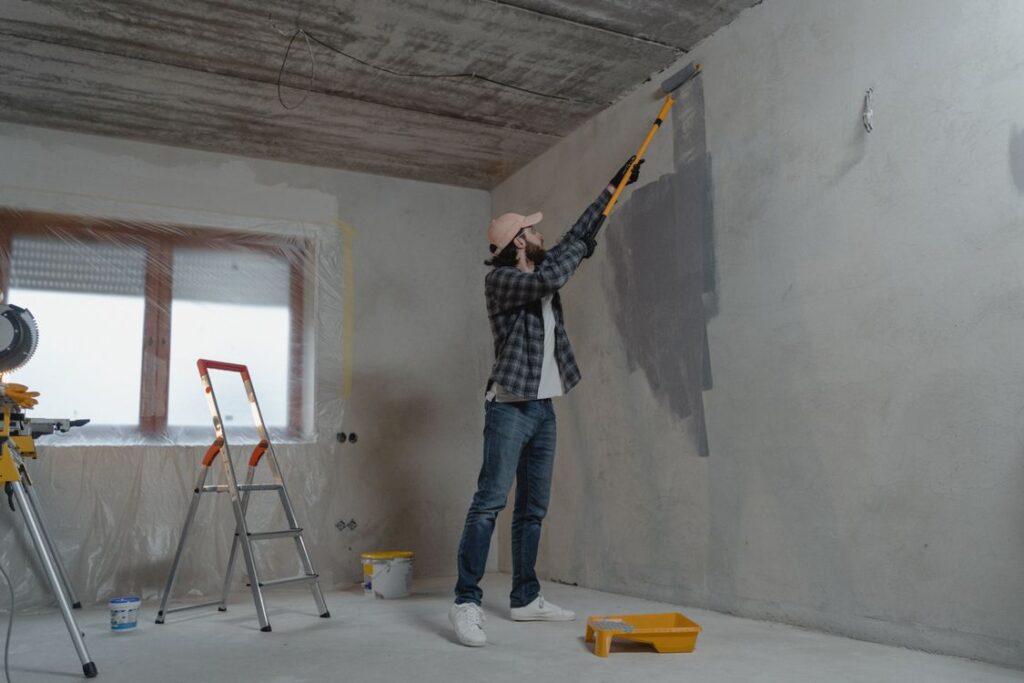
Illustration photo: Pexels, photographer Tima Miroshnichenko. General reference framework: TCVN 9014:2011 and TCVN 12574-2018 on paints and coatings; product-specific figures are to be checked against the TDS of the specific product.

Pingback: Epoxy floor delamination: causes