

 Tiếng Việt
 中文 (中国)
Note on the figures in this article (read first): This is a technical article. Every moisture threshold and hydrostatic pressure below is an industry reference or documentation from another paint manufacturer, not a Kadier specification or commitment. Kadier’s own specifications for each RollCoat, LevelFlow, StatGuard and AquaBase system — the permitted moisture threshold per system, the chemical resistance table per chemical and concentration, the ability to withstand reverse hydrostatic pressure, and chloride resistance — do not yet have technical data sheets (TDS), so this article only gives a general framework together with this statement; the final thresholds follow the technical documentation of the paint manufacturer Kadier uses and the findings of an actual survey. This is the article’s main HOLD.
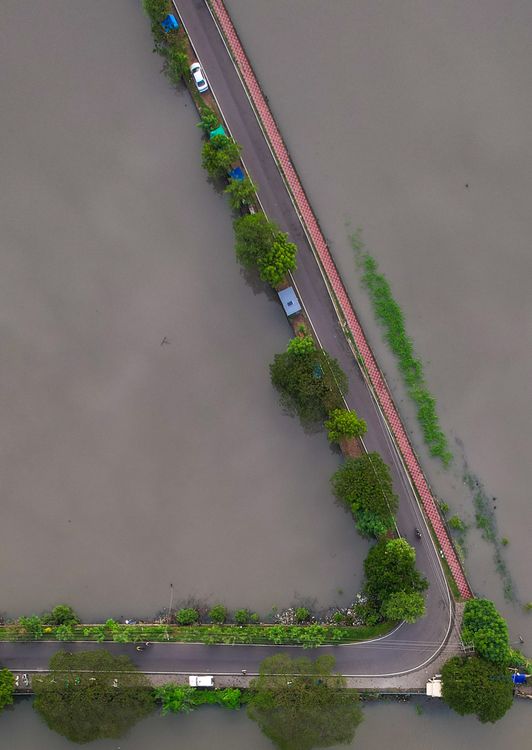
A flood-zone factory floor fails differently from floors elsewhere in one respect: water pushes from below, not from above. No matter how good the topcoat, if the substrate is still pushing water upwards, the coating will blister and peel.
1. Blistering and peeling mechanism: a sealed film, trapped vapour and hydrostatic pressure
Under the general principles of the industry, ordinary epoxy forms a sealed film; when applied over a damp substrate, vapour is “trapped”, pressure builds up — vapour pressure and hydrostatic pressure — and pushes the coating off, causing blistering and peeling. According to reference sources, this is the most common cause of early epoxy floor failure in high-humidity regions. Diagnosing a flood-zone floor therefore starts with a question about water under the substrate, not about the coating on the surface. See the published articles: Epoxy floor blistering caused by substrate moisture and Epoxy floor peeling caused by a weak substrate.
2. Measuring moisture before coating: three industry-reference methods and how to read their thresholds
Three industry-reference methods are commonly mentioned: ASTM F2170, measuring relative humidity inside concrete; ASTM F1869, measuring moisture vapour emission rate with calcium chloride; and ASTM D4263, the plastic sheet method, together with electronic moisture meters for screening. The industry-reference thresholds, not Kadier commitments, are recorded in secondary sources as follows: ordinary epoxy requires the relative humidity inside concrete to be no more than 75% under ASTM F2170, with some sources recording about 75–80%; moisture-tolerant systems extend to about 85% but do not remove the limit; above 85%, a two-coat moisture-barrier system or urethane cement screed is needed; above 90%, a barrier system or urethane cement is usually required instead of ordinary epoxy. Under ASTM F1869, the reference vapour emission rate is no more than 3 lbs per 1,000 sq ft in 24 hours, equivalent to about 15 g per m² in 24 hours according to secondary sources. Electronic moisture meters for screening commonly mention a level of no more than 5%. All thresholds above must be read together with the statement at the top of this article: the final thresholds follow the paint manufacturer’s technical documentation and the findings of an actual survey.
3. Solutions by moisture level: ordinary epoxy, negative waterproofing primer, reverse-pressure membrane and penetrating materials
The general framework by moisture level has four layers. First, where moisture is within the reference threshold, use ordinary epoxy with a suitable primer. Second, where moisture exceeds the threshold, use a negative waterproofing epoxy primer, a moisture-blocking film that locks vapour in. Third, where hydrostatic pressure is high, as in basements, flood zones or rising groundwater, consider a dedicated epoxy waterproofing membrane resisting hydrostatic pressure in both directions — an industry-reference example from another manufacturer’s documentation: Quicseal 119 withstands 250 kPa, equivalent to a 25 m water column, and once the primer film has cured it withstands 400 kPa, equivalent to a 40 m water column; these figures only illustrate the principle and are not a Kadier product or specification. Fourth, cement-based crystalline penetrating materials: active agents penetrate the concrete capillaries, react with free lime and moisture to form insoluble crystals, seal the pores and become part of the concrete mass, following industry-reference principles. No claim is made about what hydrostatic pressure any Kadier system withstands while no TDS exists.
4. Negative waterproofing process: treating leaks, moisture saturation, multi-coat application and adhesion checks
The mandatory process comprises: measuring moisture with dedicated equipment, never by eye or experience; treating leak points first by widening the opening and using rapid-setting cement to stop water; for penetrating materials, the surface needs to be moisture-saturated but without standing water, and applied in at least 2–3 coats at right angles according to reference sources; and checking adhesion after application. Under an industry principle clearly recorded in sources, bitumen membranes and ordinary PU membranes are not used for negative waterproofing — this is an industry principle, not an absolute ban by the manufacturer. See also: Concrete floor moisture and how to measure it, Epoxy coating on damp floors and Epoxy flooring for basements and car parks.
5. Mekong Delta flood zones and the “post-flood” process
Mekong Delta flood zones have weak ground from 0–40 m, high moisture, acid sulphate soils and coastal salinity, a rainy season and a flood season, so moisture measurement and negative waterproofing are mandatory steps, not options; construction schedules need to avoid flood peaks and heavy rain. After flooding, the “post-flood” process is: re-measure moisture before any repair coating, treat the substrate, and only recoat once the substrate is in adequate condition; if the substrate is still highly moist or the old coating has peeled over a wide area, it must be stripped and redone rather than coated over. Never advise coating directly over a substrate that has just been flooded without re-measuring moisture. This article does not use the “90% of floors fail because of moisture” figure from a reference source, because that is one contractor’s opinion, not an industry statistic.
Frequently asked questions
Does a blistered floor necessarily mean poor-quality paint? Not necessarily. The most common cause in high-humidity regions is water vapour and hydrostatic pressure from beneath the substrate pushing the sealed coating film off. Moisture must be measured and the water source diagnosed before any conclusion about paint quality.
Are the 75% RH and 3 lbs thresholds Kadier commitments? No. They are industry-reference thresholds under ASTM F2170 and F1869 from secondary sources. The final thresholds follow the technical documentation of the paint manufacturer Kadier uses and the findings of an actual survey; what each Kadier system withstands is still awaiting its TDS (HOLD).
Can a substrate that has just been flooded be recoated immediately? No. Moisture must be re-measured, the substrate treated, and recoating done only when the substrate is in adequate condition; a substrate that is still highly moist, or an old coating that has peeled over a wide area, must be stripped and redone.
How does negative waterproofing differ from positive waterproofing? Positive waterproofing stops water coming from above; negative waterproofing stops water and vapour pushing up from beneath the substrate. Ordinary bitumen or PU membranes therefore cannot replace a negative waterproofing solution, under industry principles.
Contact for advice and quotations
Does your floor show signs of blistering or peeling, is substrate moisture high, or has it just been through flooding? Send photos of the substrate and its location to receive advice on moisture measurement and a suitable negative waterproofing solution. Get a quotation at the quotation page or contact us via the contact page — hotline and Zalo 0899355489, WeChat wxid_95o54joujyrr12.
