

 Tiếng Việt
 中文 (中国)
This article covers only Dong Nam Industrial Park, developed by Sai Gon VRG (342.53 ha, on Provincial Road 8, Binh My commune, Cu Chi) — not the Southeast region in general, not the Dong Nam Industrial Park in Quang Tri, and not the Binh My commune of former Bac Tan Uyen (now Binh Co ward). The Binh My commune in this article is the new commune formed on 01/07/2025 from the former Binh My, Hoa Phu and Trung An communes of Cu Chi district; the name Cu Chi here is a geographic reference only.
Which park Dong Nam is: multi-industry, prioritising high technology and environmental friendliness
Dong Nam Industrial Park covers a total area of 342.53 ha, and its infrastructure developer is Sai Gon VRG Investment Corporation. According to compiled summaries, the project was planned under Decision No. 5945/QD-UBND dated 29/12/2009 of the Ho Chi Minh City People’s Committee. The park sits on Provincial Road 8 (TL8), in Binh My commune, Ho Chi Minh City, at the city’s northwest gateway, bordering the former Binh Duong area. Its technical infrastructure is complete, and both land plots and ready-built factories are handed over. The park’s orientation is multi-industry, prioritising high technology and environmental friendliness: mechanical manufacturing, auto and motorcycle assembly, electrical and electromechanical equipment; electronics, information technology, components and software; pharmaceuticals and herbal medicine; food and beverage processing; building materials and interiors; high-tech rubber products. This is an investment-attraction orientation, not a list of tenants currently operating in the park, and this article names no tenant.
Why the floor question in Dong Nam differs from neighbouring parks
The difference lies in the leasing model. According to the Invest Vietnam portal, the park is currently only available for lease in the form of leasing ready-built factory/warehouse units, with areas starting from 1000 m²; the developer reports total ready-built factory area of nearly 150,000 m², 89% filled as of mid-2025 — a developer-reported press figure from that date, not a current measured vacancy figure, and tenants should re-check at the time of leasing. The direct consequence is that a tenant taking a ready-built unit also inherits that unit’s existing floor, with its full use history. The floor question here is therefore not “build a new floor on empty land” but “take over an existing floor, then decide whether to keep it, repair it locally, or recoat it”.
That frame differs sharply from nearby parks. The article on epoxy flooring for Tan Phu Trung Industrial Park, in the same Cu Chi district, starts from a land-lease model where the tenant builds its own floor from the start. The article on epoxy flooring for Le Minh Xuan 3 Industrial Park starts from first-fit new floors for first tenants in a clean-technology park that is still filling up. The article on epoxy flooring for An Ha Industrial Park starts from a park of two halves, existing units plus new lots. The old inner-city parks such as Tan Binh or Vinh Loc pose a refurbishment problem for ageing shells. In Dong Nam, the central question is the handover question: what condition is this ready-built unit’s floor in, and how does the handover record state that condition. The overview of epoxy flooring for industrial parks in Ho Chi Minh City and nearby areas covers the whole region; this article goes deep into one park only, Dong Nam, with its own survey frame.
Surveying a ready-built unit’s floor before signing: what must be seen in person
Before signing a lease, the floor of a ready-built unit must be surveyed as a separate item, not folded into a general unit handover note. Adhesion of the existing coating — tested at several points, not judged by looking at the surface. Oil and grease history: a unit previously used for mechanical work or assembly will have oil soaked into the floor over time, and a new coating applied over an oily substrate will peel even if applied correctly. Cracks and joints: the position, width and state of each one must be recorded, because a live crack will tear a new coating if not treated properly. Flatness: measured with a long straightedge along the real forklift routes and walkways, not from a single point in the middle of the unit. Substrate moisture: measured with instruments, especially in ground-bearing areas and near drainage. The previous tenant’s use: a unit formerly used for food or pharmaceutical purposes carries different hygiene requirements from a mechanical workshop; the loads the floor has already carried, and the state of drainage — poor drainage leaves standing water that attacks a coating from its edges. All findings belong in the handover record with photographs and measurements, so that at lease end nobody has to argue whether a crack or an oil stain predates the tenancy.
Zone map for ready-built units: four shell types, four different floor requirements
Electronics and precision production shell: flat, seamless, dust-controlled. Electronics, components and hardware-linked software production need a flat, seamless floor that generates little dust and is easy to clean. An anti-static requirement arises only when the plant itself has its own standard; this article assigns Dong Nam no general anti-static requirement, and does not claim that ordinary epoxy is anti-static. The survey must check the plant’s own standard before a system is chosen.
Mechanics and auto or motorcycle assembly shell: impact-resistant, oil-resistant, locally strengthened. Mechanical manufacturing and assembly areas carry wheel loads, tool impacts and regular oil exposure. The system here needs abrasion resistance, oil resistance and impact resistance; at turning points, load-concentration points and heavy-machine positions, the survey should separate those areas for local strengthening rather than thickening the whole floor uniformly. Old oil must be cleaned to a level the new coating can bond to, not coated over in the hope of adhesion.
Food and pharmaceutical ancillary areas: hygienic, washable, chemical resistance by the actual list. Ancillary areas for food and beverage processing or pharmaceuticals and herbal medicine need a hygienic, washable, non-absorbent floor. Chemical resistance must be checked item by item against the manufacturer’s chemical resistance table, for the actual chemicals, concentrations and contact times of the plant — including cleaning chemicals. No system resists every chemical, and this article does not choose a system by industry name but by the real chemical list.
Warehouse shell and loading areas: forklift traffic, slip resistance, lane marking. Warehouse floors in a ready-built unit serve high-frequency forklift traffic, so they need wheel-load capacity, slip resistance when wet, and clear lane marking. At turning points, the survey should separate the vehicle routes for strengthening; lane markings worn on the old floor must be repainted after recoating, not reused as a reference.
Refurbishment inside a leased shell: the scope must be agreed with the landlord first
Refurbishing a floor inside a leased unit differs from refurbishing one’s own unit in one respect: every change sits within a scope the landlord has agreed, and that scope should be written into a lease appendix before work starts. The appendix covers which systems may be used, the permitted thickness, and the return condition at lease end. Work should be phased by the plant’s real operating areas, so that grinding noise, dust and paint odour do not disturb neighbouring units — sound, dust and odour all travel through the party walls of a ready-built unit. Coating over an old coating is permitted only after an adhesion test and grinding to key the surface; where the old coating has already peeled in patches, the failed areas must be removed rather than coated over. Before coating, substrate moisture must be measured with instruments; a coating applied over a damp substrate will blister after a period of use. Acceptance should run vehicles at the real loads and along the real routes the plant uses daily, rather than judging the floor by eye.
Points to have answered before signing a ready-built lease in Dong Nam
Before signing, a tenant should have answers to the following points: has the ready-built unit’s floor been fully surveyed — old-coating adhesion, oil and grease history, cracks and joints, flatness, substrate moisture, the previous tenant’s use, the loads the floor has carried, and the state of drainage; what are the maximum load and the real vehicle routes, including turning points and load-concentration points; what is the full chemical list, including cleaning chemicals, with the concentration and contact time of each; does the handover record state the floor’s condition with photographs and measurements; who pays for floor refurbishment, and what is the return condition at lease end; and is there an option to expand into an adjacent unit if the business grows. The final system decision rests on the manufacturer’s technical documents and the survey results at the unit, not on the size of the park or its general name.
Contact for advice and a quote
For advice on a floor system suited to a ready-built shell, its loads and chemicals, for a plant or warehouse in Dong Nam Industrial Park, and to arrange a survey, send the area, the type of plant or warehouse and the industry. See the epoxy floor coating quote page, or contact us through the contact page (hotline/Zalo 0899355489, WeChat wxid_95o54joujyrr12).
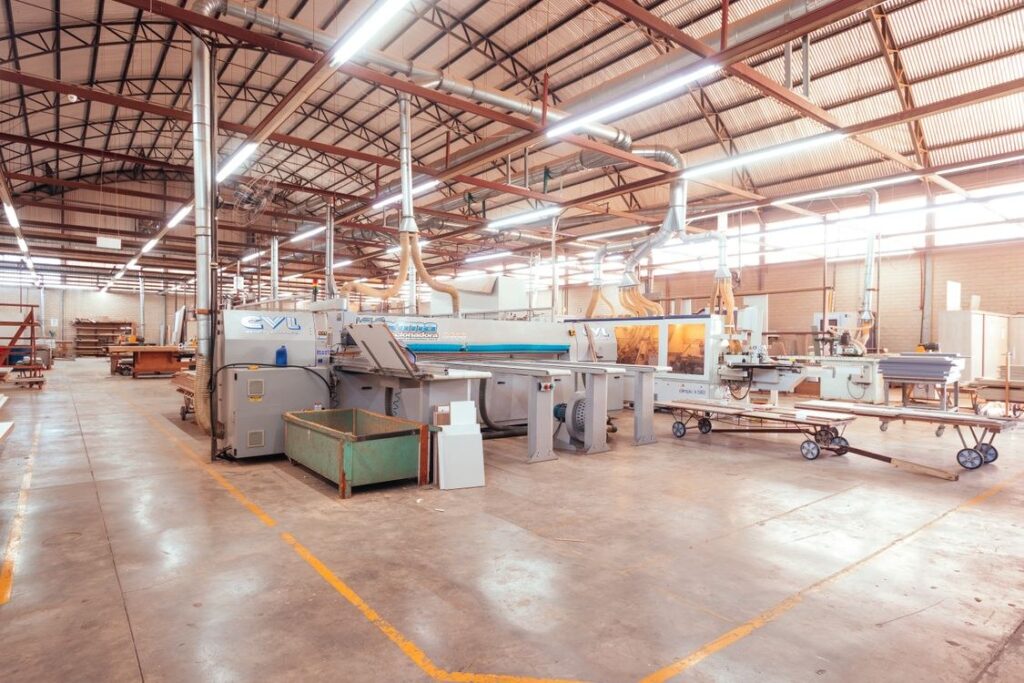
Illustration: Pexels stock photo (photo ID 30990853), by Jhonny’ Mages. Illustration only, not a Kadier project and not a floor inside Dong Nam Industrial Park.
