

 Tiếng Việt
 中文 (中国)
Epoxy coating for tanks, reservoirs, and metal surfaces is an application quite different from factory floor coating. Floors bear loads and abrasion; tanks bear continuous immersion, liquid pressure, and corrosion from the inside. Although the material is the same epoxy, the choice of system, the surface preparation, and the acceptance inspection for tanks must be calculated according to immersion and chemical-contact conditions, and floor-coating experience cannot be transferred wholesale.
This article presents the general framework of epoxy materials in tank and metal-surface applications. The properties described below are general material properties, not confirmed specifications of a specific Kadier system. The specific parameters of each coating system must be taken from the official technical data sheet (TDS) of that system when available, and any requirement for contact with drinking water or food — if applicable — must additionally be checked against the regulations and certifications that apply to that intended use, and must not be inferred from this article.
Tanks and reservoirs: a corrosion-protection lining, not a decorative coat
Inside a tank, the epoxy coating acts as a barrier film: it prevents liquid from contacting the tank wall directly, slows corrosion, and reduces reverse contamination of the contents. Because the coating is continuously immersed in liquid, the two decisive factors are not gloss or color, but the immersion resistance of the film and its adhesion to the prepared substrate. An ordinary floor coating, however good on a dry floor, may blister after prolonged immersion if it was not designed for immersion conditions.
Three commonly found tank groups are water tanks, tanks for dilute chemicals, and tanks for oils, greases, or industrial solutions. Each group sets different requirements for chemical resistance, the temperature of the contents, and the drain-down cycle for cleaning. Before choosing a system, it is necessary to list clearly the contents, concentration, maximum working temperature, and frequency of draining for cleaning, because these four pieces of information determine the suitable film type, not the general name of the product.
Metal surfaces: surface preparation determines more than half of coating life
On steel, epoxy adhesion depends mainly on the degree of cleaning and the surface roughness. Rust, mill scale, grease, oil, and old peeling paint are all separating layers that prevent the new film from adhering to the real metal. The standard process for metal surfaces therefore usually includes degreasing, abrasive blasting or mechanical sanding to a specified cleanliness level, dust removal by blowing, and then priming within the permitted time window before the surface re-rusts.
Roughness must also be just right: a surface that is too smooth gives the film difficulty adhering, while a surface that is too rough may have roughness peaks protruding through a thin primer coat and becoming early rust points. This is why primer thickness on metal is usually controlled more strictly than on concrete, and why edges, corners, and welds need careful priming before the whole surface is coated — these are the places where the film is thinnest and also where corrosion starts.
Welds, corners, and details: where coatings fail most easily
Inside a tank, a weld is a double weak point: it carries concentrated stress and is difficult to coat evenly because of its angular geometry. The general treatment is to grind sharp welds flat, apply reinforced primer at welds and corners before the main coat, and then inspect visually and with a thickness gauge at exactly those locations. Skipping the corner-priming step is a common cause of early tank-coating failure even when the large flat surfaces remain good.
Details penetrating the tank wall, such as inlet and outlet pipes, flanges, and internal ladders, need similar treatment, and movement and expansion must also be taken into account: an absolutely rigid coating may crack at locations with repeated movement, so choosing a system with suitable flexibility for the structure is part of the design, not only a choice of paint color.
How does continuous immersion differ from spillage?
On a floor, chemicals are usually only spilled and then cleaned up within a short time. In a tank, chemicals are immersed continuously for months and years, at temperatures that may be higher than room temperature. The longer contact time causes small effects to accumulate into failures: the film absorbs liquid, softens, loses adhesion, and then blisters. A chemical-resistance table for floors therefore cannot be applied as-is to tanks; a chemical-resistance table for immersion conditions is needed, together with the corresponding temperature and test duration.
When consulting a chemical-resistance table, read all three columns: chemical name, concentration, and temperature. A system that resists a dilute acid at room temperature may not necessarily resist the same acid at a higher concentration or higher temperature. If your contents fall outside the table, the correct approach is to test on a sample before coating the whole tank, rather than guessing from a similar case.
Application and acceptance inspection for tanks
Working inside a closed tank sets specific safety requirements: forced ventilation, control of solvent-vapor and toxic-vapor concentrations, explosion-proof lighting where needed, and personnel entering the tank must follow the confined-space working procedure. This is work for a team experienced with tanks and vessels, not only with floor coating.
Acceptance inspection of a tank coating usually includes dry-thickness measurement at many points, pinhole testing with a low- or high-voltage detector depending on the system, and adhesion testing at representative locations. Pinhole testing is especially important for tanks because a single small pinhole is enough for liquid to reach the metal and for corrosion to spread under the film. After acceptance, the tank needs sufficient curing time before contents are introduced; putting it into service early, before the film is fully cured, is one of the causes of early failure that leaves no sign at handover.
Maintenance: scheduled inspection instead of waiting for a leak
Tank coatings should be inspected on a schedule at every drain-down: check for discoloration, blistering, cracking at welds, and adhesion at edges. Small signs at this stage can still be repaired locally; waiting until a leak or large-scale peeling occurs means the repair must drain the whole tank, clean it again, and recoat a large area, at much greater cost.
For local repairs, the repaired surface must be cleaned down to metal, primed, and topcoated with the same system or a confirmed compatible system. Overcoating a different system onto an old system without checking compatibility can cause the new coat to peel soon after the tank returns to service.
To choose a system for a specific tank, reservoir, or metal surface, sufficient information must be provided: contents and concentration, working temperature, tank-wall material, current surface condition, and the drain-down maintenance cycle. The Kadier coating systems include the roller-applied RollCoat system, the self-leveling LevelFlow system, the water-based AquaBase system, and the anti-static StatGuard system; which system suits a specific immersion condition or metal surface must be checked against the official TDS and the corresponding immersion-test results, and must not be inferred from the system name.
Request a consultation to compare immersion conditions, contents, and actual surface condition before finalizing a coating system for a tank, reservoir, or metal structure.
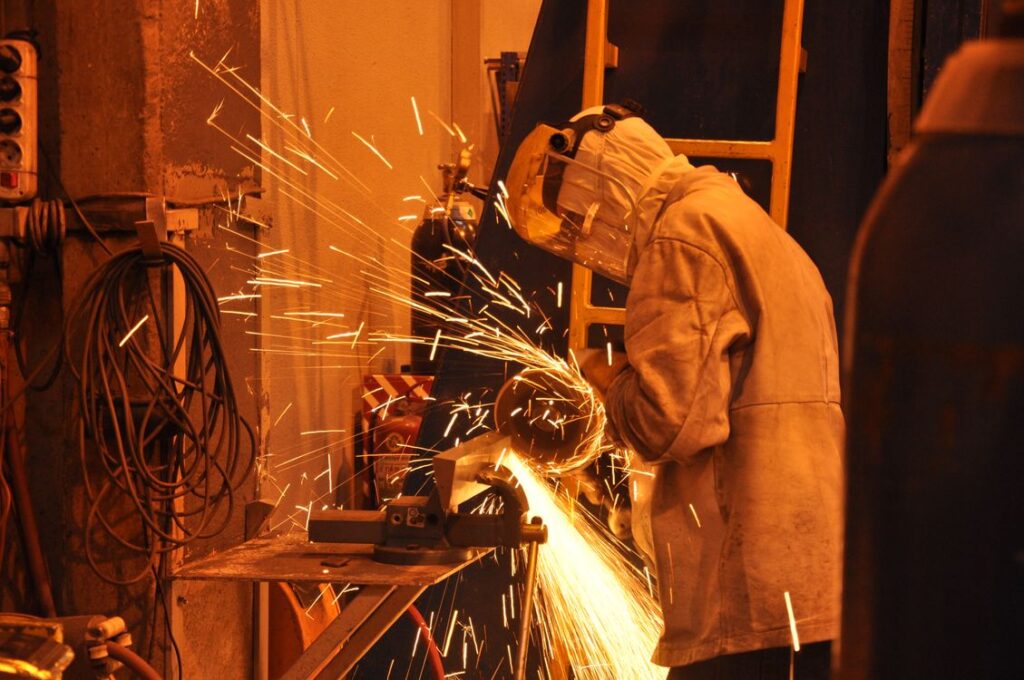
Illustrative image: a worker grinding metal in a workshop (Source: Uğur Bozdoğan / Pexels).
