

 Tiếng Việt
 中文 (中国)
In epoxy coating application, there is a surface defect that is very easy to encounter but also very easy to underestimate: impurities and dust mixed into the coating while the paint is still wet. Dust particles, fabric fibres, grinding debris, or fragments falling into the paint are trapped when the paint cures, creating rough points, raised grains, or faint scratch lines on the surface. This article discusses only impurities and dust mixed into the coating during application — where they come from, how to prevent them, and how to treat them at the level of principle once they have occurred.
This article does not repeat the whole application process, nor does it go deep into concrete substrate treatment before coating. The overall process is given in the article on the standard epoxy flooring installation process from survey to handover, while grinding, crack repair, and moisture measurement are covered separately in the article on concrete floor preparation before epoxy coating. Impurities mixed in during application also differ from dust settling on the floor during later use, and differ from air bubbles trapped in the coating — each phenomenon has its own causes and treatments and should not be lumped together as one defect.
What do impurities mixed into the coating look like?
While the paint is still wet, any solid particle touching the surface can stick to it. After the paint cures, these particles can no longer be washed away. Common signs are a surface that feels rough to the touch at individual points or lines, raised grains, threads, fabric lint, or dark speckles visible when viewed at an angle under light. In some cases, a particle sits only shallowly on the surface; in others, it sinks deep into the coating and makes the paint surface locally uneven.
The impact is not only aesthetic. A spot with a trapped particle is usually a local weak point: the surface is no longer seamless, traps dirt more easily, and when cleaned with scrubbing tools, a raised grain can be dislodged, leaving a small dent. For floors in high-hygiene areas such as food or pharmaceutical plants, a rough surface caused by impurities is also harder to clean thoroughly than a flat, seamless surface. Prevention during application is therefore always more effective than treatment after the paint has dried.
Where do impurities and dust come from?
1. Dust remaining on the substrate after grinding and substrate treatment. Grinding a floor creates a great deal of fine dust. If the surface is only swept lightly without thorough vacuuming, fine dust remains lodged in the pores and cracks of the concrete. When the primer or topcoat is rolled on, this dust can be stirred up and mixed into the paint, or it can prevent the paint from adhering evenly to the substrate.
2. Dust from the application space and surrounding work. A construction site under way is rarely a fully enclosed space. Open doors, draughts, vehicles, and people coming and going carry dust in from outside. More dangerous still are other jobs taking place at the same time in the same area: cutting, grinding, drilling, or transporting materials all generate dust and debris, which can fall at exactly the moment the paint is still wet.
3. Unclean tools and materials. Rollers, brushes, paint trays, mixing buckets, and stirring tools that still carry dried old paint, fabric fibres, or dust from a previous use will introduce impurities directly into a new paint batch. Cloths for wiping the floor, rags for cleaning tools, or protective clothing that sheds fibres are also sources of fibres mixed into the coating. Even a paint can lid opened in a dusty environment and then closed loosely can introduce dust into the paint.
4. Applicators carrying dust into the coating area. Footwear walking straight from a grinding area, an outdoor area, or a dusty area into the coating area drags dust along with every step. Hands, gloves, or tools that have touched a dirty surface and then touch the wet coating also carry impurities along. Working in the reverse direction, or walking repeatedly across a freshly coated zone, further increases this risk.
5. Objects falling from above and from surrounding structures. Ceilings, beams, racking, pipework, or partitions still under construction can shed dust, dry mortar, flaking old paint, or fragments onto the floor. These objects falling onto wet paint sink in and are very hard to remove without damaging the surface.
Prevention: screening, substrate cleaning, and correct application sequence
The general principle is to keep the substrate, tools, paint, and application space clean throughout the time the paint remains wet, not only clean at the starting moment. The measures below are all at the level of work organisation principles; consumption rates, waiting times between coats, and specific requirements of each product must follow the manufacturer’s documentation for the product in use.
Clean the substrate thoroughly immediately before coating. After grinding and substrate treatment are finished, vacuum the entire surface, including wall bases, hidden corners, cracks, and areas around column feet. Sweeping only pushes dust from one place to another, so vacuuming is a step that cannot be skipped. Before rolling the next coat, also check and clean the surface of the previous coat as the manufacturer directs, because dust can settle during the waiting time between coats.
Separate the coating area from dust sources. Screen off and separate the area being coated from areas where grinding, cutting, or material transport is under way. Doors into the coating area need to be controlled: limit unrelated people entering, close doors when there is dusty wind, and arrange a separate route for applicators so they do not have to walk through a dusty zone. Dust-generating work overhead — such as ceiling, beam, or partition repairs — should be completed before the topcoat is applied, or screened off completely if it must proceed in parallel.
Keep tools and paint clean. Rollers, brushes, paint trays, and stirring tools need to be inspected before each paint batch: no dried paint remaining, no shedding fibres, no dust clinging. Open paint cans in a clean area and close them tightly when not in use. Wiping cloths and protective clothing should be of a low-lint type when working near wet paint. Applicators’ footwear, boots, and gloves need to be cleaned before entering the coating area, and there should be a clear rule on who may step into a freshly coated zone.
Apply in the correct sequence, in one direction, finishing each zone completely. The application sequence needs to be arranged so that the team always moves from a clean area towards an uncoated area, without turning back across a freshly coated zone. Each zone should be coated completely in one session, avoiding leaving wet paint exposed to a dusty environment for a long time while the team moves on to other work. When applying several coats, the order of coats and the timing of the next coat must follow the manufacturer’s instructions, because applying a new coat onto an old coat that is not yet ready to receive it can also scratch the surface and stir impurities in.
Inspect the surface between coats. Before applying the next coat, inspect the surface at an angle under light to detect raised grains, fabric fibres, or dirt marks. Detecting them early, in the primer or intermediate coat, helps treatment while the consequences are still small, instead of letting impurities be sealed under the topcoat and only discovered at the handover inspection stage. The inspector should wear clean footwear and not touch the surface being inspected directly by hand.
How to treat contamination at the level of principle, once it has occurred
The treatment depends on the level and location of the contamination, and must be assessed directly on the actual surface by the installer. At the level of principle, the following distinctions can be made:
Light, scattered contamination: shallow raised grains, few in number, not affecting the overall flatness. The usual approach is to clean, treat the defective points locally, and then recoat that area following the coating system in use, so that the repaired spot blends with the surrounding surface. Do not scrape or scrub a whole floor area forcefully for a few defective points.
Heavy, widespread contamination: dust and impurities covering thickly, a rough surface over a wide area, or particles sunk deep into the coating. Local spot repair is then no longer effective, and the option usually to be considered is to rework the whole coating of that area, from cleaning and surface treatment through to recoating in the correct sequence. This decision needs to rest on an actual assessment; do not arbitrarily apply another coat of paint over the defective coat in the hope of hiding the impurities, because the new coat may still show the old grains and increase uneven thickness.
Contamination from an unremoved dust source: if the cause is dust from surrounding work, open doors, or dirty tools, repairing the surface without blocking the dust source will cause the defect to repeat in the recoated layer. Before recoating, therefore, the dust source must be identified and removed, and only then should the surface be treated.
One important note: not every rough mark on the surface is an impurity mixed in during application. Air bubbles, uneven roller marks, or a delaminated coating all present differently and are treated differently. Misdiagnosing the cause leads to the wrong repair, wasted effort, and the defect remaining. When unsure, let an experienced installer inspect directly and compare with the actual application conditions before deciding on treatment.
Checklist before each coat
- The substrate has been thoroughly vacuumed, including corners, wall bases, and cracks.
- The coating area has been separated from dust-generating work; doors and access routes have been controlled.
- Tools, rollers, paint trays, and paint cans have been checked clean, with no dried paint or fabric fibres remaining.
- Applicators have cleaned their footwear and gloves and are not carrying dust from another area.
- The application sequence has been arranged in one direction, finishing each zone completely, without walking back across a freshly coated zone.
- An inspector has been assigned to check the surface under raking light before the next coat is applied.
Note on specifications
Kadier had not published an official technical data sheet (TDS) for its coating systems. This article therefore gives no quantitative values such as coating thickness, material consumption, drying time, or waiting time between coats. All recommendations in this article are at the level of work organisation principles and impurity prevention. In actual application, check the technical documentation of the manufacturer of the product in use and the specific conditions of the project. This article is also not a quotation: the cost of treatment or recoating depends on area, defect level, and floor condition, and requires an actual survey before a quotation can be given.
Conclusion
Impurities and dust mixed into the coating during application mostly do not come from a single cause, but from a chain of unclean steps: a substrate not thoroughly vacuumed, an application space not screened off, unclean tools, and an application sequence that lets people and dust walk back across wet coated zones. The most effective prevention is thorough cleaning before each coat, screening and controlling the coating area, keeping tools clean, and applying each zone completely in a pre-set sequence. When a defect has already occurred, assess the actual level before choosing localised repair or coating rework, and block the dust source before recoating.
For advice on a suitable coating system — for example, the RollCoat roller-applied system for roller application needs, or the LevelFlow self-levelling system when a flat, seamless surface is needed — and for a survey of the floor condition before application, please contact Kadier via the contact page.
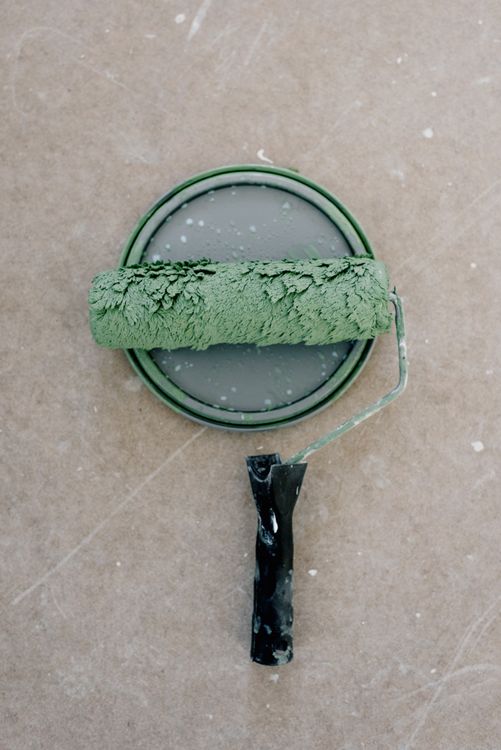
Cover image: a paint roller resting on a paint bucket, illustrating application tools that must be kept clean to avoid introducing impurities into the coating. Photo: Ksenia Chernaya / Pexels.
