

 Tiếng Việt
 中文 (中国)
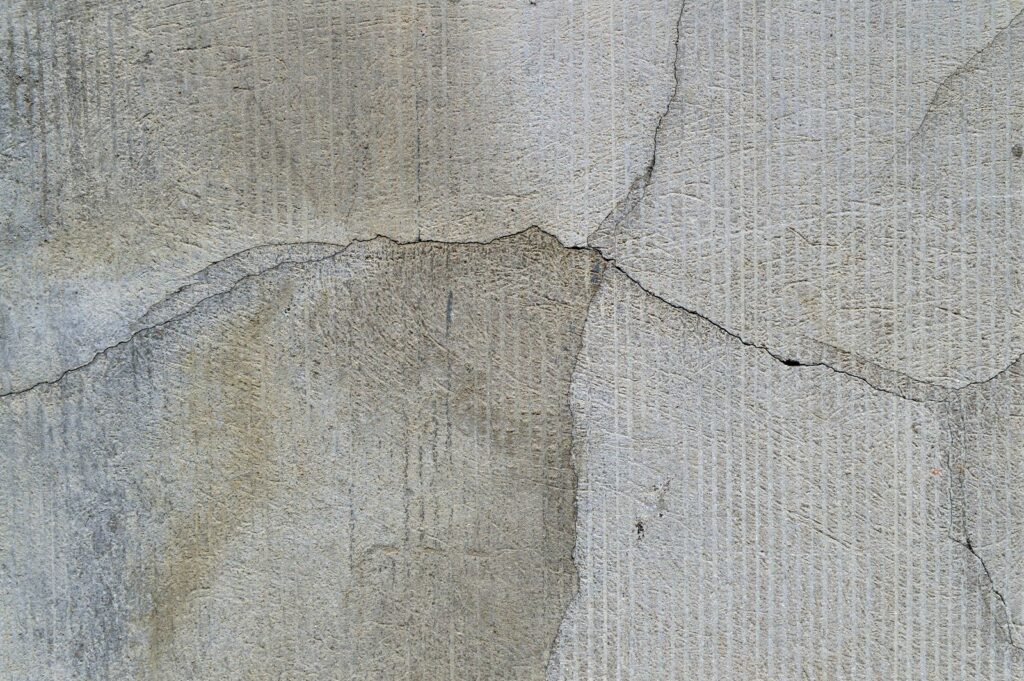
A crack running along a construction joint, spreading from a column corner toward the middle of the floor, or appearing as a network after a few weeks of use — in many such cases the crack does not start in the epoxy layer at all, but in the concrete slab shrinking underneath. Because an epoxy coating is hard and bonds tightly to the substrate, when the concrete shrinks, stress has to find a way out — and the concrete’s crack usually “prints” straight through the coating. This article helps tell shrinkage cracking apart from other crack types and gives the right fix for each type.
What is concrete shrinkage, and why does it crack epoxy floors?
Fresh concrete gradually loses water after pouring, and its volume shrinks. If the slab is restrained by walls, columns, foundations, or an old substrate, that shrinkage cannot happen freely, so tensile stress builds up inside. When the stress exceeds the young concrete’s tensile strength, a crack appears — usually at the weakest points: construction joints, column corners, spots where slab thickness changes, around drains, or at machine feet.
The epoxy coating on top of that slab does not create the crack, but neither can it stop a concrete crack from propagating upward. On the contrary, a well-bonded coating will crack together with the substrate, creating the impression that “the epoxy floor has cracked”. That is an important difference from hairline crazing confined to the coating surface — see Epoxy Floor Crazing: Hairline Cracks, Causes and Remedies for comparison.
Signs of shrinkage cracking
- Location: a straight or near-straight crack passing through construction joints, column corners, or spots where slab thickness changes; rarely a dense, patternless network.
- Width: usually a narrow gap that may open and close slightly with seasonal temperature and humidity.
- Depth: the crack runs through the coating down into the concrete; tapping lightly around the crack does not produce the widespread hollow sound of delamination.
- Timing: appearing in the early period after a new slab is poured and coated, or after a hot, dry spell or a sharp change in humidity.
By contrast, cracking from a weak, unevenly settling substrate usually comes with settlement, lifted edges, and widespread peeling — see Epoxy Floor Peeling from a Weak Substrate: Causes and Fixes. Cracking from forklift loads and impacts concentrates in traffic lanes, turning points, and heavy pallet spots — the subject of the article on forklift damage, which should not be lumped together with shrinkage.
Diagnosis before repair: do not fill in a hurry
Step 1 — Clean and mark. Clean the crack, photograph it with a ruler beside it to record its width, and mark both ends of the crack. Monitor for a while to see whether the gap widens, extends, or stays put.
Step 2 — Check whether the crack is still “live” or has stabilized. A crack that still moves with the seasons is a live crack; one that has stayed still through a dry–wet cycle is a stable crack. This distinction decides the filling material: a live crack needs a material that stays flexible — an absolutely rigid fill will crack again right at the old edge.
Step 3 — Check the substrate around the crack. Tap to check for blistering, and look for settlement, lifted edges, or accompanying dampness. If settlement or substrate dampness is present, fix the substrate cause first; merely filling the epoxy surface will let the crack return.
Repair approaches
Stable, narrow cracks without peeling
Open the gap into a shallow V shape, clean out the dust, fill with a joint filler compatible with the epoxy system in use, then recoat locally with the correct color and thickness for that area. Check the filler against the supplier of the coating system in use, because the wrong filler can cause color mismatch, edge peeling, or poor bonding.
Live cracks (still moving)
Do not fill the whole gap rigidly. The usual approach is to let the gap work as an expansion joint: fill with a compatible flexible material, or cut a deliberate expansion joint at the crack location and fill it flexibly, then recoat both sides of the joint. This accepts a controlled gap instead of trying to “erase” it and then cracking again.
Widespread cracking with peeling or settlement
This is no longer a local repair. The substrate needs surveying: thickness, strength, moisture, and the positions of original construction joints and expansion joints. The solution may include cutting out the damaged zone, treating the substrate, recreating expansion joints, and only then recoating the whole area. The article Localized Epoxy Floor Repair: Patching and Recoating by Area gives the general framework for local repair; for shrinkage cracking, the substrate survey always comes before recoating.
Prevention for new projects
- Wait for the substrate to stabilize before coating: do not apply epoxy to concrete that is still shrinking strongly. Coating timing must be based on measured moisture results and the actual substrate condition, following the coating system supplier’s guidance — see also Concrete Floor Moisture and How to Measure It Before Epoxy Coating and Concrete Floor Preparation Before Epoxy Coating: Grinding, Crack Repair, Moisture Testing.
- Respect the substrate’s expansion joints: concrete expansion joints must be carried through the coating, not coated over in the hope that the epoxy layer will “absorb” substrate movement.
- Choose a coating system suited to the area: areas subject to movement and vibration should be advised a system with suitable flexibility instead of defaulting to one system for the whole workshop. The system pages LevelFlow — Self-Leveling and RollCoat — 3-Coat Roller System describe the general framework of the systems; where Kadier’s own data has no published TDS, check directly before finalizing.
Frequently asked questions
Is shrinkage cracking an epoxy application defect?
Not necessarily. If the crack follows a substrate construction joint or column corner and runs deep into the concrete, the root cause is usually substrate shrinkage. An epoxy application defect is only established with separate evidence, for example coating too early on an unstable substrate, coating over expansion joints, or incorrect substrate preparation.
Will a filled crack crack again?
For stable cracks, filling with the right material and recoating correctly usually holds for a long time. For live cracks, filling with a rigid material makes re-cracking at the old edge very likely; the gap needs to be allowed to work with a flexible material or a deliberate expansion joint.
Can a new coat of epoxy be applied over the whole cracked floor?
Not advisable before the substrate cracks underneath have been treated. A well-bonded new coat will crack in exactly the same places, costing money without solving the cause. Treat the substrate and joints first, recoat after.
If your floor has developed cracks and you are not sure whether they are shrinkage cracks, crazing, or load cracks, describe the location and shape of the cracks and send them via the quote page or contact Kadier for advice on the right inspection approach.
Illustration: a cracked concrete surface — substrate cracks are the common root cause when an epoxy floor cracks along with them. Photo: Davis Vidal / Pexels. Not an actual Kadier project.
