

 Tiếng Việt
 中文 (中国)
This article covers one specific industrial park only: Becamex – Binh Phuoc Industrial Park, in the Chon Thanh area, Dong Nai province (former Chon Thanh district, former Binh Phuoc province). From 01/07/2025, the former Binh Phuoc area belongs to the new Dong Nai province; “Binh Phuoc” in the park name is a familiar geographic cluster name, not a currently existing administrative unit. This article covers Becamex – Binh Phuoc Industrial Park in the Chon Thanh area, Dong Nai province only — not other Becamex IDC parks such as My Phuoc or Bau Bang (former Binh Duong), and not VSIP parks. Becamex – Binh Phuoc Industrial Park is also distinct from Chon Thanh 1 Industrial Park (a separate park, about 120 ha) and from Minh Hung – Sikico and Dong Xoai III, two parks already covered in the province overview. The Dong Xoai III exclusion list (stated in the province overview) does NOT apply to Becamex – Binh Phuoc; each park has its own acceptance list, to be checked with the park management at survey time. Broader province context is in the province overview, and the priority industry groups stated there are referenced here in that one sentence only, not presented as this article’s own finding.
1. Scope first: three figures, three different scopes
A plot buyer in this park can easily confuse the three figures below if the scope is not stated with each figure, every time. The table keeps the scope word in the same sentence as each figure.
| Scope | Area | What it means for the floor decision |
|---|---|---|
| Complex | 4,633 ha | The Becamex – Binh Phuoc complex covers 4,633 ha, of which industrial land is about 2,448 ha and urban/services land is about 2,185 ha. |
| Industrial land within the complex | about 2,448 ha | This scope is the industrial land of the complex, not the whole complex. |
| Industrial park under the detailed plan | 1,993 ha | The industrial park under the detailed plan approved under Decision No. 2793/QD-UBND dated 22/12/2008 is 1,993 ha, of which leasable industrial land is 1,393.84 ha, according to a secondary source citing that decision. |
The infrastructure developer is Becamex Binh Phuoc Infrastructure Development JSC (a Becamex IDC company), established under Business Registration Certificate No. 3800405138 dated 02/01/2008. According to secondary sources, the industrial park lies at the intersection of National Road 13, National Road 14 and the Ho Chi Minh Road, in the Chon Thanh area, Dong Nai province; it is about 80 km from Ho Chi Minh City, according to secondary sources. That location sentence carries the secondary-source hedge because the underlying sources are secondary, not original texts read in full. Neighbouring clusters in the same new province are in the Dong Nai cluster article.
2. Zone map in words: National Road 14 is the divider
National Road 14 divides the industrial park into Zone A to the south (about 2,138 ha, covering part of former Minh Thanh, Thanh Tam and former Chon Thanh town) and Zone B to the north (about 310 ha, former Minh Thanh commune), according to secondary sources. This is a word map, not a drawn map, and it does not claim that a map image is reproduced here. The first check for a plot buyer is which side of National Road 14 the plot lies on, because that side shapes access and the layout of production, warehouse and yard areas before any coating system is discussed.
According to secondary sources, the main road is 62 m wide; internal roads are 15–25 m wide and connect directly to National Road 14. According to secondary sources, power comes from the national grid via a 110 kV station (Thac Mo, Tan Dinh 500/220/110 kV); there are two 110/22 kV substations inside the park; 22 kV medium voltage is supplied to the lot boundary. According to secondary sources, a factory’s wastewater is pre-treated to Type B, then sent to the central treatment plant, treated to Type A (ISO 14001:2015) before discharge to the environment; stormwater and wastewater run in separate systems. This article states no water-supply, wastewater-treatment or total power capacity, because secondary sources conflict on those capacities. A single-park neighbour example in the same province, with a different angle, is the Nhon Trach article.
3. Phasing as dated history: dates for the past, survey time for the present
According to secondary sources, Official Dispatch No. 1019/TTg-KTN dated 03/07/2008 from the Prime Minister included the park in national industrial park planning; Investment Certificate No. 44221000072 was issued on 29/12/2008; and Decision No. 2793/QD-UBND dated 22/12/2008 approved the detailed plan for the 1,993 ha industrial park in section 1. The complex officially commenced construction on 14/09/2015. The first step of phase 1 developed 510 ha to welcome the first investors (according to the developer interview at launch time); that 510 ha figure is a launch-period milestone, not the currently developed area and not a current phase status. Current phasing and plot availability are confirmed only at survey time; this article claims no current phasing status.
4. Tenant mix by sector, dated and named, with no current total
In March 2018, five first projects received investment certificates and broke ground at the complex: Hankuk Carbon, River Runs, Misung Industrial, Young Sung and Hankuk Advanced Materials, with total registered capital of USD 80 million at the ceremony. This article assigns no sector to River Runs, Misung Industrial or Young Sung, because no source gives those sectors. On 23/12/2020, the CPV Food export food-processing plant was inaugurated at the complex (USD 250 million, according to the developer). On 20/03/2022, the Hayat Kimya Vietnam plant was inaugurated at the complex (USD 250 million, according to the developer), producing consumer goods (Molfix diapers). A late-2019 dated record notes over 22 projects with nearly USD 450 million, naming CP Group, Hankuk Carbon, Public Industrial, Leoch and STR; a 2020 record notes 24 certificates with over USD 412 million and 13 projects commencing production. Both records are dated history, not current totals. This article states no current tenant count and no current fill rate, and it places no tenant in Zone A or Zone B, because no source maps tenants to zones.
5. System map by cluster
The table below is the decision core of this article: each cluster has its own floor problem, a system direction to discuss at survey, and what the survey must confirm. The table carries no technical or commercial figures, because no source gives such figures as a park requirement or a Kadier promise.
| Cluster | Floor problem | System direction to discuss at survey | Survey must confirm |
|---|---|---|---|
| Food-processing zones | Easy to clean, moisture resistance and continuous operating load; packing zones sensitive to coating odour | Self-levelling system for high-cleanliness zones; low-VOC water-based system for odour-sensitive packing zones | Chemical and cleaning-agent list by substance, concentration and contact time; substrate moisture; concrete age for new floors |
| Consumer-goods and hygiene-adjacent packing zones | Dust, easy cleaning and odour near packing | Roller system for ordinary storage and packing zones; low-VOC water-based system where odour is an issue | How odour-sensitive the packing zone is; actual cleaning conditions of the operating zone |
| Electronics and precision zones | Flat, seamless, low dust; static control only where required | Anti-static system only for the exact zones whose requirement is confirmed, never for the whole plant | The investor’s anti-static requirement in writing for each specific zone, plus survey measurement |
| Warehouse, yard and loading zones | Forklift load, abrasion and storage-zone cleaning | Factory floors distinguished from logistics warehouse floors when choosing the system | Point loads at rack feet and vehicle routes; condition of the operating substrate |
| New-build plots versus operating-plant refurbishment | New concrete needs sufficient age and moisture control before coating; operating floors need assessment of the old coating and damage | Suitable primer for new floors; a separate refurbishment approach for operating floors | Concrete age, moisture measurement results, and handover timing, with flooring as the last handover item |
Factory floors versus logistics warehouse floors are compared in the factories versus logistics warehouses article. Anti-static flooring, used only where the requirement is confirmed, is covered in the anti-static epoxy article. Roller versus self-levelling choice is compared in the roller versus self-levelling article. The roller, self-levelling, anti-static and water-based systems in the table correspond to RollCoat, LevelFlow, StatGuard and AquaBase for comparison, not as a promise that a specific system suits a specific named tenant in the park.
6. Survey checklist and what to ask before signing
- Which side of National Road 14 the plot lies on — Zone A to the south or Zone B to the north — and access via the 62 m main road or 15–25 m internal roads, according to secondary sources.
- Whether the substrate is new concrete or an operating-plant floor: concrete age, moisture measurement results, and whether a suitable primer has been identified.
- The chemical list for each specific zone by substance, concentration and contact time, checked against the manufacturer’s chemical-resistance table.
- The anti-static requirement in writing from the investor for each specific zone, plus survey measurement — no whole-plant anti-static system without confirmation.
- Whether a specific project is accepted must be checked with the park management; another park’s acceptance list does not transfer to this park.
- Handover timing: flooring is the last item in new-factory handover, so the coating schedule must match the overall handover schedule.
Kadier surveys and advises on system choice, and quotes only after a real survey; this article states no specific price and does not claim Kadier built floors for any specific tenant in the park. Send industry and handover schedule via the quote page or the contact page for system advice. Direct contact: hotline/Zalo 0899355489, WeChat wxid_95o54joujyrr12.
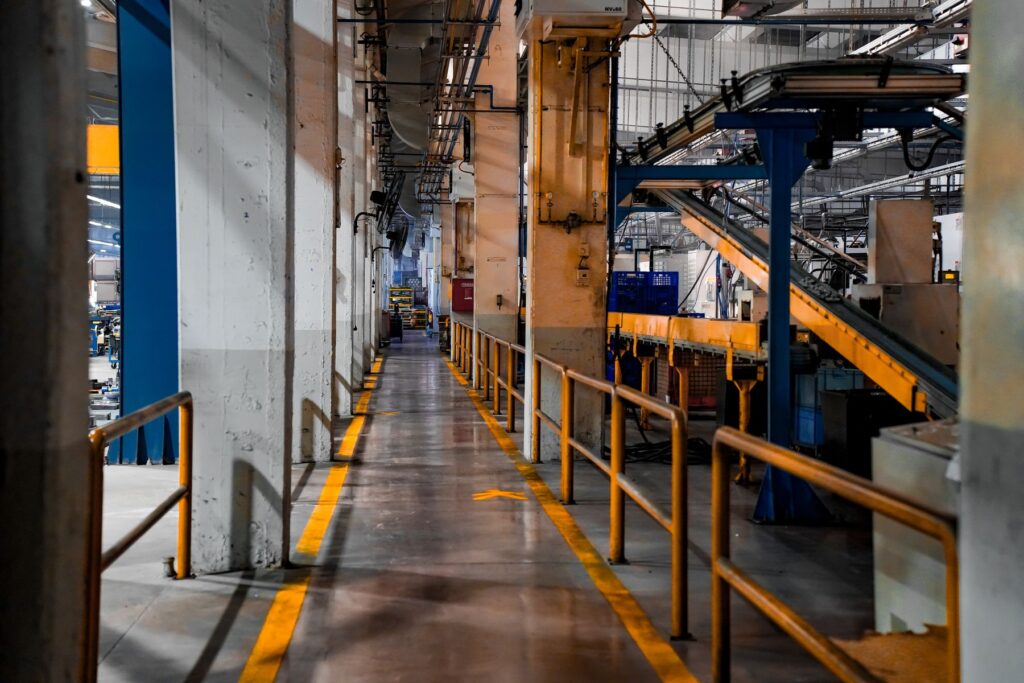
Generic stock illustration, not a Kadier project and not a floor inside Becamex – Binh Phuoc Industrial Park. Pexels stock photo (photo ID 34718926), photographer Yetkin Ağaç.

Pingback: Epoxy Flooring for Minh Hung – Sikico Industrial Park (Dong Nai): Floors for a Wet- and Heavy-Industry Park