

 Tiếng Việt
 中文 (中国)
An Hiep Industrial Park at Thuan Dien hamlet, Phu Tuc commune, Vinh Long province (formerly Chau Thanh district, Ben Tre province) is an operating industrial park with a planned area of 72 ha, industrial land of 50 ha, a fill rate of 100% of the industrial land (50 ha, according to the Vinh Long provincial People’s Committee report of July 2026), and 16 secondary investment projects. This article is only about An Hiep Industrial Park at that address — not the commune of the same name, An Hiep (of Ba Tri origin), in today’s Vinh Long province, and not the neighbouring Giao Long Industrial Park. The name “An Hiep commune, Chau Thanh district” below is used only for the pre-merger address; the current administrative unit is Phu Tuc commune, Vinh Long province.
In a park that is already full, like An Hiep, the real floor question is not choosing a coating system for a new plant on empty land. It is: where has the floor of each operating plant deteriorated, recoat or redo it entirely, how to phase the work so production does not stop — and, uniquely here, whether the plot to be coated has completed sublease paperwork and is actually being used as leased. Get that last question wrong and even the best coating can end up on land whose right of use is not settled.
1. Park profile: a small, full park oriented to agri-food processing
According to the Vinh Long provincial People’s Committee report of July 2026 (updating and supplementing Report No. 621/BC-UBND dated 10/6/2026), footnotes 40 and 42, An Hiep Industrial Park has a planned area of 72 ha, industrial land of 50 ha, a fill rate of 100% of the industrial land, and 16 projects. The 100% is of the 50 ha of industrial land, not of the 72 ha planned area — an investment listing gives 65.01 ha as the industrial-park area, which differs from the provincial report’s 50 ha; this article uses 50 ha as the fill-rate denominator and does not use 65.01 ha as a denominator.
The park sits beside the Ham Luong river and provincial road DT884, towards the former Ben Tre city centre and Giao Long Industrial Park. Its encouraged industries, according to a TTTFIC listing, are processing of agricultural products, coconut, sugar, cocoa, fruit, grain and food; animal and aquatic feed; leather shoes and clothing; plastic, composite, building materials and mechanical engineering; and consumer and handicraft goods. That is an investment-encouragement orientation, not a list of operating companies, and this article names no company as a Kadier customer. The same listing reports infrastructure construction from October 2008 — listing-reported information, not a figure from the provincial People’s Committee report. The listing also reports that the former Ben Tre provincial People’s Committee once requested permission to expand leasable industrial land by about 6.5 ha for businesses needing expansion; that was a request once made, not available vacant land, and this article does not treat it as a land bank.
2. What “full” means — and what it does not
The provincial report’s fill rate is a land-management metric: industrial land leased over total industrial land. It is not the same as “100% of leased land is fully papered and in use”. That distinction matters at An Hiep because a separate inspection conclusion, predating the July 2026 report, speaks to exactly that gap.
According to a thematic inspection conclusion of the Vinh Long provincial inspectorate (reported by Tuoi Tre on 06/5/2026), within An Hiep Industrial Park 20,000 m² was already in use without completed sublease procedures (used by Luong Quoi Coconut Processing Company Limited since 15/5/2023), and a sugar company was not using 49,329 m² of its leased land. That conclusion predates the July 2026 provincial report and does not overturn its fill-rate metric. But it means this article does not present An Hiep as a park free of land-use issues, and a plant owner should not treat “the park is full” as proof that their own plot’s paperwork is clean. Before coating, confirm the plot sits within land properly subleased under the regulations and is being used for its leased purpose — that is a matter for the company’s legal file and the park management, not for the flooring contractor, but a contractor should not be asked to coat an area whose status the owner has not confirmed.
3. Zone map: wet processing at the centre, dry areas and warehousing around it
Wet processing zones: coconut, food, feed. These are the harshest floors in the park: constant washdown water, high humidity, food oils and cleaning chemicals. A wet-zone coating must do three things at once: stop wash water penetrating the slab, keep grip when the floor is still wet, and resist the cleaning chemicals actually in use without peeling. Falls to drainage channels and wall coving are mandatory, not decoration: water standing on a flat floor seeps into cracks and destroys the coating from below. Before finalising a system, the plant owner should give the coating manufacturer the full list of cleaning chemicals in use — with dilution and contact time — for checking against that manufacturer’s own chemical-resistance table; no coating resists every chemical.
Dry zones: clothing, leather shoes, assembly and consumer-goods packing. Here the floor works dry but wears steadily: materials trolleys, light forklifts and machine feet travelling the same routes every day. The main requirements are flatness and cleanability: an uneven floor pushes trolleys off route, a dusty floor raises cleaning work. Before recoating, check cracks along vehicle routes, peeling around machine feet and patches from earlier repairs — coating over them will peel again in exactly the same places. Vehicle routes should be clearly marked after coating, so traffic stays in its lanes instead of spreading across production areas.
Warehouse and loading areas. A warehouse in an operating park differs from a new one in one respect: its vehicle routes already exist. Forklifts travel fixed routes between racking and loading areas, so wear concentrates on certain routes rather than spreading evenly. Warehouse floors must carry concentrated rack-foot loads and forklift-wheel wear, and stay flat enough that forklifts do not judder when lifting high. Cracked or slightly settled rack-foot positions must be dealt with before recoating, because a coating does not repair a settled slab.
Riverside substrate moisture: measure first, never coat a damp slab. The park sits beside the Ham Luong river, and concrete slabs in a humid riverside setting carry a higher moisture risk than slabs in a dry inland park. Moisture from the slab is a common cause of blistering after recoating. So substrate-moisture measurement is mandatory before any recoat decision at An Hiep, together with checking slab levels against surrounding drainage and where rainwater goes in heavy rain. Coating a damp slab is a reliable way to lose the coating after the first rainy season.
4. Recoating an operating plant: grind off or overcoat, and phase the work
This is the most important technical decision for An Hiep, because most demand in an operating park is recoating, not building new floors. The two main routes are grinding off the old coating and starting again, or preparing the surface and overcoating an old layer that still adheres well. Old layers that are peeling, blistering or heavily oil-contaminated usually have to be ground off; an old layer that still adheres well and is only surface-worn may be overcoated with less disruption. The decision must rest on adhesion testing and the actual slab condition, never on photographs alone.
Working zone by zone, agreeing in advance which zone goes first and which goods move where, lets the plant keep producing while its floors are upgraded in stages. In operating areas sensitive to odour, a low-VOC water-based system is worth considering where the survey confirms the slab suits it. Timing should also allow for the rainy season, not only for the production schedule. Final system parameters follow the coating manufacturer’s technical documents and the survey results; this article gives a general selection framework, not a substitute for a slab survey.
5. Checklist before signing a flooring contract at An Hiep Industrial Park
The pre-signing checklist is: is the plot to be coated fully covered by completed sublease paperwork and used for its leased purpose; which industry group is the plant in, wet or dry, and how many years has the floor been in use; which chemicals touch the floor, at what concentration and for how long, and what does the manufacturer’s chemical-resistance table say about exactly those chemicals; has substrate moisture been measured, and where does water go in heavy rain; does the old layer still adhere well enough to overcoat, or must it be ground off; which zone goes first, which goods move, and how does the plant keep producing during the work. A contractor who refuses to measure moisture, refuses adhesion testing, or claims one system resists every chemical, is a reason to stop.
To get advice in the right direction, send only: industry group, new floor or old floor to recoat, area of each zone, vehicle types and frequency, chemicals in contact if any, and the sublease-paperwork status of the plot (confirmed or still awaiting confirmation). Related articles: Ben Tre Industrial Cluster (Giao Hoa – Phu Thuan), Giao Long Industrial Park, Binh Minh Industrial Park (Cai Von, Vinh Long), how to choose an epoxy floor system by industry and use, quote, contact.
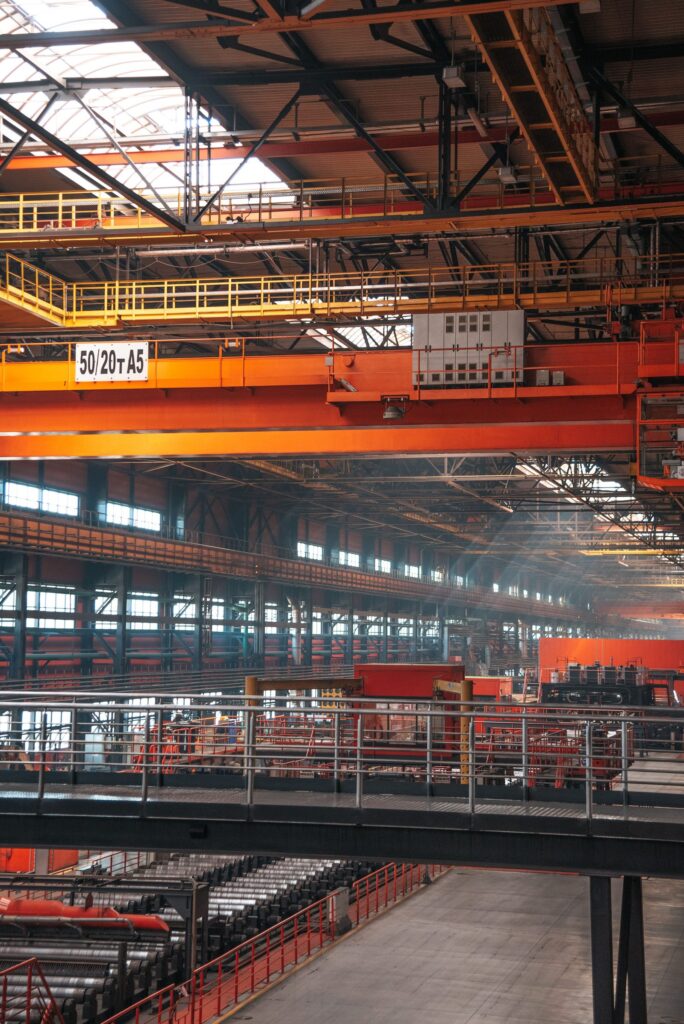
Illustration: a stock factory photograph with machinery and a concrete floor, not a plant inside An Hiep Industrial Park and not a Kadier project. Image source: see the article’s image file.
