

 Tiếng Việt
 中文 (中国)
Giao Long Industrial Park in Giao Long commune, Vinh Long province, is an operating park that has been running since 2005 and now has no vacant land left for new-build expansion in the way a new park does. Developed by the Ben Tre Industrial Zones Infrastructure Development Company and regarded as Ben Tre province’s first industrial park, it covers about 170 hectares in two phases of about 101 hectares and about 68 hectares. According to the Vinh Long Province Economic Zone Management Board (October 2026), the park hosts 41 projects employing 34,145 workers; in the first nine months of 2026 its revenue reached 24,238 billion VND, with exports of 852.94 million USD. The same board reported in July 2026 that Giao Long was among the province’s parks at 100% occupancy. For a park like this, the practical flooring question is not which system to specify for a new factory, but whether to recoat, patch locally or rebuild a slab that has served for many years — and what to survey before deciding.
A note on names: This article is only about Giao Long Industrial Park — the operating park since 2005, about 170 hectares — not Giao Hoa Industrial Park (a new park of about 248.51 hectares in the same commune, see the article on the Ben Tre Industrial Cluster (Giao Hoa – Phu Thuan)), not Giao Long commune itself (the administrative unit), not Giao Long Port, and not the neighbouring An Hiep Industrial Park. The old names “Ben Tre province” and “An Phuoc commune, Chau Thanh district” below refer to history only; the current administration is Giao Long commune, Vinh Long province. This article also differs from the Tien Giang and Vinh Long Industrial Clusters article, which looks at the whole region, and from the Hoa Phu Industrial Park (Vinh Long) article, which covers a different single park.
The tenant map: Giao Long’s floor-decision framework
Giao Long’s main sectors are garments, automotive wiring-harness assembly, food and coconut processing, paper and plastic packaging, and activated carbon. Operating tenants in the park include Alliance One Garments (garments), Furukawa Automotive Systems (Vietnam) (automotive wiring harnesses) and Dong Hai Ben Tre Joint Stock Company. These five sector groups do not place the same demand on a floor: garment and assembly halls need flat, dust-controlled floors that carry trolleys and forklifts along fixed routes; wet processing areas need floors that handle washdown water, stay safe underfoot when wet and drain well; packaging warehouses need floors that carry racking loads and forklift traffic. In this park, then, the first question is not which coating is best in general, but which sector group the hall belongs to, whether it runs wet or dry, and how many years its slab has served — those three answers drive the system choice, not the park name. The park’s shared infrastructure covers site levelling, power, water, storm drainage and a central wastewater treatment system — but good shared infrastructure does not replace a survey of each individual hall floor before recoating.
Dry halls: garments and wiring assembly
In garment and wiring-assembly halls, floors work in dry conditions but under steady, repeated wear: material trolleys, light forklifts and machine feet moving along the same routes every day. The biggest requirements here are flatness and cleanability: an uneven floor pushes trolleys off route, and a dusty floor raises cleaning effort and affects an assembly environment. Before recoating, the floor should be checked for cracks along vehicle routes, delamination around machine feet and patches from earlier repairs — coating straight over those points will peel again in exactly the same places. Local repair (patching, grinding flat, treating cracks) followed by a full recoat usually works better than coating directly over an unevenly deteriorated slab. Vehicle routes should also be marked clearly after coating, so trolleys and forklifts stay in their lanes instead of crossing assembly areas.
Wet zones: food, coconut and washdown cleaning
Food and coconut processing areas put the hardest conditions on a floor in this park: regular washdown water, high humidity, food oils and cleaning chemicals. A system for these areas therefore has to meet three requirements at once — resist washdown water, stay slip-resistant when wet, and resist the cleaning chemicals without losing adhesion. Falls to drains and wall coving are mandatory, not decoration: water ponding on a flat floor will find cracks and break the coating from below. Before the system is fixed, the factory should hand the coating maker its full list of cleaning chemicals in use — with dilution and dwell time on the floor — for checking against that maker’s own resistance chart; no system resists every chemical, and any claim to the contrary is a reason to stop. Areas in direct contact with wet raw material should also be surveyed separately, because their floors deteriorate faster than dry-hall floors in the same factory.
Packaging warehouses and loading areas: racking loads and forklift routes
Packaging warehouses for paper and plastic, and the loading areas of Giao Long, place a different load on the floor: tall racking, heavy pallets and forklifts on fixed routes, plus paper dust and packaging offcuts. A warehouse floor needs to carry concentrated loads at rack feet and resist forklift-wheel abrasion, while staying flat enough that a forklift does not rock when lifting high. Rack feet with cracks or slight settlement must be dealt with before recoating, because a coating cannot fix a settled slab. Forklift lanes, pallet staging areas and pedestrian walkways should be planned together with the recoat, rather than painted over afterwards. For a warehouse that has operated for many years, recoating bay by bay while part of the warehouse keeps running also needs to be planned in advance, so loading is not interrupted.
Low ground and drainage: Giao Long’s own problem, and what it means for a recoat
Giao Long has a ground problem that no new park in the region shares at this level: the park sits low, and rainwater from outside can flow in. According to the Ben Tre Province Industrial Zones Management Board (speaking to the press in 2019), rainwater from provincial road 883 — which sits higher than the park’s internal roads — flowed into the park, while three pumps (2,400 cubic metres per hour each) could not pump out the inflow; the drainage on road 883 was then incomplete. Workers reported flooding in heavy rain for ten years up to 2023, it recurred in the heavy rains of May and September 2024, and as recently as October 2026 the province ordered the construction department to survey and dredge the drainage canals around the park within two weeks. This article does not claim that any factory interior floods, and it does not claim the problem has been solved — the evidence concerns park roads and shared drainage only. But for a factory owner the practical consequence is clear: before recoating any floor in this park, measure substrate moisture, check floor levels against surrounding roads and drains, and ask where rainwater goes in heavy rain. Coating over a damp slab, or a slab that rainwater can cross, is a reliable way to lose the coating after the first rainy season. The timing of the work should also take the rainy season into account, not only the production schedule.
Before signing a recoat contract in Giao Long Industrial Park, get answers to these points
Before signing a flooring contract in Giao Long Industrial Park, a factory owner should have answers to the following points: which sector group the hall belongs to, and whether the area is dry, wet-processing or warehouse; the heaviest load and the real vehicle routes, including loads at rack feet; whether the maker has checked the full cleaning list — names, dilutions, dwell times — against its own resistance chart; whether substrate moisture has been measured and levels and drainage checked, especially for low ground in this park; and whether the job is local repair plus recoat, or a full rebuild after survey. The system is fixed in the end on two things: the technical documents supplied by the coating maker and the measurements taken in the hall. The park name and the hall size are not a basis for choosing a system.
Contact for advice and quotes
To get advice on a system matched to the sector, wet or dry area, loads and the moisture and drainage state of a Giao Long factory or warehouse, send the area, hall or warehouse type and production sector; Kadier will advise on a system and book an on-site survey. Browse epoxy flooring quotes, epoxy systems and the contact page (hotline/Zalo 0899355489, WeChat wxid_95o54joujyrr12).
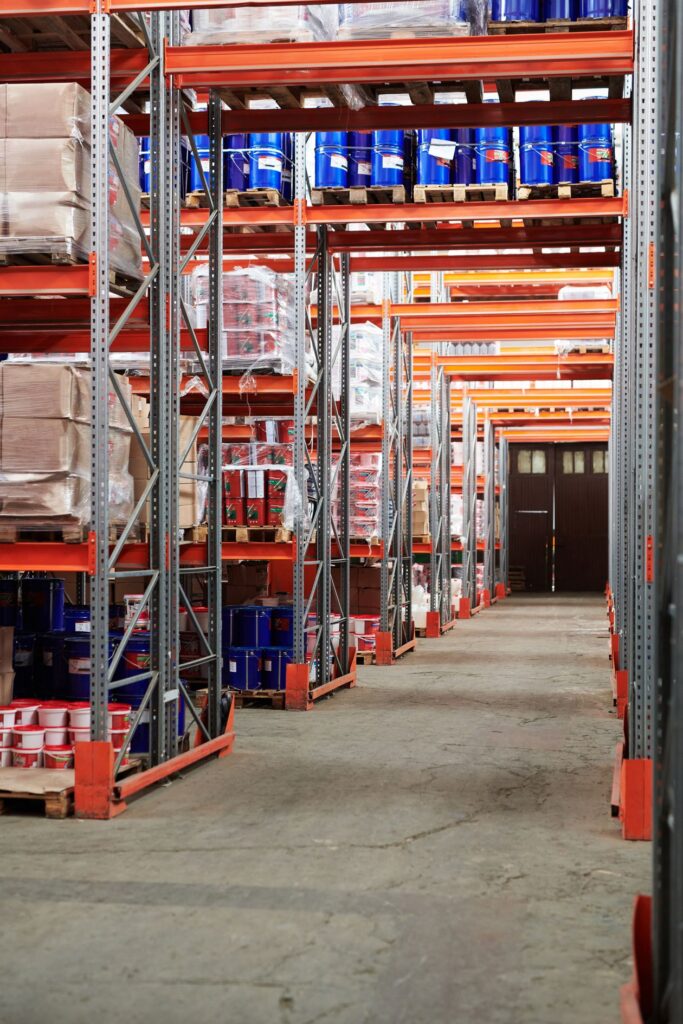
Illustration from the Pexels library (ID 4483609); it shows no Kadier project and no actual floor inside Giao Long Industrial Park.

Pingback: Epoxy Flooring for An Hiep Industrial Park (Vinh Long): Recoating Operating-Plant Floors in a Full Park