

 Tiếng Việt
 中文 (中国)
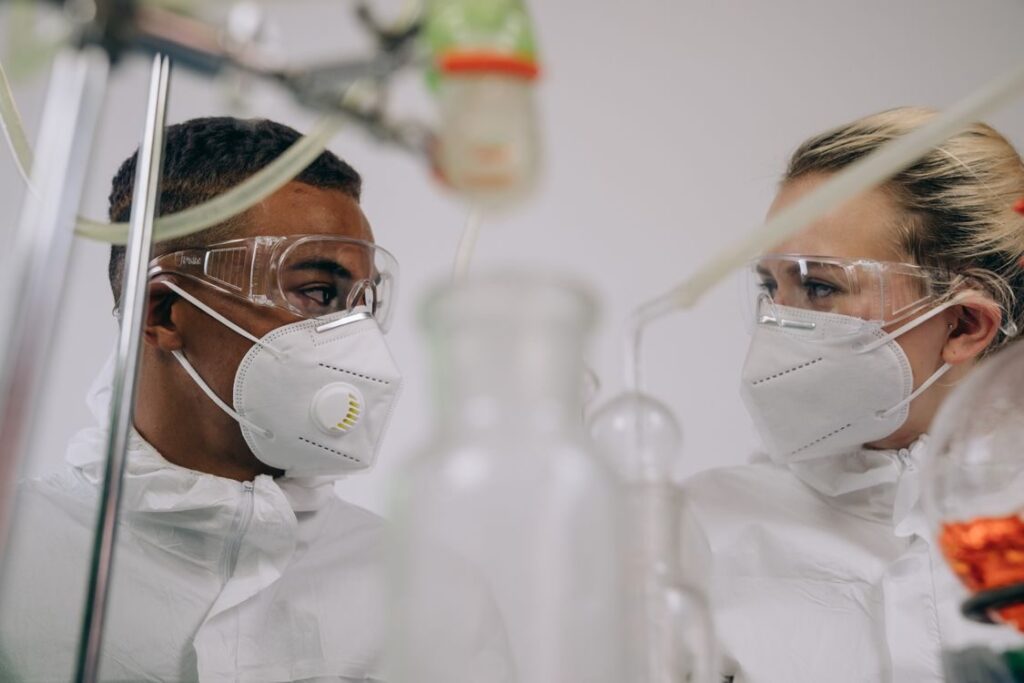
A laboratory is a place where the floor has to withstand several pressures at the same time: spilled chemicals, water from washing equipment, trolleys carrying instruments, safety footwear moving continuously, and strict cleaning requirements. Epoxy floor coating is chosen for a lab not because of a single feature, but because of the combination of a seamless surface, easy cleaning, chemical resistance at an appropriate level, and the ability to arrange electrostatic protection for individual zones when needed.
How lab floor requirements differ from ordinary factory floors
In a factory, a stain on the floor usually affects only appearance and walking safety. In a lab, a chemical stain soaking into a porous floor can leave an odour, cause discolouration, and become a source of cross-contamination for test samples. A seamless epoxy surface, with few joints, helps spilled chemicals stay on the floor surface instead of soaking in, so staff can handle, clean, and decontaminate them more quickly.
A lab is also often divided into many small zones with different risk levels: a sample preparation zone, an analysis zone, an equipment-washing zone, a chemical storage zone, and an office zone. Each zone has a different spill frequency and different cleaning requirements, so a single flooring solution should not be applied to the whole lab without distinguishing between zones.
A qualitative chemical table: how to read it correctly
The table below is only a general guide; it does not replace the technical documentation of a specific product. Every row must be checked against the official TDS before a decision is made, because actual chemical resistance depends on the type of chemical, the contact time, the temperature, and the specific coating system.
| Groups of chemicals commonly found in labs | Qualitative assessment direction | Basis for the decision |
|---|---|---|
| Neutral cleaning solutions used for daily cleaning | Generally compatible well with epoxy floors in general | Check against the TDS of the specific product |
| Alcohol used for surface cleaning | Generally compatible, needs to be wiped clean after contact | Check against the TDS of the specific product |
| Dilute acids and dilute alkalis used in analysis | Depends on type and contact time; spills need early handling | Check against the TDS of the specific product |
| Light organic solvents | More sensitive, each type needs separate assessment | Check against the TDS of the specific product |
| Strong oxidisers and highly corrosive chemicals | Do not assume every epoxy floor can withstand them | Check against the TDS of the specific product |
This article deliberately records no concentration or numerical value in the table, because a number separated from its test conditions can easily mislead. The correct approach is to list the chemicals the lab actually uses, together with the expected contact time, and then check each row against the official TDS of the coating system to be applied. See also the general reference framework in the article Chemical Resistance of Epoxy Floors: A Reference Table by Acid Concentration, while keeping the same principle of checking the TDS before finalising the material.
Electrostatic protection: only in zones that need it
Not every zone in a lab needs an electrostatic-protective floor. Only zones working with sensitive electronic components, precision measuring instruments, or environments at risk of electrostatic discharge need to consider an electrostatic-protective system, together with earthing and testing under the lab’s own procedures. The remaining zones can use ordinary epoxy flooring, saving cost without reducing safety.
Under Kadier’s approach, the StatGuard system with electrostatic protection is for zones with this requirement, while the LevelFlow system, which is self-levelling, suits analysis zones that need a flat floor that is easy to clean, and the AquaBase system, which is water-based, suits labs that are in operation and sensitive to odour. Zoning for electrostatic protection needs to be drawn clearly on the floor plan from the start, to avoid finishing the work and only then discovering that a zone needing electrostatic protection lies outside the treated area.
Cleaning and spill handling
A lab cleaning procedure should clearly set out three things: handling a spill as soon as it is found, using a cleaning solution suited to the type of chemical just spilled, and checking the surface again after wiping. Curved wall-to-floor junctions, sealed expansion-joint gaps, and floor drains with suitable covers will make cleaning faster and limit chemicals pooling in hidden corners.
Limits to keep in mind
This article presents the general characteristics of epoxy material and Kadier’s guidance on choosing a coating system; it is not the technical documentation of a specific product. Every decision on chemical resistance, the level of electrostatic protection, or coating thickness must be checked against the official TDS of the specific product and the chemical safety procedures of the laboratory itself.
Get advice on an epoxy flooring option for a laboratory, together with the list of chemicals the lab uses, so the TDS can be checked before a coating system is chosen.
Featured image: Mikhail Nilov on Pexels.
