

 Tiếng Việt
 中文 (中国)
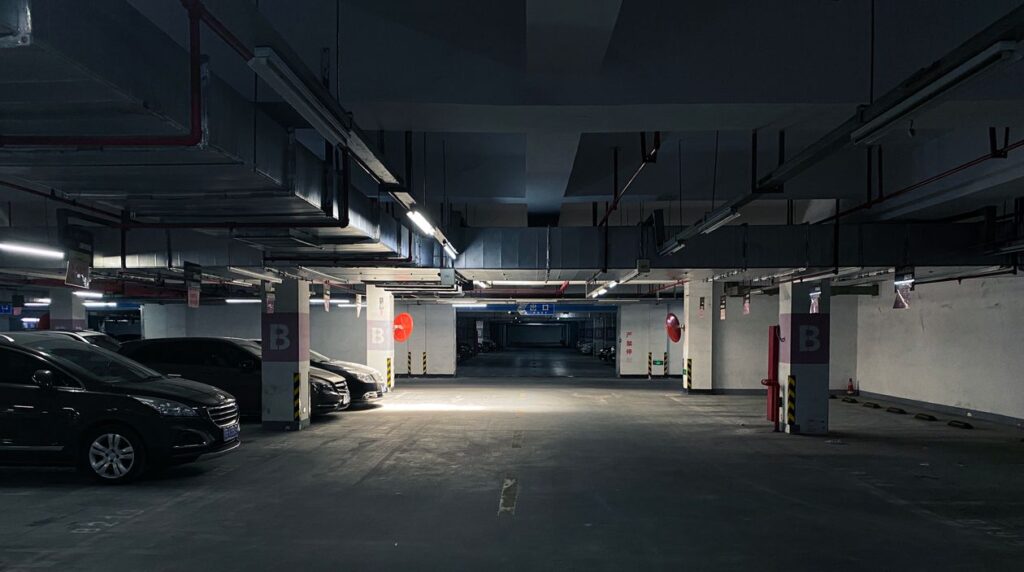
A basement is one of the harshest environments for epoxy flooring: moisture rising from below the substrate, turning and hard-braking vehicle loads, vehicle chemicals, rainwater carried in by vehicles, and a constant need for drainage. This article sets out 5 requirements for basement parking and how each requirement is verified. This article sets no moisture, slip-resistance or load threshold in the name of Kadier — every applicable threshold follows the contract and the TDS of the specific coating system.
Why a basement is harder than a surface car park
A surface car park dries quickly in sun and wind, while an enclosed basement stays humid and moisture from the concrete substrate escapes slowly. A moisture difference above and below the slab creates vapour pressure under the coating, causing blistering, bubbling and delamination if the substrate has not been treated correctly. In addition, vehicles bring in water, mud, oil, grease and salt, while poor lighting makes floor-surface defects hard to spot by eye unless inspected under the lighting actually used. See epoxy coating solutions for basements and epoxy for basements and parking to compare the general context.
5 requirements for basement parking
1. Rising-damp resistance — the decisive step is in the substrate, not the surface coat
In a basement, substrate moisture treatment and a moisture-tolerant primer are the decisive step. However good the surface coat looks, it cannot compensate for an untreated damp substrate. Before coating, substrate moisture must be measured, the moisture source assessed and a suitable treatment chosen, and only then the coating system applied.
2. Load and wear resistance — fastest wear on lanes, ramps and turning areas
Static parking bays wear slowly, but lanes, up/down ramps and turning areas carry braking, wheel-turning and concentrated loads, so they wear much faster. When assessing a coating system, these high-wear zones must be considered separately rather than assessed generally for the whole basement floor.
3. Slip resistance — especially on ramps and in wet areas
Up/down ramps, pedestrian walkways and wet areas are the most dangerous slip points. Anti-slip aggregates (for example bauxite or aluminium oxide in high-wear zones) increase friction, but must be balanced against cleanability: an excessively rough surface traps dirt and is hard to wash free of oil and grease.
4. Resistance to vehicle chemicals
Engine oil, petrol, coolant, salt and battery acid regularly contact basement floors. The actual chemical list must be checked against the manufacturer chemical-resistance table for the correct coating system, following the same concentration — time — temperature principle set out in the chemical-resistance articles.
5. Drainage and traffic markings
Basement floors need falls to collection pits, with no ponding after washing or after rain. Lane markings, traffic lanes and symbols must last under repeated wheel traffic, and must be inspected in the same round as floor-surface acceptance, not accepted separately afterwards.
Rising damp: how to measure it, how to treat it
The two commonly used substrate-moisture measurement methods are ASTM F2170 (relative humidity within the concrete slab, drilled to 40% of the thickness of a slab drying from one side) and ASTM F1869 (moisture vapour emission rate by the calcium chloride method, in lb/1,000 ft²/24 hours). When recording results, the method, measurement locations and measurement conditions must be stated, because the two methods measure different quantities and do not replace each other. Some contractor documents commonly mention general reference thresholds of around 75% RH (F2170) or around 3 lb (F1869) for standard epoxy — these are only general references in third-party documents, not Kadier acceptance thresholds; the threshold for a specific project follows the contract and the TDS of the chosen coating system.
Slip resistance: 3 measurement methods, not interchangeable
The three slip-resistance measurement methods commonly mentioned are: the DIN 51130 ramp method (grades R9–R13); the PTV pendulum method per BS EN 13036-4 or ASTM E303 (a wet PTV of 36 or above is commonly regarded as low slip risk in general reference documents); and dynamic coefficient of friction DCOF per ANSI A326.3 (a wet value of 0.42 or above for interior flat surfaces in general reference documents). These methods measure different aspects and do not convert directly into one another: an R result must not be converted into PTV or DCOF as if on the same scale. At acceptance, the agreed method must be stated and applied, and the reference values above must be recorded as values of the method and general documents, not as Kadier slip-resistance thresholds.
Basement parking acceptance checklist
- Measure substrate moisture before application by F2170 or F1869, recording the method and locations in the file.
- Measure film thickness and test adhesion at locations agreed in advance.
- Check slip resistance by the agreed method, especially on ramps and in wet areas.
- Test drainage with real water: where water ponds, which collection pit it drains to, and whether puddles remain after washing.
- Check lane markings, traffic lanes and symbols under the lighting actually used in the basement.
- Monitor during the first 1–3 months at turning areas and ramps — where wear and delamination show earliest.
Frequently asked questions
Why has a newly coated basement floor blistered when the surface looks dry?
The most common cause is moisture rising from below the substrate. A dry-looking surface is not enough to conclude the substrate was ready for coating; substrate moisture must be measured by F2170 or F1869 and the results filed before application.
Can an R9 slip-resistance result be used to infer PTV or DCOF?
No. DIN 51130, PTV and DCOF are three different methods, not directly convertible into one another. Acceptance must state the method used.
Which areas in a basement need the most attention after handover?
Up/down ramps, turning areas and main lanes — where vehicles brake, turn their wheels and concentrate loads, and where wear and delamination appear earliest.
What should be prepared before contacting us for a basement survey?
Basement area, number of basement levels, current damp and ponding condition, vehicle traffic volume, and ramp and collection-pit locations.
For a basement survey before choosing a system, please contact us for a quotation or send a request via the contact page (hotline/Zalo 0899355489, WeChat wxid_95o54joujyrr12), for substrate moisture measurement and assessment of ramps and drainage before deciding on a coating system.
Illustration: a basement car park with markings, zone columns and vehicle lanes. Pexels stock photo (photo ID 4486743, author Li Sun), illustrating a basement parking space, not a photograph of a Kadier project.
