

 Tiếng Việt
 中文 (中国)
A slippery epoxy floor when wet is a surface that is fine to walk on when dry but becomes dangerously slippery as soon as it gets wet: wash water, wind-blown rain, leaks or condensed moisture. Pedestrians can easily slip and fall, and forklifts and trolleys can lose control on wet routes. This article is about fixing the problem after the fact: a floor already installed and in use, where slipperiness only shows when the floor is wet. That is a different angle from the article on anti-slip epoxy floors: quartz sand or aluminium oxide? — which covers choosing anti-slip materials when designing and installing a new floor. This article is for an existing floor that is slippery when wet: diagnosing why it is slippery, what to do temporarily, and how to fix it properly without redoing the whole floor.
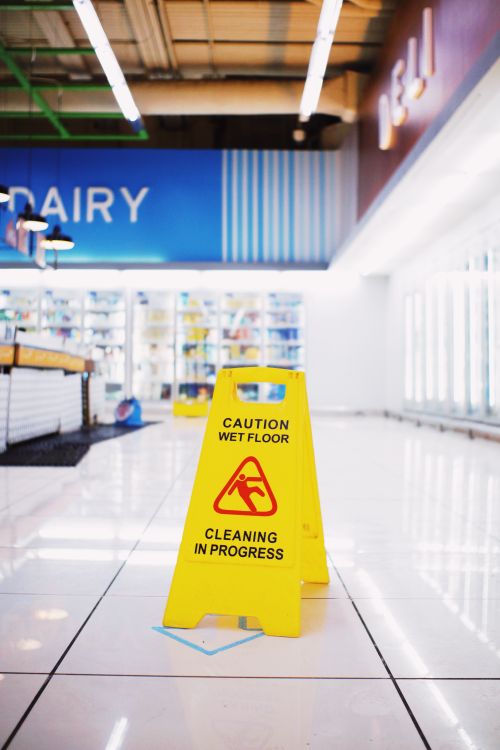
Illustration: a wet-floor warning sign — the first temporary measure when a slippery-when-wet area is found, before a permanent fix. Photo: Nothing Ahead on Pexels, not a Kadier project.
Why are epoxy floors slippery when wet?
Cured epoxy forms a seamless, glossy, barely absorbent film. That very property means water does not soak in but sits as a thin film on the surface, separating shoe soles and wheels from the floor. When dry, friction between shoe soles and the epoxy film is enough for normal walking; when wet, the water film suddenly cuts friction. How slippery it is depends on the surface gloss and roughness: a mirror-gloss floor is more slippery than a matt floor, and a perfectly smooth floor is more slippery than one with anti-slip grains.
Some factors make it worse: water mixed with grease, soap or fine powder forms a double slippery layer on the water film; slight slopes or hollows that pond water make the water film thicker; smooth-soled shoes and hard wheels slip more on wet floors than grooved soles. Also check whether the floor is really only slippery when wet: if it is slippery even when dry, the cause may be oil contamination, polishing wax or chemicals on the coat — which needs a different fix from wet anti-slip treatment.
Temporary fixes: reduce the risk today
Before a permanent fix, a slippery-when-wet area needs immediate control to prevent accidents. Put wet-floor warning signs at the entrances to the area, especially after washing or when rain blows water in. Dry the main walking routes after washing instead of letting water dry into a thin film on its own. For areas that are often wet, such as entrances from outdoors, wash bays and areas near roller doors, temporary entrance mats and rubber mats at entry points reduce the water carried onto the floor.
On cleaning: use a cleaner suited to epoxy floors, and do not leave soap to dry into a slippery film after mopping. Wash water with soap not fully rinsed off is a very common but often overlooked cause of slipperiness, because the floor looks clean yet still slips. Wrong cleaning methods and their consequences are covered separately in the article on wrong epoxy floor cleaning. If the floor only slips after mopping and not with clean water, check the rinsing and drying routine before concluding that the floor needs anti-slip treatment.
Permanent fixes: adding grip to a floor in use
The principle of a permanent fix is to increase surface roughness in the slippery area, so that even when wet there are still contact points between shoe soles and the floor through the water film. There are three main approaches, chosen by slipperiness level and the area’s function:
Anti-slip topcoat
Sand the old surface, clean it, then apply a new coat mixed with anti-slip grains or broadcast with grains onto the still-wet coat. Anti-slip grains are usually quartz sand or aluminium oxide; grain size determines both grip level and how hard the floor is to clean afterwards: the larger the grain, the better the anti-slip performance but the harder to clean and the faster shoe soles and wheels wear. This approach suits wide slippery areas needing an even fix. Choosing grain type and size for a new floor is covered in the anti-slip materials article; for an old floor the grain-selection principle is similar, with the added requirement that the new coat must bond well to the sanded old coat.
Localised anti-slip treatment at slippery points
When only a few spots are slippery — stair treads, entrances, areas around taps — localised anti-slip treatment can be used instead of recoating the whole floor. These spots can use adhesive anti-slip strips, localised anti-slip paint or anti-slip coating along walkway lines. The advantage is fast work with little floor downtime; the drawback is that the joint edge between the treated area and the old floor may be visible and needs periodic adhesion checks. Staircases and walkways are especially dangerous when wet, as covered separately in the article on epoxy coating for staircases and walkways.
Improving drainage and reducing ponding
If the floor has hollows that pond water, grip treatment alone has limited effect, because a thick water film still covers the anti-slip grains. In that case, slope, drainage channels or filling the hollows must be dealt with before anti-slip coating. When a floor is both uneven with ponding and slippery when wet, flatness and drainage should be fixed first, anti-slip second.
Special case: areas needing both anti-slip and electrostatic control
In electronics factories, cleanrooms or component stores, floors must both control static electricity and resist slipping when wet. These two requirements can conflict: anti-slip grains broadcast onto an electrostatic-control coat can change the floor’s surface resistance, so the floor may no longer meet its electrostatic-control requirement. So in areas using an electrostatic-control system such as StatGuard — electrostatic control, every grip treatment must be confirmed not to break the surface-resistance requirement, and surface resistance must be rechecked after treatment. Do not broadcast grains onto an electrostatic-control floor without this confirmation.
Frequently asked questions
Does anti-slip treatment for an old floor mean redoing the whole floor?
No, not necessarily. If the old coat is still well bonded and only some areas are slippery, localised anti-slip treatment or area-by-area anti-slip coating is enough. Redoing the whole floor is only needed when the old coat is already weak, peeling widely, or when flatness and drainage are also problems.
After anti-slip coating, is the floor harder to clean?
Yes, cleaning difficulty rises with roughness. Anti-slip grains trap dust and dirty water in their gaps, needing more thorough scrubbing than a smooth floor. So do not make the floor rougher than necessary: a walking area needs a different roughness level from a forklift area, and a high-hygiene area needs a balance between anti-slip performance and ease of cleaning.
How do you know the anti-slip treatment is enough?
Practical testing is the most reliable way: wet the treated area and walk it in the type of shoes and vehicles normally used in the area, at normal working speed. Checking by eye or by dry hand is not enough, because wet slipperiness only shows when water is present. Recheck after a period of use, because anti-slip grains wear down and anti-slip performance falls over time, especially on main walkways.
A note on specifications
Official technical data (TDS) for each Kadier product is published on the Products page; this article sets out a general framework and does not replace the TDS of a specific product. Standards such as TCVN 9014:2011 and TCVN 12574-2018 set the general framework for epoxy paints and coatings; in actual anti-slip coating work, grain type, grain size and the coat used must follow the TDS of the specific product to be used, and in electrostatic-control areas surface resistance must be rechecked after treatment. Project owners should ask the supplier to confirm in writing that the grip treatment suits the area’s function and cleaning requirements.
If your floor is dangerously slippery whenever wet, send photos of the slippery area, the type of water that usually ponds (clean water, wash water, wind-blown rain) and the types of vehicles and shoes used in the area, for advice on an anti-slip coating or localised fix — see Get a quote and contact Kadier for an on-site survey.
See also
- Anti-slip epoxy floors: quartz sand or aluminium oxide? — choosing anti-slip materials when designing a new floor, different from fixing a problem in this article.
- StatGuard — electrostatic control — notes for areas that are slippery and also require static control.
- RollCoat — 3-coat roller system — the roller system often used as the anti-slip recoat over an old floor.
- Epoxy coating for staircases and walkways — the most dangerous positions when the floor is wet.
- Wrong epoxy floor cleaning — checking whether slipperiness is caused by soap residue left after mopping.
