

 Tiếng Việt
 中文 (中国)
The flooring problem in the Tay Ninh border-gate cluster does not start at the factory — it starts at the warehouse, the yard and the dry port. Bonded warehouses, inspection yards, bonded storage and dry ports around the four international border gates of Moc Bai, Xa Mat, Tan Nam and Binh Hiep set their own floor conditions: high-frequency truck and container traffic, border-road dust, prolonged heat, and a requirement that customs clearance must not stop while work is under way. That is the axis of this article, which differs from the article about factories in the same province.
Administrative note: from 01/07/2025, the new Tay Ninh province comprises former Tay Ninh and former Long An. In this article, the old locality names are only familiar geographic cluster names, not current administrative units. Duc Hoa and Ben Luc (the former Long An area) are now in the same new Tay Ninh province as Moc Bai, but this article belongs to the border-gate pole, not the Duc Hoa pole; the two poles are kept clearly distinct.
A map of the four international border gates and the Moc Bai dry port
According to a VietnamPlus/TTXVN source on a conference in October 2026, the new Tay Ninh has a border of nearly 369 km, 21 border gates of all kinds, 4 international border gates (Moc Bai, Xa Mat, Tan Nam, Binh Hiep) and 4 main border gates (Chang Riec, Phuoc Tan, Ka Tum, My Quy Tay), together with 3 border-gate economic zones (Moc Bai, Xa Mat and the former Long An area). The border-economy scheme to 2030/2035 sets targets for the 2031–2035 period of USD 25–32 billion in import-export goods passing through the border and 4–5 hub logistics centres at Moc Bai, Xa Mat, Tan Nam and Binh Hiep; by 2050, becoming a major border economic centre and a gateway for Vietnam – Cambodia – the trans-Asian corridor. This article states clearly: these are targets and a scheme, not the current situation.
Existing and planned logistics infrastructure, according to sources, includes a logistics centre at Moc Bai (150 ha), one at Xa Mat (100 ha), warehouse and logistics services at Binh Hiep (10 ha) and My Quy Tay (10 ha); the Tan Cang – Tay Ninh dry port at Moc Bai (VND 550 billion invested, phase 1 already operating, around 100,000 vehicle trips in 2025 according to the source); 30 border markets according to sources; the Moc Bai border-gate economic zone master plan to 2045 (over 21,000 ha, approved according to the source); and the Xa Mat border-gate economic zone (nearly 35,000 ha, under appraisal according to the source — not claimed to be approved). This article is about market demand; it does not claim Kadier has built at any border gate or served any dry port, and it does not tie any specific border-trade goods to any business.
Inspection yards and outdoor container yards: heavy loads, dust, sun, PU topcoat
Inspection yards and container truck parks are the harshest link in the border warehouse chain: trucks and containers moving in and out continuously, loads concentrated at wheel points and turning points, border-road dust settling on the floor, and prolonged heat. Standard epoxy chalks under UV, so outdoor and semi-outdoor areas need a protective PU topcoat, plus slip resistance when wet and clear traffic-lane markings. Outdoor yard floors must also allow for rainwater drainage: standing water on a yard not only causes slipping, it also speeds up coating failure wherever water sits for a long time. The RollCoat roller system, able to take forklifts and trucks and to carry line markings, is often considered for this group, with a PU topcoat for the outdoor sections; final specifications follow the paint manufacturer’s technical documents and the results of an on-site survey.
Bonded warehouses and general warehouses: high frequency, line markings, easy cleaning
Bonded warehouses and general warehouses in the border-gate area take higher forklift and truck frequencies than purely domestic warehouses, because cross-border goods are typically consolidated, inspected and only then distributed onward. Floors here prioritise even load and wear resistance, durable line markings, and easy cleaning of dust with low dirt retention. Traffic flows inside the warehouse — forklift aisles, pedestrian walkways, counting areas and staging areas awaiting clearance — need to be marked from the outset, because re-marking after a border-trade warehouse is already operating costs far more downtime. See also epoxy flooring solutions for logistics warehouses and the article how epoxy for factories and logistics warehouses differs for comparison.
Export farm-produce warehouse floors: dust, moisture, packing zones
Farm produce exported across the border brings its own problem into the border-gate warehouse: dust from dry raw materials, moisture from fresh produce, and packing and sorting zones. Farm-produce warehouse floors need low dust retention, easy cleaning, slip resistance in lightly wet washing and packing zones, and the ability to carry forklifts loaded with produce pallets. Unlike a consumer-goods bonded warehouse, a farm-produce warehouse is also seasonal: peak harvest pushes forklift frequency up many times over, so load and wear acceptance must be rated for the peak, not for an ordinary day.
Support workshops around the border gates, and building without interrupting clearance
Around the border gates there are also support workshops — packaging, preliminary processing — with medium loads and easy-cleaning requirements, similar to inland support workshops but tied to the clearance rhythm. Construction in an operating border area must proceed in sections: each zone is handed over before work moves to the next, low-odour systems are used near offices and working areas, and the schedule avoids clearance peaks. This is a major operational difference from building inside an inland industrial park: shutting down an entire border warehouse to paint its floors is almost never acceptable, so phased work with handover zone by zone is a mandatory requirement, not an option.
For comparison, the article on the Tay Ninh industrial cluster and border gates looks from the factory side — textiles, footwear, rubber, plastics, electronics — with only one short section on bonded warehouses; this article looks from the warehouse, yard and dry-port side, with the network of four international border gates, the dry port, inspection yards and bonded warehouses as its main axis, together with the border-economy scheme and the particular conditions of dust, sun and cross-border truck traffic.
Frequently asked questions
Should a border-gate warehouse choose a roller system or a self-levelling system?
Bonded warehouses and general warehouses carrying high-frequency forklift and truck traffic usually prioritise a roller system with line markings and slip resistance; cleaner areas inside the warehouse, such as counting and packing zones, may merit consideration of the LevelFlow self-levelling system. The final decision rests on a survey of loads, frequencies and wetness zone by zone; no single system is applied to the whole warehouse.
Can an outdoor container yard be coated with epoxy?
Yes, provided there is a PU topcoat to resist chalking under UV for the outdoor sections, together with slip resistance when wet and good drainage. Epoxy without a protective topcoat will chalk and degrade quickly under direct sun, so outdoor yard sections should not use bare epoxy.
Does painting a border warehouse floor require stopping customs clearance?
Not necessarily, if the work is phased and handed over zone by zone. Phased work, low-odour systems and a schedule that avoids clearance peaks are operating requirements for border warehouses, and they need to be agreed at the survey stage rather than dealt with once work has started.
How is a quote for epoxy flooring for a border-gate warehouse calculated?
Kadier quotes after an on-site survey, based on area, the type of warehouse or yard — indoor or outdoor — truck and container loads, and the phased construction schedule. This article gives no specific prices, because price lists circulating online are not Kadier prices.
Which border gate is your warehouse or yard at — Moc Bai, Xa Mat, Tan Nam or Binh Hiep — and is it an indoor warehouse or an outdoor yard? Send the area and load details via the quote page or the contact page for advice on a suitable border-warehouse flooring system. Direct contact: hotline/Zalo 0899355489, WeChat wxid_95o54joujyrr12.
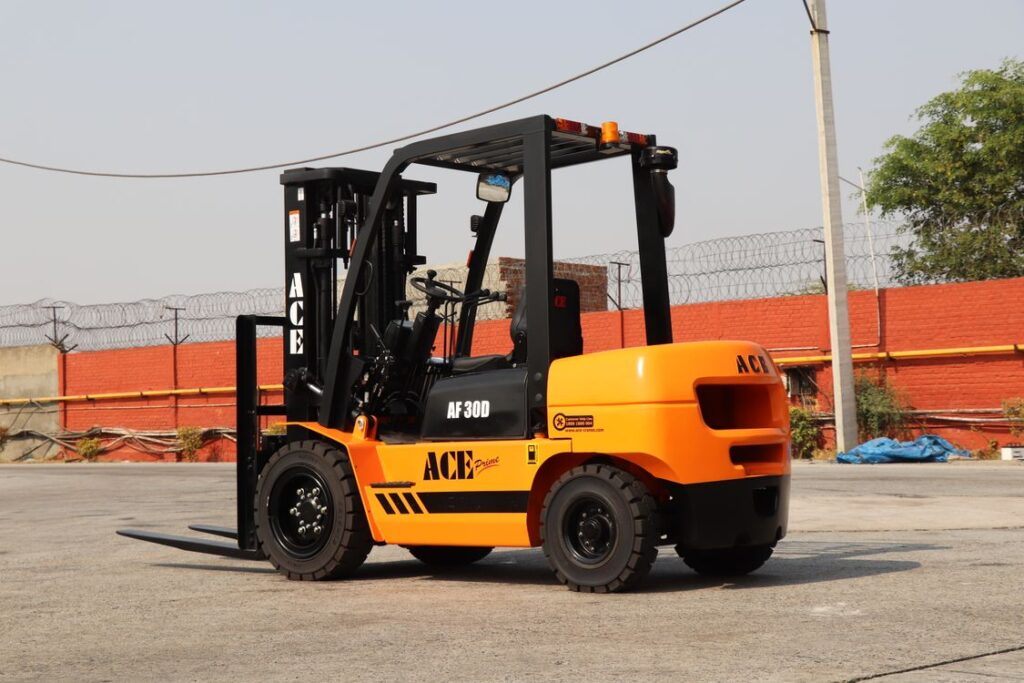
Illustrative photo, not a Kadier project. Pexels stock photo (photo ID 29480727) — by Action Construction Equipment Ltd. – ACE, a general illustration of forklifts in an industrial yard, not tied to any specific border gate or dry port.
