

 Tiếng Việt
 中文 (中国)
My Phuoc is not a single factory estate but a three-phase complex developed by Becamex IDC at Ben Cat, in the north of former Binh Duong province, along the National Route 13 corridor. My Phuoc 1 dates from 2002 with an initial scale of about 400 hectares, My Phuoc 2 expanded to about 800 hectares, and My Phuoc 3 reaches about 2,280 hectares. Because the three phases were built at different times, with different ages of factory floors and different industry mixes, there is no single epoxy answer for “My Phuoc”. The right answer always depends on the phase and on the functional zone inside the plant.
Naming note: “Binh Duong” in this article is the familiar geographic name readers use to find My Phuoc; administratively, the former Binh Duong area has belonged to Ho Chi Minh City since the merger of 1 July 2025. The old name is not used here as a current administrative unit.
Unlike the Binh Duong cluster article on VSIP and Song Than and unlike the Southeast Vietnam regional overview, this article covers My Phuoc only: its three generations of factories, its common industries and floor types, and how to choose a coating system zone by zone.
Three generations, three floor problems
My Phuoc 1: renovation comes first
As the earliest phase, in operation since 2002, My Phuoc 1 holds many factories that have run for years. Old concrete floors there typically carry the marks of that history: cracked joints, oil stains, patches of delaminated coating and surfaces that are no longer level. For these plants, the decisive step is not choosing a colour but surveying the substrate properly: how well the old coating still adheres, what the moisture level is, which areas are heavily oil-contaminated, and which areas only need grinding and local repair.
Some plants only need grinding back to sound concrete, crack repair, oil treatment and a recoat after adhesion testing. Others must have the old coating fully removed because delamination has spread too far. That decision cannot be made from surface photographs; it must rest on on-site testing. Phased work, handing over one zone at a time, is also a common requirement in My Phuoc 1, because many plants cannot halt all production just to recoat a floor.
My Phuoc 2: the mixed floor problem
My Phuoc 2, at about 800 hectares, is a multi-industry expansion: electrical and electronics, machinery, light industry such as textiles and garments, footwear, wood processing, consumer goods and assembly. A single plant here rarely has one floor type. The general production area needs a flat, low-dust, easy-to-clean surface; the warehouse needs to carry forklifts and heavy pallets; walkways need slip resistance and clear line marking. Mapping the coating system zone by zone from the start — which system for which area, which area carries heavy loads, which area needs cleanliness — avoids the common mistake of coating an entire plant with one system and then finding the warehouse wearing fast while the production floor is hard to keep clean.
My Phuoc 3: new floors on new concrete
My Phuoc 3, at about 2,280 hectares, is the largest of the three phases, oriented towards electronics, precision mechanics, food processing and textiles. Here the floor problem leans towards new build rather than renovation: new concrete must be prepared correctly before coating — grinding to create a profile, moisture testing, and treatment of shrinkage cracks where present — before a system is chosen by the function of each zone. A clean zone, an electronics zone with static-control requirements and a heavy-load warehouse inside the same new plant still need three different answers, even though every floor starts as new concrete.
Common industries and floor types at My Phuoc
Electronics and precision mechanics: flat, low-dust, possibly static-controlled
Electronics and precision plants need flat, seamless, low-dust floors, because dust and uneven surfaces affect precision equipment and assembly directly. For general production areas that demand a high degree of flatness, the LevelFlow self-levelling system is the suitable direction. Where static control is required, the StatGuard anti-static system is the direction to consider, but the static-controlled area must be drawn clearly on the floor plan from the start, with grounding and testing carried out to the plant’s own procedure. This article sets no universal threshold for all plants, because each plant has its own standard.
Food processing: seamless, easy to clean, resistant to frequent washing
Food processing areas need seamless floors with no joints that trap dirt, able to withstand frequent washing and to resist deep staining. Coved wall bases, sealed joints and wet areas separated from dry areas are details that decide long-term cleanability, no less than the main coating layer. To be clear: an epoxy floor is only one infrastructure component; a plant’s certification belongs to the plant’s whole management and operating system, not to the coating alone.
Textiles, footwear, wood and consumer goods: durable general floors, low dust retention
These labour-intensive industries generate textile dust and wood dust and see heavy foot and trolley traffic during shifts. Floors here need to retain little dust, be quick to clean at shift end and resist wear on main walkways. The RollCoat roller-applied system suits general production areas and walkways with moderate requirements, applies quickly and is easy to repair zone by zone when local wear appears. Raw-material and finished-goods storage should be mapped separately, because loads and vehicle frequency there differ sharply from production areas.
Warehouses and internal logistics: heavy loads, slip resistance, line marking
My Phuoc sits in the north on the National Route 13 axis towards Ho Chi Minh City and further north, so its internal warehouses serve both inbound supply and outbound dispatch. Warehouse floors carry different loads from production floors: fully loaded forklifts turning repeatedly, heavy pallets dragged across the surface and dust from yard areas. Warehouse floors need abrasion resistance, slip resistance on walkways and turning areas, and lane marking that separates forklift routes from pedestrian routes. Concentrated-load areas should be surveyed separately for load and vehicle frequency before a system is chosen, rather than applying one system across the whole warehouse.
Choosing a system by functional zone
| Zone | Direction | Survey watch-out |
|---|---|---|
| General production, flat and clean | LevelFlow self-levelling | Floor flatness, moisture, end-of-shift dust |
| Zone with static-control requirements | StatGuard anti-static | Draw the scope clearly, grounding, testing to the plant standard |
| General areas, walkways, moderate loads | RollCoat roller-applied | Walkway wear, local repairability |
| Live areas sensitive to odour | AquaBase water-based | Effect on neighbouring lines, ventilation |
| Heavy-load warehouse, forklift turning areas | Survey first, then choose by load | Load, vehicle frequency, slip resistance, line marking |
This table is an orientation framework, not a price list or a technical commitment for any specific plant. The final system is always confirmed after an on-site substrate survey.
Working at My Phuoc: practical points to plan early
First, My Phuoc was developed as an integrated industrial, urban and service complex, so factories often sit close to housing, services and other plants in operation. Phased work, dust protection and a low-odour system for areas near running lines — for example the AquaBase water-based system — reduce disruption to neighbouring production. Second, the rainy season raises substrate moisture risk, especially at indoor-outdoor transitions; the work schedule should allow for more thorough moisture testing and must not be forced by coating a substrate that has not yet met the required condition. Third, for older plants in My Phuoc 1, handover documentation should be prepared from the start: a substrate survey record, the coating type and number of layers per zone, multi-point thickness measurements and records of delamination and ponding checks. A floor that looks good but lacks a clear record can still cause disputes at handover.
Frequently asked questions about epoxy flooring at My Phuoc Industrial Park
Must an old plant in My Phuoc 1 strip all of its old coating?
Not necessarily. The decision rests on adhesion testing, moisture and the actual extent of delamination zone by zone. Areas that still adhere well can be ground and recoated after local treatment; only areas with widespread delamination need full removal.
Does a new plant in My Phuoc 3 still need a thorough substrate survey?
Yes, but with a different focus. New concrete needs grinding to create a profile, moisture testing and treatment of shrinkage cracks where present before coating. Skipping this step because the floor “is still new” is a common cause of early delamination.
Should a multi-industry plant in My Phuoc 2 use one system throughout?
No. Production areas, warehouses, walkways and any clean or static-controlled zones (where required) need their own zone-by-zone system map, even within a single plant.
What information is needed for advice?
The My Phuoc phase of the plant (1, 2 or 3), the industry, the area of each zone, any cleanliness or static-control requirements, the type and frequency of vehicles running on the floor, and whether the substrate is old or new. That is enough to orient the system choice before a survey and a specific quotation.
Which My Phuoc phase and industry is your plant in? Send the areas and the cleanliness and load requirements to receive advice on a suitable floor system via the quotation page or the contact page (hotline/Zalo 0899355489, WeChat wxid_95o54joujyrr12).
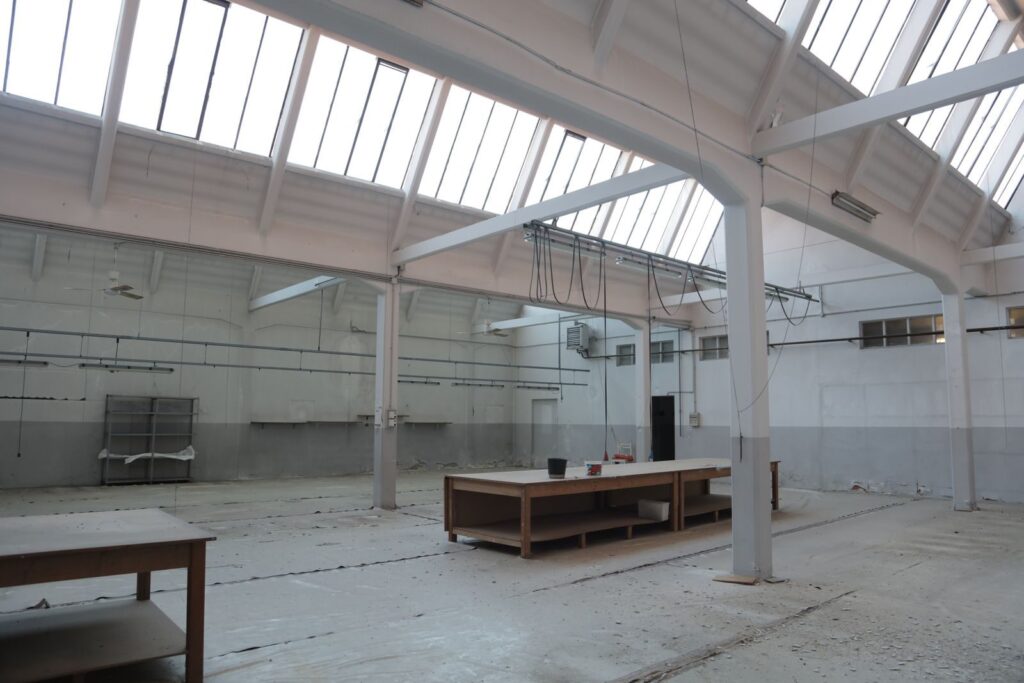
Featured image: Andrea Piacquadio on Pexels — view the original on Pexels. Stock photo of an empty warehouse, not a Kadier project.
