

 Tiếng Việt
 中文 (中国)
Hoa Phu is not an industrial cluster. It is a single park with its own boundary, its own two development phases and its own list of attracted industries. That changes the flooring question. Instead of asking what coating this region generally uses, a plant here should ask what floor each zone inside its own factory needs. This article builds that map: from the park’s transit-node position, through its industry mix, to a floor type for each production, warehouse and wet zone.
Administrative note: since 01/07/2025, the enlarged Vinh Long province has comprised the former Vinh Long, Ben Tre and Tra Vinh provinces. Hoa Phu Industrial Park remains in Hoa Phu commune, Long Ho district, Vinh Long province, and the familiar name “Hoa Phu Industrial Park (Vinh Long)” is kept here because it is how investors and contractors normally search for it.
A transit node between My Thuan Bridge and Can Tho
Hoa Phu sits along National Highway 1A in the centre of the Mekong Delta, on the corridor linking Ho Chi Minh City with the provinces south of the Hau River. What sets it apart from gateway clusters is its position midway along the My Thuan – Can Tho expressway, only about 4 km from a major interchange. Freight from Hoa Phu does not move in one direction only: farm produce from surrounding provinces flows in, finished goods go to Ho Chi Minh City, to Can Tho and to river ports across the region.
For factory floors, a transit position has a direct consequence: warehouse floors and forklift aisles carry traffic far more often than the floor of a plant serving a single line. Forklifts move in and out all day, trucks turn inside the warehouse yard, and pallets are set down and picked up many times a day. A warehouse floor at Hoa Phu therefore has to be specified as a wear zone in its own right, not by borrowing the standard of a light production area. Marking forklift lanes and pedestrian routes at coating time matters more here too, because vehicle routes cross pedestrian routes between workshops.
Two phases and an industry list of its own
The park covers about 259.32 hectares in total: Phase I of about 122.16 hectares and Phase II of about 137.16 hectares. The split matters in practice for flooring work. Plants in Phase I are mostly already operating, so the typical job is recoating, local repair or upgrading a deteriorating floor without stopping the line. Phase II and newer plots have more fresh concrete slabs, where the work starts with grinding, moisture testing and treating shrinkage cracks before any topcoat goes on.
The park’s attracted industries are grain and fruit processing, pharmaceuticals and cosmetics, consumer goods, household items and packaging, textiles and weaving, manufacture or assembly of electrical and electronic equipment, mechanical engineering serving agricultural mechanisation, building materials and ceramics, warehousing and services, plus some other low-pollution manufacturing. Each group stresses a floor differently, which is why a multi-industry plant inside one park should not coat its whole site with a single system.
A floor map, zone by zone
Food, pharmaceutical and cosmetics zones. These zones carry the highest hygiene demands. Floors must be seamless, with no joints that trap dirt, easy to wash down at the end of a shift, and slip-resistant in wash areas, fresh-material areas and equipment-cleaning areas. Packing and formulation zones should also be flat and low-dust. For this group, the self-levelling LevelFlow system is the first direction to consider for high-cleanliness zones, while ancillary areas can use a roller system to control cost without losing seamlessness.
Electrical and electronics assembly. The outstanding requirements are flatness, low dust and stability. Dust shed by a peeling floor is the enemy of components, so the coating must bond firmly and shed no surface dust. Depending on the investor’s requirements, some zones also need electrostatic control; in that case the StatGuard system should be compared directly, rather than coating with a standard product and improvising static control afterwards.
Textiles, consumer goods and packaging. Fibre dust, paper dust and packaging dust are generated continuously, alongside steady internal forklift and trolley traffic. Floors need to resist dust build-up, be easy to sweep and withstand even wear. The roller-applied RollCoat system often suits production and dry-warehouse areas in this group, because it goes down fast over medium areas and allows clear lane marking for vehicles and people.
Machinery, building materials and ceramics. This is the heavy-load and impact group: machine tools, moulds, material pallets and heavy forklifts. Floors here must be surveyed for real loads before a system is chosen, and local repair should be planned at concentrated-load points instead of expecting a thin coating to survive every impact. Raw-material storage and wet machining areas also need slip resistance and moisture resistance.
Warehousing and logistics. A transit warehouse at Hoa Phu sees high forklift density and rapid pallet turnover. Beyond wear resistance, the floor needs durable lane markings that do not peel where forklifts turn repeatedly in the same spot. Separating forklift lanes, pedestrian lanes and staging areas in the coating design reduces accidents and reduces the cost of repainting lines later.
Mekong Delta ground: measure moisture first, never coat over a problem slab
Hoa Phu shares the delta’s ground conditions: high slab moisture and locally weak soils. The common failure is not a slab collapsing under load. It is blistering after the first rainy season because slab moisture was never dealt with, or coating cracks from slight settlement that nobody surveyed. Moisture measurement and crack and settlement checks are therefore mandatory before coating, for large and small plants alike, on old floors and new slabs alike.
If slab moisture exceeds what the chosen system allows, a moisture-barrier primer or another suitable moisture treatment must come before the main coats. Coating directly over a damp slab to meet a deadline is a short-term saving and a long-term expense, because a debonded coating has to be ground off and the whole zone redone. For an operating plant, work should be phased zone by zone while other zones keep running, and the water-based AquaBase system with low VOC is worth prioritising near production lines and finished-goods stores to limit odour affecting production.
Choosing a system: map it by zone, not one system for the whole plant
The Hoa Phu problem, then, is not choosing one coating for the whole park. It is drawing a system map zone by zone before work starts, and accepting each zone against its own standard: self-levelling for clean zones, antistatic comparison for electronics, roller systems for production and dry stores, and low-odour water-based systems for operating areas. That approach avoids both wastes: premium coating where it is not needed, and standard coating where demands are high, followed by rework.
For the wider regional picture, see the overview of the Tien Giang and Vinh Long industrial clusters. That article covers several parks; this one goes deep into a single park, Hoa Phu, with its own industry list and transit-node position.
Frequently asked questions
What floor does a food or pharmaceutical zone at Hoa Phu need?
A seamless, easy-to-clean floor, slip-resistant in wet zones and flat and low-dust in packing and formulation zones. Self-levelling systems are usually the first direction to consider for high-cleanliness zones; ancillary areas can use a roller system.
Does an electronics assembly zone always need an antistatic floor?
Not always. It depends on the investor’s requirements and the type of components. Where electrostatic control is required, the antistatic system should be chosen from the start, because temporary measures applied after standard coating rarely give stable performance.
How is a transit warehouse at Hoa Phu different from an ordinary store?
In forklift density and pallet turnover, driven by its position between My Thuan and Can Tho. Warehouse floors need wear resistance, durable lane markings and a clear separation of vehicle and pedestrian routes from the coating design stage.
Can fresh concrete be coated with epoxy straight away?
It should not be coated before the slab meets its conditions. New concrete still needs grinding for grip, moisture testing and treatment of shrinkage cracks where they appear. Waiting for the slab to be ready takes longer than coating early, but it costs far less than stripping a peeled coating and redoing the whole floor.
How is an epoxy quotation for a Hoa Phu plant calculated?
Kadier quotes after a site survey, based on the area of each zone, whether the floor is old or new, the system chosen per zone, and whether work is phased or whole-site. This article gives no fixed price, because prices circulating online do not reflect the actual condition of any individual floor.
Which phase of Hoa Phu is your plant in, and which zone in your plant carries the heaviest load? Send the industry, the size of each zone and the current floor condition through the quotation page or the contact page. Direct contact for Kadier: hotline and Zalo on the same number 0899355489, WeChat wxid_95o54joujyrr12.
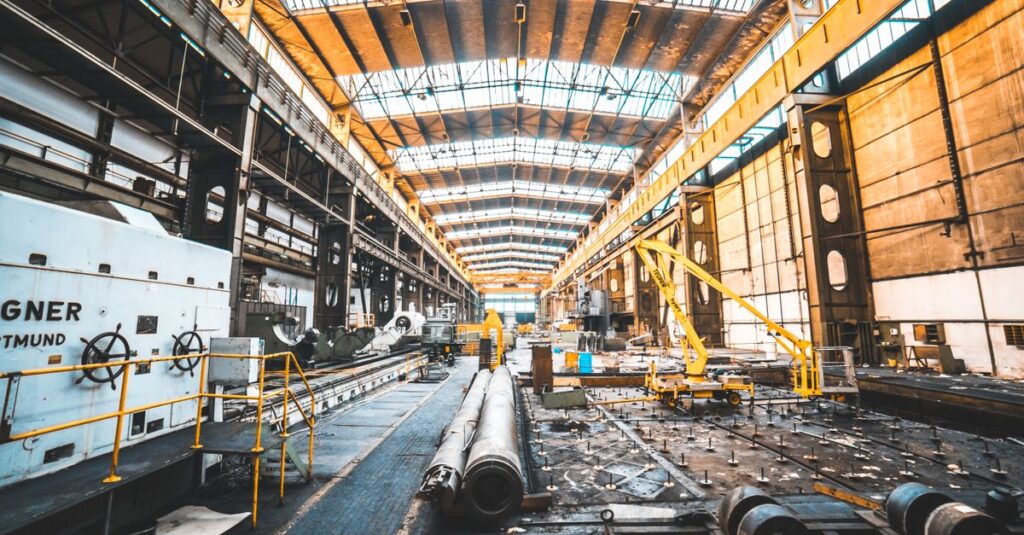
Illustration image: Pexels stock photo 1468390 — a general view of an industrial hall, used as a general illustration and not a record of a Kadier project at Hoa Phu.
