

 Tiếng Việt
 中文 (中国)
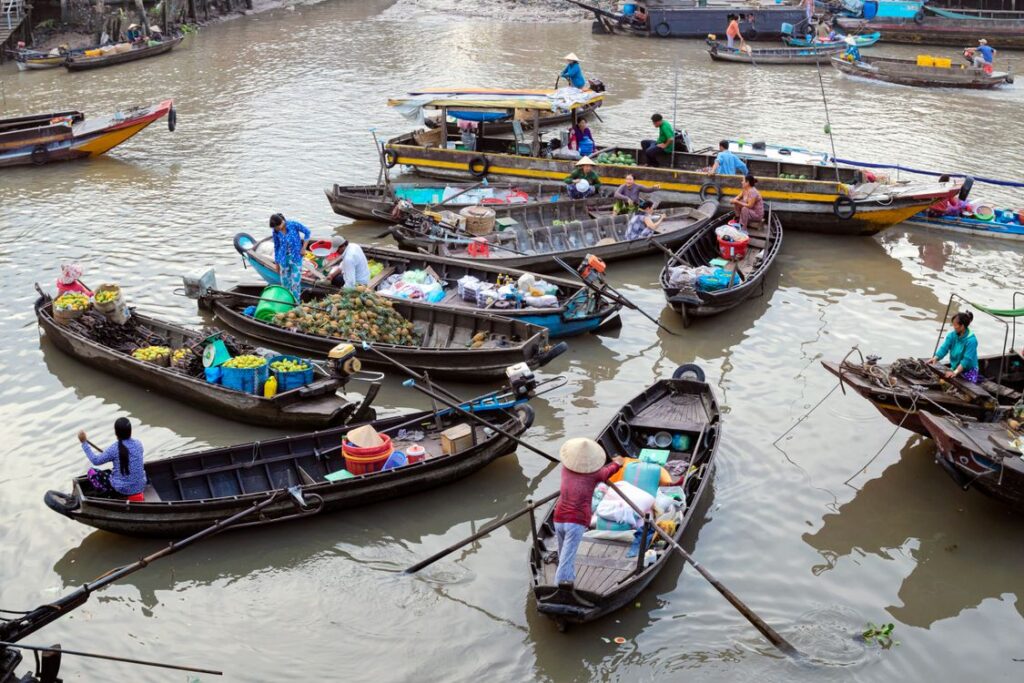
The Mekong Delta is not an epoxy flooring market for heavy industry or electronics. It is a market of deep processing and the cold chain: rice, seafood and fruit are pre-processed, processed, kept cold and exported, and factory and cold-storage floors are one link in that chain. This article is a regional overview: it compares the region’s clusters, sets out a framework for choosing coating systems along the agricultural and seafood value chain, and does not repeat the detail of the Can Tho cluster article or turn itself into a disguised coastal-cluster article.
Administrative note: from 01/07/2025, the former Tien Giang area now belongs to Dong Thap province; the new Vinh Long province comprises the former Vinh Long, Ben Tre and Tra Vinh; and the new Can Tho City comprises the former Can Tho, Soc Trang and Hau Giang. Old province names in this article are only familiar geographic cluster names, not current administrative units. More generally: the new Ho Chi Minh City comprises the former Ho Chi Minh City, Binh Duong and Ba Ria – Vung Tau; the new Tay Ninh comprises the former Tay Ninh and Long An; the new Dong Nai comprises the former Dong Nai and Binh Phuoc; the new Dong Thap comprises the former Dong Thap and Tien Giang; the new Vinh Long comprises the former Vinh Long, Ben Tre and Tra Vinh; and the new Can Tho City comprises the former Can Tho, Soc Trang and Hau Giang.
Comparison table of clusters in the region
| Cluster | Role in the region | Main flooring problem |
|---|---|---|
| Central Can Tho | Deep-processing and cold-chain centre of the whole region, tied to river ports and logistics | Seafood wet zones, cold storage, weak and high-moisture ground, renovating old plants alongside floors for new plants |
| My Tho, Tan Huong and Binh Minh gateway | Northern gateway of the region, nearest to Ho Chi Minh City via the Trung Luong expressway | Small and medium workshops, animal feed and medium-scale processing, multi-industry workshops in a small area |
| Former Long An corridor (now part of Tay Ninh) | Corridor linking the Mekong Delta with Ho Chi Minh City and river ports | Warehousing, pharmaceuticals needing clean floors, and river-port-linked processing, filled-ground slabs |
The table above only summarises each cluster’s role and main flooring problem for comparison. The detail of each cluster sits in its own cluster article; this overview focuses on three region-level flooring problems and the framework for choosing coating systems along the value chain, rather than retelling each industrial park.
Three region-specific flooring problems
The first problem is weak, high-moisture, acid-sulphate and saline ground. It is the region’s most important problem, because it decides the lifespan of every coating system whatever the industry. Thick weak clay, naturally high moisture and coastal acid-sulphate and saline contamination raise the risk of blistering and coating cracks if moisture is not measured, settlement is not checked and a rising-damp barrier primer is not used when needed. At region level, this problem is not only an application technique but a precondition: without a slab that meets the standard, there is no durable floor.
The second problem is seafood and food wet zones. Salt water, fish oil, mild organic acids and frequent washdowns create their own corrosive environment, demanding seamless floors that resist mild chemicals, resist slipping and drain well. The third problem is cold storage and the export cold chain: thermal shock, condensation, slip resistance on cold floors and application and curing schedules suited to cooling before operation. The three problems link into one chain: processing creates the product, cold storage preserves it, logistics moves it to ports and markets, and floors must serve all three links.
Choosing a coating system by function along the region’s value chain
Along the value chain, food and seafood processing zones need seamless, easy-to-clean floors with wet-zone slip resistance, usually the LevelFlow self-levelling system for zones demanding high cleanliness and flatness. Dry warehouses, finished-goods warehouses and forklift aisles need wear-resistant systems with lane markings and slip resistance, usually the RollCoat roller system. Cold-storage zones need a system confirmed by the manufacturer as suitable for low-temperature conditions, plus slip resistance. Odour-sensitive zones or zones near food packing may consider the AquaBase water-based system with low VOC. Quality-inspection or electronics assembly zones, if they require electrostatic control, need the StatGuard system for exactly those zones.
The point to stress is that the cold chain is not a single coating system. One export processing plant may need three to four different coating systems for its processing zone, packing zone, cold storage and dry warehouse. Mapping coating systems zone by zone before application is the most important step — more important even than choosing a paint brand.
Working in the rainy and flood seasons: moisture measurement, schedules and curing
The rainy and flood seasons are the region’s distinctive working conditions. Rising slab moisture, rising groundwater and high air humidity all raise the blistering risk if work is rushed. Schedules must therefore allow for the season: measuring moisture more carefully in the rainy season, prioritising rising-damp treatment, covering indoor–outdoor transition zones and never forcing a deadline by coating over a slab that has not yet met the conditions.
Regional logistics is also tightly tied to processing and exports: according to information from the Ministry of Industry and Trade, Can Tho has three operating logistics centres, including an agricultural export logistics centre, and the region’s direction is to reduce dependence on Southeast ports through an inter-regional network. For an investor running a chain across many provinces, that means warehouse and processing floors in many locations need the same survey and acceptance standard, so quality does not depend on which province the application team is in.
Frequently asked questions about the Mekong Delta market
A floor blistered after the first rainy season: why, and how is it fixed?
The most common cause is slab moisture that was never thoroughly treated before coating. Moisture from the slab pushes the coating up into blisters, which then break into peeling patches after the first rainy season, when slab moisture peaks. The correct remedy is to grind off the damaged area, measure moisture again, use a suitable rising-damp barrier primer and recoat when the slab meets the conditions. Adding another coat of paint over a blistered spot without treating the moisture only repeats the old failure cycle.
Can a seafood processing plant and a cold storage share one coating system?
They should not. A processing zone needs seamlessness, resistance to salt water and mild cleaning chemicals, and wet-zone slip resistance; a cold storage needs low-temperature tolerance per the manufacturer’s documentation, slip resistance on cold floors and its own curing schedule. Sharing one system across both zones leaves at least one zone below standard.
What extra slab notes apply to workshops in coastal areas?
Beyond the region’s shared high moisture and weak ground, coastal areas also risk acid-sulphate and saline contamination, which affect adhesion and coating durability. Coastal slab surveys must therefore record signs of acid-sulphate and salinity clearly and include suitable slab treatment before coating, instead of applying the inland process unchanged.
How should a multi-province processing chain standardise its floors?
Standardise the survey, moisture measurement, zone-by-zone system selection and acceptance process, but still let each location keep its own coating map by industry and slab condition. Standardising the process keeps quality consistent; standardising a single coating system for every location forces the wrong system onto many zones.
How is an epoxy flooring quotation for the Mekong Delta region calculated?
Kadier quotes after an on-site survey, based on area, slab condition, the coating system for each zone — especially wet zones and cold storage — and the schedule by season. This article gives no specific prices, because price lists circulating online are not Kadier prices and do not reflect the actual slab condition of each plant.
Request advice and a quotation: send the processing-chain or cold-storage location, industry, area and which wet or cold zones need coating via Kadier’s quotation page or contact page. Direct contact: hotline/Zalo 0899355489, WeChat wxid_95o54joujyrr12. Illustrative photo: Pexels stock photo (photo ID 5218142), a general illustration of Mekong Delta river trade, not a Kadier project and not tied to any specific place name.
