

 Tiếng Việt
 中文 (中国)
Forklifts running every day, heavy pallets stacked in many layers, wheels pivoting in one spot — after a while, the epoxy floor shows sunken wear tracks along traffic lanes, cracks at turning points, and peeled patches where pallets sat for a long time. This is an article about diagnosing and repairing damage from operating loads, different from the article on choosing a floor for forklifts from the start. If your floor has not been coated yet, read Epoxy Flooring for Forklift and Heavy-Truck Floors to choose a system; this article is for floors already in use and gradually failing.
How do forklifts and pallets damage floors?
1. Concentrated load through small wheels
Forklifts do not harm floors because of their total weight, but because that weight is concentrated through the very small contact area of their wheels, especially solid wheels, unevenly worn wheels, or wheels with stones or metal stuck to them. High local pressure causes dents, surface wear, and cracks spreading from the contact point.
2. Lateral force when turning, braking, and accelerating
Turning points, sharp corners, and braking spots before warehouse doors are where tearing lateral forces are greatest. The coating there suffers both compression and shear, so it peels at edges, scratches deeply, and cracks in a fan pattern more readily than on straight runs.
3. Long-term static load from heavy pallets
A pallet left in one place for weeks, feet shimmed unevenly, load leaning to one side — all create a zone under continuous compression. The usual marks are slight dents and loss of gloss, then cracks around the support feet when the pallet is repeatedly lifted and set back down.
4. Impact and dragging
Fork tines scraping the floor, pallets dragged instead of fully lifted, goods dropped from a low height — these impacts do not destroy a floor in one go, but they create micro-weak points where wear and cracking gradually develop.
Reading the marks to diagnose correctly
- Sunken wear along straight lanes: load and frequency exceed the current coating system’s wear resistance, or the coating is thinner than the traffic zone requires.
- Cracking and peeling at turning points: concentrated lateral force; check both the wheels (wear, stuck hard objects) and the coating adhesion at that spot.
- Dents and cracks around pallet feet: static load and uneven shimming; check whether the actual load exceeds the zone’s design load.
- Deep scratches, torn patches: usually fork scraping, dragging, or hard objects stuck to wheels — fixing operations matters as much as fixing the floor.
Distinguish from other damage types: surface scratches alone, without dents or cracks, may only need surface repair — see Scratched Epoxy Floor: Spot Repair or Full Recoat?. Widespread peeling that does not follow traffic lanes suggests a weak substrate or moisture, not load — see Epoxy Floor Peeling from a Weak Substrate: Causes and Fixes.
Repair by severity
Light damage: surface wear, shallow scratches, no deep cracks
Light grinding to clean, patching, and locally recoating with the current system and color, preferably outside peak hours so the new coat has enough curing time before trucks run again. The article Localized Epoxy Floor Repair: Patching and Recoating by Area gives the general framework for this kind of repair.
Moderate damage: dents and cracks in traffic lanes and turning points
Cut out the damaged zone down to sound substrate, treat the substrate, fill, and recoat at a thickness suited to the traffic zone — not thinly to match the general floor level. At the same time, inspect and replace worn wheels and clean out stuck stones; otherwise the freshly repaired zone will fail by the same mechanism.
Severe, widespread, or repeatedly recurring damage
This signals that the current coating system no longer suits the actual operating loads. Re-survey: truck loads, frequency, wheel types, turning points, pallet loads — then upgrade the coating system for the traffic zone (for example a thicker self-leveling system or a higher wear-resistant system) instead of patching repeatedly with the same old system. The system pages LevelFlow — Self-Leveling and RollCoat — 3-Coat Roller System describe the general framework of the systems; the specific choice must rest on an actual survey and supplier data, since Kadier’s own data has no published TDS.
Reducing damage through operations, not just repair
- Plan traffic lanes: mark fixed traffic lanes, separate turning lanes from straight runs, and avoid having every truck turn at the same point — see Line Marking and Zone Painting for Factory Floors.
- Inspect wheels regularly: unevenly worn, cracked wheels, or wheels with stones or metal stuck to them are the cheapest cause to eliminate, yet often overlooked.
- Shim pallets evenly, avoid lopsided loads: use load-spreading pads where heavy pallets sit long-term, and rotate placement to avoid compressing one point for too long.
- Ban dragging and fork scraping: require pallets to be fully lifted before moving; one fork scrape can weaken a whole floor zone.
- Floor maintenance schedule: patch deep scratches and small cracks as soon as they are found; left alone, water and dust entering the gaps will spread the damage and raise repair costs.
Frequently asked questions
How many tonnes of forklift load can an epoxy floor carry?
There is no single figure for all epoxy systems. Load capacity depends on the coating system, thickness, concrete substrate strength, wheel type, and operating frequency. A figure only means something when tied to a specific system and specific operating conditions, so an actual truck load should not be judged against a generic threshold read online.
Does locally patching a traffic lane last?
Yes, if the patched zone is cut down to sound substrate, coated at the right thickness for the traffic zone, and the operating cause (wheels, turning point) has been dealt with. A thin patch over a damaged zone without treating the root cause usually fails again quickly.
When to recoat fully instead of patching spot by spot?
When damaged zones have spread and joined into a network, or the same spot fails again after every patch. At that point the cost of repeated patching plus warehouse downtime will exceed the cost of recoating a larger zone with a more suitable system.
If your warehouse is wearing into sunken lanes or cracking at turning points, describe the truck type, running frequency, and damage locations via the quote page or contact Kadier for advice on the right survey and repair approach.
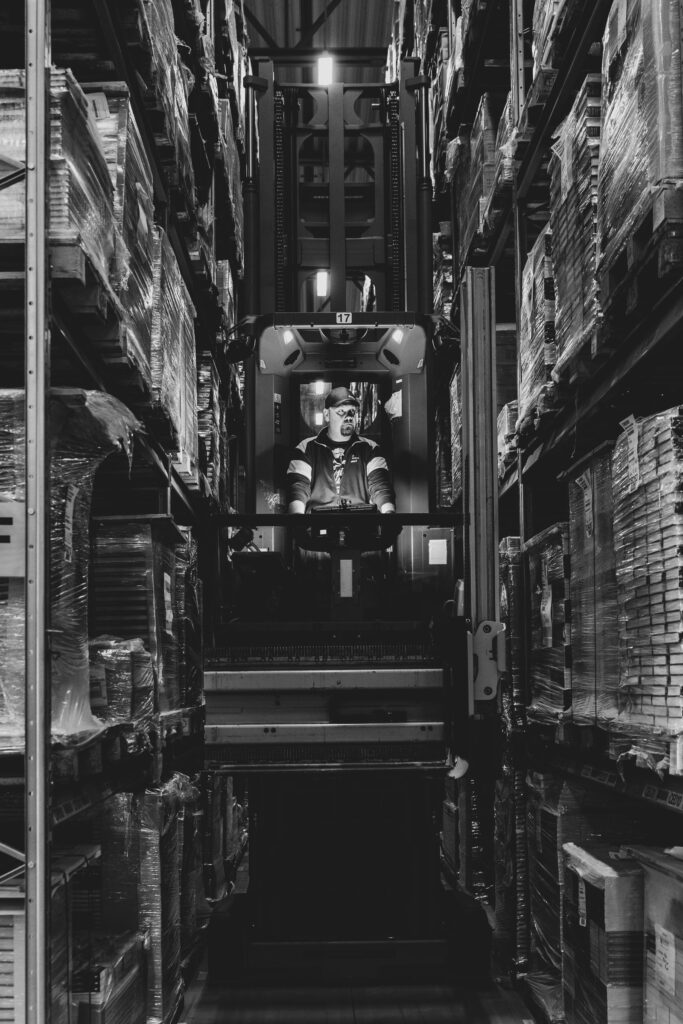
Illustration: a forklift operating in a warehouse — concentrated wheel loads and turning forces are the two main damage mechanisms. Photo: Jimmy Nilsson Masth / Pexels. Not an actual Kadier project.
