

 Tiếng Việt
 中文 (中国)
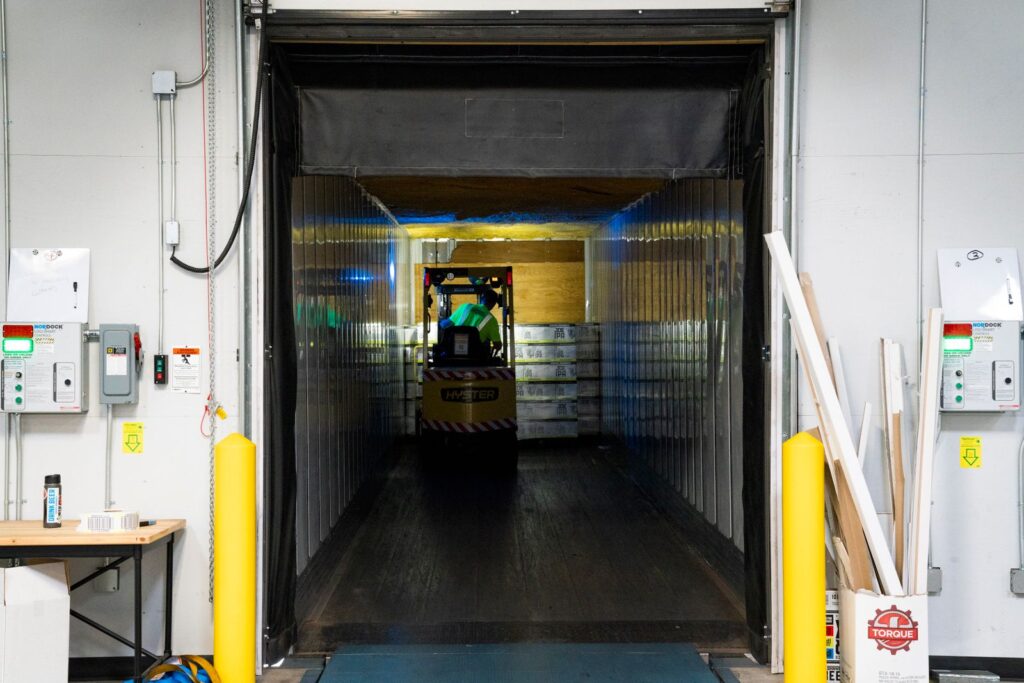
This article covers one specific angle: floors that carry forklifts and heavy trucks, considered in terms of vehicle load and how vehicles actually wear the floor. This angle differs from the article on machine workshops in general, which covers oil and grease, metal chips and many machining processes, and it differs from the article on high-abrasion floors in general, which covers every source of abrasion, from foot traffic and dragging to vehicles. Here, the sole focus is vehicles: where forklifts travel, where they turn, where they stop, what type of wheels they have, and along which paths load is transmitted to the floor.
Featured image: ELEVATE on Pexels.
How forklifts and trucks wear floors in their own way
Unlike pedestrians, who spread a light load evenly, a forklift concentrates its entire load onto the very small contact area of its wheels. When a forklift carries a heavy pallet, the load on each wheel increases; when it turns on the spot, a wheel bears load while twisting sideways across the floor surface; when it brakes hard or accelerates at a warehouse door, lateral force drags the coating in the direction of travel. Damage caused by vehicles therefore tends to appear along tracks: ruts worn along the main aisles, edge peeling at turning points, and swirl scratches where a vehicle spins its wheels in place.
Heavy trucks create a different kind of pressure. Trucks usually move slowly across yards and warehouse doors, stand for a long time at loading points, and transmit load through dual or single wheels with high contact pressure. Truck parking points, warehouse door thresholds and the transition between the outdoor yard and the indoor floor are prone to cracking, edge settlement and coating peeling if the substrate and the coating are not designed as one system. The indoor warehouse floor and the outdoor yard also face different weather conditions, so the same solution should not be applied to both without a separate survey of each.
Read the traffic flow before choosing a floor
Before choosing a coating system, the actual vehicle flow needs to be mapped: what type of forklifts run on the floor, how often each aisle is used, where vehicles turn, where loading stops happen, and whether any stretch of vehicle traffic overlaps with pedestrian routes. A warehouse with a few forklifts running infrequently is very different from a distribution centre with vehicles running continuously over many shifts. Frequency and load concentration points matter no less than the load of a single vehicle, because floor wear is the accumulated result of thousands of vehicle passes, not of a single trial run.
Wheel type also has a direct effect. Solid wheels, pneumatic wheels, polyurethane wheels and rubber wheels differ in hardness and contact area, and produce different wear patterns on the same floor. A floor with foreign objects such as nails, metal fragments or gravel caught in wheel grooves will suffer much deeper scratches than a floor that is swept regularly. A vehicle-floor solution therefore always goes together with a solution for cleaning the vehicle routes, not merely with choosing a thicker coating.
Weak points commonly found on vehicle floors
Main aisles and warehouse door entrances: ruts worn along the wheel tracks, because vehicles repeat exactly the same path. The usual response is to widen the traffic distribution where possible, mark vehicle routes clearly, and check wear periodically along the tracks, instead of waiting for wear to spread across the whole floor.
Turning points and on-the-spot turning positions: peeling and surface swirling where vehicles turn, especially when a vehicle turns many times a day at the same point. Pressure can be reduced by providing a wide turning point, limiting on-the-spot turning at a single point, and choosing a coating system with suitable adhesion and hardness according to the TDS.
Construction joints, expansion joints and door edges: wheels bounce and load suddenly when crossing a joint, causing edge chipping and coating peeling around the joint. Treating joints and door edges correctly before coating is a step that cannot be skipped; coating over an already damaged joint only hides it temporarily and will peel again once vehicles run over it.
Parking and loading points: prolonged static load while a truck stands for loading, combined with spilled oil and grease, shortens the life of the coating at the parking point. This area needs a separate survey, set apart from the general warehouse floor if truck parking is frequent.
Choosing a coating system for vehicle floors: a general framework, no invented load figures
This article deliberately does not state a Kadier-specific tonnage figure, because the allowable load of a coating system depends on the concrete substrate, the thickness of the coating system, the wheel type and the conditions of use, and is only meaningful when checked against the official TDS of the exact product together with the results of a substrate survey. Writing a single general tonnage figure for every warehouse would mislead and could lead to choosing the wrong coating system.
As a general framework: areas with infrequent vehicle traffic and moderate loads are often considered for a roller-applied system such as RollCoat, because it is easy to apply and to repair locally along worn tracks; areas with dense vehicle traffic that require a flat and even floor surface are often considered for a self-levelling system such as LevelFlow. Which system is suitable, what thickness is needed, and whether reinforcement is required at turning points must be decided after a substrate survey, a vehicle-flow survey and checking against the official Kadier TDS.
It is also important to distinguish clearly: the abrasion resistance of the surface coating is different from the load-bearing capacity of the whole floor system, which includes the concrete substrate, the primer and the coating. A hard surface coating on a weak substrate will still crack and peel when heavy vehicles run over it. A substrate survey — flatness, strength, cracking and moisture — is therefore a mandatory step before discussing the name of a coating system.
Maintaining vehicle floors
Vehicle-floor maintenance should follow the vehicle tracks, not a generic schedule. Inspect the main aisles, turning points and door edges periodically; clear foreign objects from vehicle routes every day; and repair locally as soon as edge peeling or rut wear appears, before wheels dig deeper. Once a worn track has spread widely, local recoating along the track is usually more effective than waiting to recoat the entire floor in one long warehouse shutdown.
Conclusion
A floor for forklifts and heavy trucks must be designed from actual vehicle flow: aisles, turning points, parking points, wheel types and running frequency. This article stays on this vehicle-load angle, distinct from the overall solution for machine workshops and from the topic of high abrasion in general. The allowable load of each Kadier coating system is not invented here; that figure should only be taken from the official TDS, after a survey of the substrate and vehicle flow of the project.
Request a consultation on a forklift and heavy-truck floor solution, including a survey of vehicle flow and the actual floor at your warehouse.
