

 Tiếng Việt
 中文 (中国)
Phuoc Dong Industrial Park does not present one generic flooring question for the whole province. It presents the question of a single, very large park that holds two generations of factories at once: plants that have been operating for years, and new plots still waiting for their first buildings. The park sits in the Go Dau – Trang Bang area of Tay Ninh province, inside the Phuoc Dong – Boi Loi industrial–urban–service complex, with about 2,190 hectares of industrial land and Saigon VRG Investment Corporation as its developer. Phase 1 is reported to be about 90% leased, while Phase 2 is being leased for higher-technology, less labour-intensive industry. Those two generations cannot share one flooring approach, and this article stays inside that distinction.
Readers who need the wider cluster picture can read the Tay Ninh industrial cluster and border gates overview. Within Phuoc Dong itself, the practical question is different: which generation of the park your plant belongs to, what it makes, and which lanes its forklifts run every day.
Scale changes how the floor plan is drawn
With roughly 2,190 hectares of industrial land, Phuoc Dong allows large plots and long production buildings. The direct consequence for flooring is that vehicle routes stop being short runs around a gate and become long corridors through the plant: forklifts carry finished goods from the end of the line to a buffer warehouse, then from that warehouse to the loading area. Wear therefore concentrates on fixed lanes and turning points instead of spreading evenly across the floor. A floor plan for Phuoc Dong has to mark the main forklift lane, the turning points and the loading area before any coating system is discussed.
The park location reinforces the role of the buffer warehouse. Phuoc Dong lies on the DT782 corridor, with connections to National Highway 22 and the Ho Chi Minh City – Moc Bai expressway route, about 20 km from the Moc Bai international border gate. Finished goods from many plants here wait for truck schedules and border clearance, so the buffer warehouse is a working zone with its own rhythm: high pallet racking, constant forklift turning and pedestrian routes that must stay separate from vehicle routes. Its floor deserves a survey of its own, covering loads, vehicle frequency and lane marking, rather than borrowing the production floor standard.
Phuoc Dong industries and their floors, zone by zone
Textiles, garments, leather and footwear: fibre dust and end-of-shift cleaning
Textiles, leather and related products, and apparel are among the priority industries for the development space where Phuoc Dong is the nucleus. In a textile, garment or footwear plant, fabric dust and loose fibres are generated throughout the shift and settle into every rough surface. The floor that suits this group is flat and seamless, with no tile joints to trap dust, so the end-of-shift cleaning team can sweep and mop quickly without scrubbing joint by joint. Aisles between machine rows and raw-material trolley routes need extra grip, because dry fabric dust on a glossy floor lowers friction. For general production areas and aisles, the roller-applied RollCoat system is usually considered first, while areas that need a higher degree of flatness for fixed machinery can be looked at through the self-levelling LevelFlow system.
Rubber, tyres, plastics, mechanical engineering and metal processing: oil and point loads
Alongside textiles, Phuoc Dong concentrates rubber manufacturing, tyres, plastics, mechanical engineering and metal processing, plus food and consumer goods. This group loads the floor differently: oil leaks around presses and maintenance areas, abrasion concentrated where moulds and fixed machines stand, and heavy point loads at rack feet and forklift stopping points. Before any coating goes down, the oil contamination level of these floors has to be checked, because oil soaked deep into concrete breaks the bond of a coating that is simply ground lightly and painted over. Heavily oil-affected areas need dedicated oil treatment and an adhesion check; cleaner general areas can be done bay by bay with RollCoat, so that when one bay wears out, only that bay is treated instead of recoating the whole plant.
Food and consumer goods: wet zones, drainage and phased work
For food processing and consumer goods, the centre of the flooring question is the wet zone: water, grease and cleaning solutions appear every day, and daily washing exposes any badly finished detail. The practical requirements are a seamless surface, slip resistance when wet on walkways and work areas, drainage that leaves no standing water at work positions, coved skirting and sealed joints. Many plants in the park cannot stop a whole line just to redo a floor, so phased work area by area is the usual approach; where a section sits next to a running line, the water-based AquaBase system is worth considering. One limit has to be stated plainly: a coating is only one infrastructure component of a plant, and any certification of a plant belongs to the whole management and operating system of that plant itself, not to the floor coating alone.
Phase 2: new buildings, new slabs and higher cleanliness needs
Phase 2 of Phuoc Dong is aimed at electronics assembly and components, computers and semiconductors, cables and telecom materials, electrical equipment, pharmaceuticals, medical devices, precision mechanics, new materials and nano-technology. For a new building on these plots, the flooring question reverses compared with Phase 1: the concrete is new, but it still has to be ground for grip, tested for moisture and repaired for shrinkage cracks where they appear, because skipping preparation on the grounds that the slab is new is a common cause of early peeling. Assembly areas need flat, seamless, low-dust floors, and LevelFlow self-levelling is the reference direction. Where a specific plant has an electrostatic control requirement, the StatGuard system should only be included after the electrostatic protection area has been fixed on the drawings, together with earthing and testing to that plant’s own internal standard — no single threshold can be applied to every plant.
System direction by functional zone in a Phuoc Dong plant
| Zone | System direction | Survey point that decides |
|---|---|---|
| Textile, garment and footwear areas with heavy fibre dust | Flat seamless surface, extra grip on aisles; RollCoat or LevelFlow depending on the flatness required | End-of-shift dust load, grip under dry dust, condition of old joints |
| Rubber, plastics and mechanical areas with oil exposure | Oil treatment first, then bay-by-bay RollCoat | Oil contamination level, adhesion, point loads at machine feet |
| Wet food and consumer-goods zones | Seamless, slip-resistant when wet; AquaBase for phased work | Drainage, coved skirting, sealed joints, slab moisture |
| New Phase 2 buildings needing clean, flat floors | LevelFlow self-levelling; StatGuard only where an ESD scope is fixed on drawings | Flatness, new-slab moisture, shrinkage cracks, earthing |
| Export buffer warehouse, forklift lanes, loading areas | Separate survey by lane, then system by load | Loads, vehicle frequency, turning points, lane marking |
The table is an orientation framework, not a price list, and it does not replace a survey of the actual plant floor. The final system choice is made only after moisture, cracks, old oil and flatness have been measured in that exact plant.
Old Phase 1 floors and new Phase 2 concrete need different preparation
In Phase 1, many plants have produced for a long time, so old floors often carry cracked joints, oil stains and patches where an old coating has peeled. The deciding step there is to establish how well the old coating still bonds: areas that still bond firmly need only grinding and local treatment before recoating, while areas with widespread peeling have to be stripped completely. In Phase 2, new concrete has to be prepared carefully before coating, and the programme should not be forced by painting over a slab that has not met its moisture condition. In both generations, indoor–outdoor transition points deserve closer moisture checks, because rain and road dust enter there first. The acceptance file should be started at the beginning, with the floor survey record, the coating type and number of coats per zone, thickness measurements at many points, and a record of peeling and ponding found after the work.
Buffer warehouses, yard transitions and the export rhythm of Phuoc Dong
A buffer warehouse for an exporting plant in Phuoc Dong works to the rhythm of trucks heading for the border gate, so its floor has to carry fully loaded forklifts turning constantly and heavy pallets dragged across the surface. At acceptance, the main forklift lane should be load-tested rather than judged by looking at the surface overall. Transition areas between inside and outside need separate attention: areas under direct sun should not share the standard of indoor areas, and drainage must prevent water standing after rain, because standing water both creates slip risk and shortens coating life. Clear lane marking in the buffer warehouse is part of the floor itself, since it keeps forklift routes apart from pedestrian routes during peak dispatch hours.
Frequently asked questions about epoxy flooring in Phuoc Dong Industrial Park
Should one coating system cover a whole Phuoc Dong plant, warehouse included?
No. Three floor types inside one plant — the making floor, the wet-process floor and the dispatch-warehouse floor — work under very different loads, vehicle counts and contact with water and oil, so each type needs its own plan. The dispatch warehouse and its forklift lanes in particular have to be looked at on their own, with attention to the busiest lane and the places where trucks turn.
Can an oil-stained Phase 1 floor be recoated?
That depends on the test results for each separate area. Lightly oil-affected concrete that has been treated and passes an adhesion check can be recoated, but deeply oil-soaked concrete that is only lightly ground and then painted will peel early. The decision cannot be made remotely; it rests on the recorded oil locations, crack levels and slab moisture at the plant.
Can new Phase 2 concrete be coated straight after pouring?
It should not be coated before the slab meets its conditions. New concrete still needs grinding for grip, moisture testing and treatment of shrinkage cracks where they appear. Waiting for the slab to be ready takes longer than painting early, but it costs far less than stripping a peeled coating and redoing the whole floor.
What details should a Phuoc Dong plant send so the advice fits its real floor?
When contacting us, a plant should state whether it sits in Phase 1 or Phase 2 of the park, what it manufactures, the size of each zone, which zones are wet, which zones forklifts or trucks use and how often, and whether the existing floor is an old used floor or new concrete. From that information, an adviser can sketch a suitable system direction before any site survey takes place.
Which phase of Phuoc Dong is your plant in, and which zone in your plant carries the heaviest load? Send the industry, the size of each zone and the current floor condition through the quotation page or the contact page. Direct contact for Kadier: hotline and Zalo on the same number 0899355489, WeChat wxid_95o54joujyrr12.
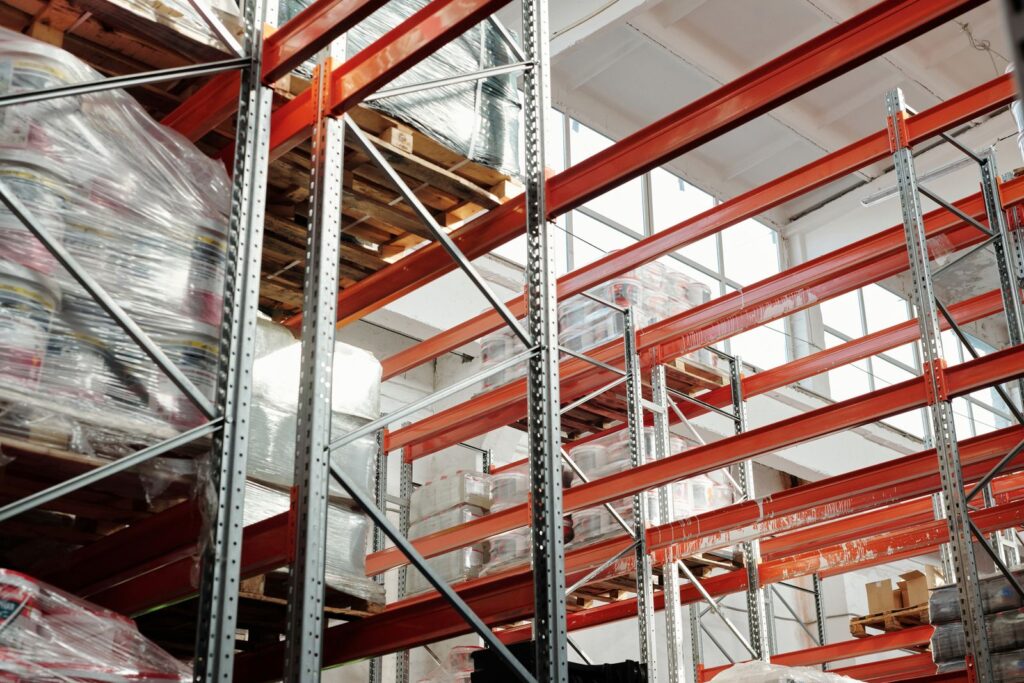
Illustration image: Pexels stock photo 4487363 — a warehouse with pallet racking, used as a general illustration and not a record of a Kadier project in Phuoc Dong.

Pingback: Epoxy Flooring for Hiep Thanh Industrial Park (Tay Ninh): New-Build Floors for a Green, Smart Park
Pingback: Epoxy Flooring for Trang Bang Industrial Park (Tay Ninh): Recoating Floors in a Fully-Filled Park Since 1999