

 Tiếng Việt
 中文 (中国)
The industrial park cluster around Di An, Thuan An and Thu Dau Mot sets a demand few other clusters set to the same degree: a floor must not only be durable, it must also pass an FDI-style acceptance inspection. Foreign investors, EHS managers and quality managers often check a floor against their own checklist: thickness measured at many points, load tests, handover records and the cleanliness standard of each zone. A good-looking floor without clear acceptance documentation can still fail.
A note on place names: the former province names used in this article are geographic cluster names only, not current administrative units. Since the merger effective 01/07/2025, the new Ho Chi Minh City comprises the former Ho Chi Minh City, Binh Duong and Ba Ria – Vung Tau; the new Tay Ninh comprises the former Tay Ninh and Long An; the new Dong Nai comprises the former Dong Nai and Binh Phuoc; the new Dong Thap comprises the former Dong Thap and Tien Giang; the new Vinh Long comprises the former Vinh Long, Ben Tre and Tra Vinh; and the new Can Tho comprises the former Can Tho, Soc Trang and Hau Giang. This article uses the name Binh Duong only so readers can recognise the VSIP and Song Than cluster; it does not use the old name as a current administrative unit.
Two extremes in one cluster: VSIP and Song Than
VSIP is oriented towards clean industry and high technology, with electronics and components, precision engineering, pharmaceuticals and medical devices, automotive and supporting industries, high-tech food and logistics. Infrastructure inside the park is built to international standards, so plant floors here are usually required to be flat, seamless and low-dust, with anti-static control where needed. Floors for pharmaceuticals and food instead emphasise seamless surfaces, easy cleaning and resistance to frequent washdowns.
Song Than is the opposite extreme: traditional multi-industry parks with textiles, footwear, wood and furniture, engineering, electrical and electronics, food, plus warehousing and logistics. The area also has a distinct advantage in Song Than railway station and its rail ICD, which drives demand for heavy-load warehouse floors, anti-slip surfaces and marked lanes for forklifts and trucks coming and going continuously. These two extremes mean the Binh Duong geographic cluster cannot use one common floor answer: in the same cluster, the floor problem of an electronics plant and the floor problem of an ICD warehouse barely overlap.
Floors for electronics and precision engineering: anti-static and low dust
Electronics and precision engineering plants need a flat, low-dust floor that stays stable while precision equipment moves. Where an area has an anti-static requirement, the direction is the StatGuard anti-static system, but the anti-static area must be drawn clearly on the floor plan from the outset, with earthing and testing following that particular plant’s own procedure. Each plant has its own standard, so this article does not set any single threshold or common standard for all electronics plants.
For general production areas needing a flat, seamless surface, the LevelFlow self-levelling system is the suitable direction. See also the floor requirements framework for electronics plants in Epoxy Flooring for Electronics Plants: Anti-Static and Cleanroom Requirements. Fabric dust and production dust also need to be factored in: a low-dust, easy-to-wipe floor makes end-of-shift cleaning faster and more consistent than raw concrete.
Floors for pharmaceuticals and food: seamless, easy to clean, washdown-resistant
Pharmaceutical and high-tech food areas in VSIP need seamless floors with no joints that trap dirt, resistance to frequent washdowns and no deep absorption of soiling. Coved skirting, sealed joints and wet areas separated from dry areas are details that decide long-term cleanability, no less important than the main coating. See also the pharmaceutical floor framework in Epoxy Flooring for Pharmaceutical Plants: GMP Standard. To be clear: an epoxy floor is only one part of the infrastructure; whether a plant meets its standard depends on the plant’s entire management and operating system, not on the coating alone.
Floors for Song Than ICD warehouses and logistics: heavy loads and high frequency
A warehouse linked to an ICD and railway station carries very different loads from a production floor: fully loaded forklifts turning continuously, trucks coming and going, heavy pallets dragged across the surface and dust from the yard. Floors here need abrasion resistance, anti-slip traffic routes and turning areas, and marked lanes separating forklift traffic from pedestrian routes. The RollCoat roller-applied system suits general areas and traffic routes with moderate requirements, while concentrated load zones need a separate survey of load and vehicle frequency before a system is chosen. See also the load-bearing floor framework in Epoxy Flooring for Forklift and Heavy Truck Floors.
FDI-style acceptance: prepare the documentation from the start
For an FDI plant, floor acceptance should be prepared as an item with its own file: the substrate survey record, the coating type and number of coats for each zone, thickness measurements at many points, load-test and forklift turning-test results, and records of peeling and ponding checks. This avoids discovering after completion that an area needing anti-static treatment lies outside the treated zone, or that a heavy-load zone was never load-tested before handover. For areas in operation that are sensitive to odour, the water-based AquaBase system is worth considering to reduce the impact on neighbouring production.
Renovating old plants: grinding and phased coating
Many older plants in Song Than are long-established and running steadily, so renovating without stopping production is a very real need. Renovation starts with grinding down to sound concrete, treating cracks and old oil contamination, then coating zone by zone and handing each zone back in turn. An area that is still well bonded may be treated differently from an area that has already peeled, but that decision must rest on an actual adhesion test, not on how the surface looks.
Frequently asked questions
Do FDI plants have separate floor requirements for each zone?
Yes. Electronics, pharmaceutical, food and warehouse zones usually differ in flatness, cleanliness, anti-static and load requirements. The specific requirements come from the investor’s own standard and the survey results; no single standard is applied to every plant.
Does an anti-static floor need to cover the whole plant?
No. Only the zones that require it need anti-static treatment, with earthing and testing. Covering the whole plant when it is not needed adds cost without a matching gain in safety.
What is different about an ICD warehouse compared with an ordinary warehouse?
Higher forklift and truck frequency, greater concentrated loads at turning points and more dust from the yard. An ICD warehouse floor therefore needs to emphasise abrasion resistance, anti-slip surfaces, marked lanes and load testing before handover.
What information should I send to receive advice?
The industry, the area of each zone, any cleanliness or anti-static requirements, the type and frequency of vehicles running on the floor, and whether the slab is old or new. That is enough to point towards a system before a survey and a specific quotation.
Which industry is your plant in (electronics, pharmaceuticals, food, logistics)? Send the area and the cleanliness and load requirements to receive advice on a suitable flooring system via the quotation page or the contact page (hotline/Zalo 0899355489, WeChat wxid_95o54joujyrr12).
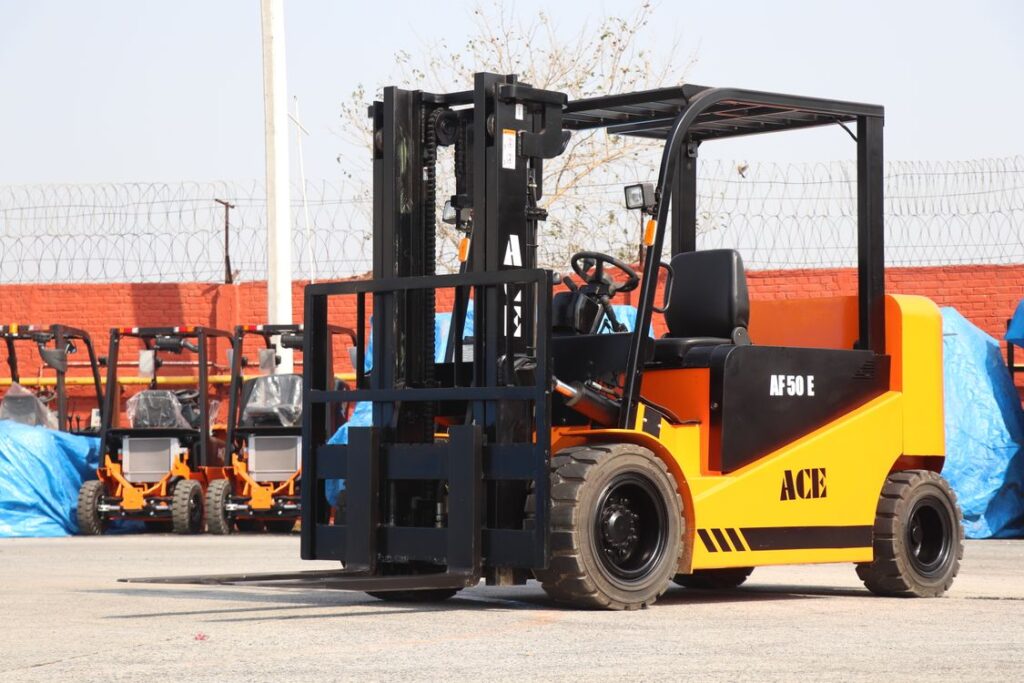
Featured image: Action Construction Equipment Ltd. – ACE on Pexels — view the original on Pexels. A stock photo illustrating a forklift in a general plant, not a Kadier project.
