

 Tiếng Việt
 中文 (中国)
The former Binh Phuoc area is a newly emerging industrial region: large land reserves, mostly newly built factories, agro- and forestry-processing tied to raw-material zones, plus electronics and consumer goods. The axis of this article is therefore new floors — new concrete slabs, moisture control, waiting for concrete to reach sufficient age — quite different from the renovation axis of long-established clusters such as Bien Hoa, Song Than or Tan Tao. This article is about the region’s market demand; it does not claim Kadier has built at Becamex, Minh Hung or Dong Xoai, or served any specific business named in the sources.
Administrative note: from 01/07/2025, the former Binh Phuoc area is now part of the new Dong Nai province (former Dong Nai plus former Binh Phuoc). In this article, “Binh Phuoc” is only a familiar geographic cluster name, not a current administrative unit; the old name is not used in the present tense as if the unit still existed.
Becamex: an industry – urban – service complex with a green orientation
Becamex – Binh Phuoc is an industry – urban – service complex oriented towards “clean – valuable – sustainable” development in the direction of green industry and ESG, according to sources. On scale, sources record two different scopes and this article states the scope rather than giving one absolute figure: over 4,600 ha is the scale of the complex according to the former local government source, while the leasable industrial-park area is around 2,450–2,500 ha, with over 50 projects and capital of nearly USD 1 billion according to sources. Priority industries include electrical and electronics, machinery manufacturing and precision engineering, food, foodstuff and agro-forestry processing, textiles, consumer goods, building materials, medical equipment, sports equipment, children’s toys and supporting industries.
For large “clean” factories in the complex, floors need to be flat, seamless, low-dust and easy to clean; electronics and precision-engineering zones need electrostatic control to be considered when a survey confirms the requirement — the StatGuard system is used only for zones that genuinely require it, rather than applied to the whole factory. See also epoxy flooring solutions for factories for the industry-based system-selection framework.
Agro- and forestry-processing floors: wood dust, oil, machine loads, easy cleaning
Raw-material zones for rubber, cashew and pepper, together with a Cambodian border of around 240 km according to sources, make agro- and forestry-processing tied to raw materials this cluster’s own angle — an angle that Bien Hoa, Nhon Trach and Long Thanh do not have. Floors for wood, rubber and cashew groups must cope with wood dust, oil, machine loads and easy-cleaning requirements: wood dust on the floor surface reduces adhesion if it is not thoroughly cleaned before coating, oil from rubber processing needs substrate treatment before coating, and wood-processing machines place concentrated loads at their feet. Raw-material storage and packing zones may use the RollCoat roller system, while zones with higher cleanliness requirements merit consideration of the LevelFlow self-levelling system.
Electronics and precision-engineering floors: flat, low-dust, electrostatic control where needed
Electronics and precision engineering in the cluster — mechanical and electrical-machine assembly, components and spare parts — need flat, low-dust floors and electrostatic control where the investor’s requirements and a survey confirm it. It is not claimed that every electronics factory must use antistatic flooring: each factory has its own standards, and an antistatic system is only finalised after measurement and comparison against the specific requirements of the production zone, the quality-inspection zone and the packing zone for sensitive components.
Textile, consumer-goods and medical floors: fabric dust, clean floors, light chemical resistance
Minh Hung – Sikico (the former Hon Quan area) has textiles, electroplating and medical gloves according to sources, and its infrastructure is being completed according to sources — this article states the source timing and does not claim anything about the current state of infrastructure completion. This group poses a dual problem: textiles need low fabric-dust retention and easy cleaning; electroplating and medical zones need light chemical resistance and clean, seamless floors. For electroplating zones, chemical resistance must be checked against the manufacturer’s chemical-resistance table for each chemical, concentration and contact time — no single system is claimed to resist every chemical. For odour-sensitive zones near packing, the AquaBase water-based system with low VOC is an option worth considering.
The Dong Xoai III exclusion list: the only system-selection framework in the series that uses an exclusion list
Dong Xoai III has a published admission list and a non-admission list according to the industrial-park directory source — and this article stresses: this list applies to that industrial park only and must not be generalised into a rule for the whole region. The admitted group includes mechanical engineering and manufacturing (power machines, cars, motorbikes, bicycles, measuring equipment, motors and generators), high-grade building materials and interior/exterior decoration, rattan, bamboo and fine wood crafts, ceramics and glass, beds, cabinets, tables and chairs. The non-admitted group includes rubber processing (fresh latex), cassava starch, paper and pulp, leather tanning and dyeing, electroplating, plant-protection chemicals, fertilisers and seafood, and fired bricks and tiles — quoted in the form “according to the industrial park’s admission directory”. This is the only article in the in-depth series that uses an exclusion list as its floor-system selection framework: a zone that does not admit heavily polluting industries has a very different flooring problem from a zone that admits both dyeing and electroplating.
Coordinating with new-workshop construction schedules: flooring is the last item
Because new floors are this region’s axis, schedule coordination is indispensable: flooring is the last item in workshop construction, so the coating schedule must match the overall handover schedule. New concrete slabs must have moisture controlled, must have reached sufficient age, and must use a suitable primer — never coat a slab that is too young. The handover checklist includes multi-point thickness measurement, load testing, checking for peeling, checking for standing water, and sufficient curing time before operation. Final specifications follow the paint manufacturer’s technical documents and the results of an on-site survey; anything for which Kadier technical documents are not yet available is written as a general framework with this disclaimer.
Frequently asked questions
When is the right time to coat floors in a new workshop at Becamex?
When the concrete slab has reached sufficient age, moisture readings meet the requirements of the chosen coating system, and a suitable primer has been identified. Coating a slab that is too young or still high in moisture is a common cause of blistering a few months later, even when the floor looked perfect at handover.
Must an electronics factory use antistatic flooring?
Not every electronics factory must. Antistatic requirements depend on each factory’s standards and each zone — production, quality inspection, packing of sensitive components — and are only finalised after a survey and resistance measurement.
Does the Dong Xoai III non-admission list apply to Becamex or Minh Hung?
No. That list applies to Dong Xoai III only, according to that industrial park’s directory source. Each industrial park has its own admission directory, and both writers and workshop owners need to check the zoning rules at survey stage rather than inferring across parks.
How is a quote for epoxy flooring for a new workshop in the former Binh Phuoc area calculated?
Kadier quotes after an on-site survey, based on area, the condition of the new concrete slab, the industry-matched coating system, and the handover schedule. This article gives no specific prices, because price lists circulating online are not Kadier prices.
Is your new workshop at Becamex, Minh Hung or Dong Xoai, in which industry, and when is handover scheduled? Send the details via the quote page or the contact page for advice on a coating system and a construction schedule matched to the building programme. Direct contact: hotline/Zalo 0899355489, WeChat wxid_95o54joujyrr12.
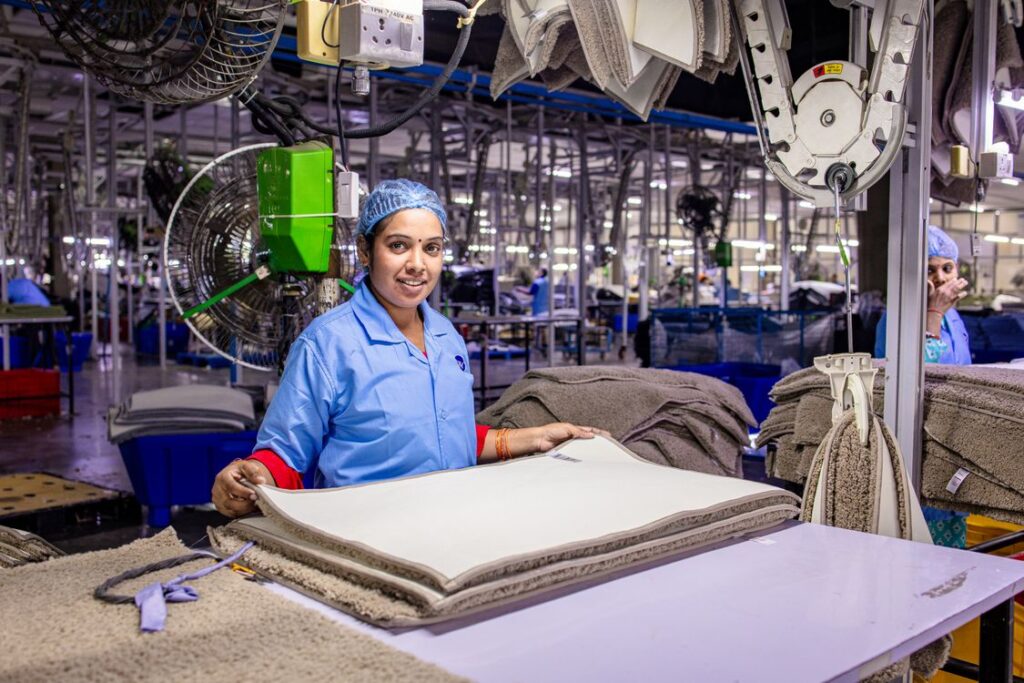
Illustrative photo, not a Kadier project. Pexels stock photo (photo ID 31090815) — by EqualStock IN, a general illustration of a textile factory, not tied to any specific industrial park or business.
