

 Tiếng Việt
 中文 (中国)
Three distinctive angles open this article, and they are also why this article stands alone rather than being merged into the Can Tho cluster article: pharmaceuticals at Tan Phu Thanh — the only clean-industry group in the southern group; the four-industry plan for Tran De tied to a future deep-water port — a “getting ahead” port angle; and a cluster combining two former provinces that now belong to one city — the south’s own administrative and geographic problem, south of the new Can Tho. This article is about the southern cluster’s market demand; it does not claim Kadier has built at Song Hau, Tan Phu Thanh or Tran De, or served any specific business.
Administrative note: from 01/07/2025, the former Hau Giang and former Soc Trang areas are now part of the new Can Tho City (former Can Tho plus former Soc Trang and former Hau Giang). In this article, “Hau Giang” and “Soc Trang” are only familiar geographic cluster names, not current administrative units; the old names are not used in the present tense as if the units still existed.
The south of the new Can Tho: two former provinces become one cluster
Song Hau, Tan Phu Thanh (the former Chau Thanh A area), An Nghiep and Tran De form the southern industrial cluster of the new Can Tho City — two former provinces in one cluster, with the Hau River as a shared logistics axis. This reading differs from the Can Tho cluster article, which looks from the deep-processing centre around Tra Noc, Hung Phu, Thot Not and O Mon: that article does not mention Tan Phu Thanh, Song Hau or Tran De, and has no pharmaceutical group. This article therefore opens with the south — Song Hau, Tan Phu Thanh and Tran De — not with an overview of the Mekong Delta or with Tra Noc.
Pharmaceutical floors at Tan Phu Thanh: clean, seamless, easy to clean, wash-resistant
Tan Phu Thanh is a multi-industry, high-tech and environmentally friendly park according to sources: mechanical engineering, assembly, electronic components and vehicle parts, consumer goods and handicrafts, textiles and footwear, food, foodstuff and farm-produce processing, metal processing, telecommunications and electronics, and precision engineering. Secondary-source market context — used only to indicate industry direction — also mentions pharmaceuticals, export garments, frozen seafood processing, packaging, manufacturing engineering and general logistics warehousing.
Within that group, pharmaceuticals are the south’s only clean-industry group and the first distinctive angle of this article. Pharmaceutical floors need to be seamless, with no grout lines trapping dirt, easy to clean and resistant to frequent washing; production, packing and finished-goods warehouse zones each have different cleanliness and washing levels, so zoning must come before system selection. The LevelFlow self-levelling system is often considered for zones requiring flatness and seamlessness, and see also epoxy flooring solutions for cleanrooms for the clean-floor framework — but each pharmaceutical plant’s specific cleanliness requirements still have to be confirmed by survey; no single standard is applied to every plant.
Seafood and aquatic-feed processing floors: wet zones, salt, grease, dust, slip resistance
Song Hau is a multi-industry park of around 286–300 ha according to sources — two sources record different scopes, so this article does not give an absolute figure but states the scope per source. Its industries include food, foodstuff and canned-fruit processing, components, electrical-machine assembly, electronics, semiconductors and high technology; its priority groups include seafood processing, electronics and consumer goods (textiles, footwear, garments, high-grade plastics); plus animal-feed processing, new materials, garments, agricultural machinery, building materials and high-quality engineering.
Seafood and aquatic feed pose a dual problem: wet zones with salt water, fish grease and frequent washing, plus dust from aquatic-feed and livestock-feed raw materials. Floors here must be seamless, slip-resistant, lightly chemical-resistant and easy to clean after every shift, while also carrying forklifts moving raw materials and finished goods. Raw-material reception, preliminary processing, packing and finished-goods warehouse zones need separate zoning, because the wetness and dust levels of each zone differ markedly.
Garment, electronics and consumer-goods floors: fabric dust, electrostatic control where needed, medium loads
Garments, electronics and consumer goods in the cluster — textiles, footwear, garments, high-grade plastics, components and assembly — carry medium loads, but fabric dust and cleanliness requirements are their particular background conditions. Floors for this group prioritise low dust retention, easy cleaning and even wear resistance; electronics and quality-inspection zones need electrostatic control to be considered when a survey confirms the requirement, with the StatGuard system used only for zones that genuinely require it. Dry warehouses and forklift aisles in the same plant may use the RollCoat roller system with line markings and slip resistance.
Tran De’s four-industry plan and the future deep-water port
Tran De has a four-industry plan according to planning sources — this article states clearly that this is a plan, not a picture of current occupancy. Group A: seafood and farm-produce processing, requiring food-hygiene, clean water and waste treatment. Group B: heavy industry, large areas and modern workshops. Group C: aquatic and livestock feed, close to raw materials and waste treatment. Group D: light industry and supporting industries. Each group poses a different flooring problem — wet and clean zones for Group A, heavy loads for Group B, wet zones plus dust for Group C, medium loads and easy cleaning for Group D — and flooring advice for Tran De at present must be written in a “prepare and get ahead” tense, not as if an existing, occupied floor market were already there.
The Tran De deep-water seaport is also in a future state according to sources: under submission for approval and prioritised for capital, not written about as an operating port. When this future port takes shape, port-linked logistics flooring on the Hau River and the port — truck loads, line markings, outdoor yards with PU topcoats — will become the cluster’s new link; at present, the cluster’s logistics-floor advice still rests on warehouses and yards operating around the Hau River. See also epoxy flooring solutions for logistics warehouses and the article on the Can Tho and central Mekong Delta cluster for comparison with the north of the same new city.
Weak ground and high moisture: moisture measurement, reverse waterproofing
The Mekong Delta’s weak ground and high moisture make moisture measurement and reverse waterproofing mandatory steps before coating across the whole southern cluster, from Tan Phu Thanh pharmaceuticals to Song Hau seafood and Tran De. For pharmaceutical zones, substrate moisture not only causes blistering but also threatens the production zone’s cleanliness standards; for wet seafood zones, substrate moisture plus frequent washing accelerates peeling if not dealt with thoroughly. The general process covers substrate moisture measurement, checking for settlement and cracking, a reverse-waterproofing primer where moisture exceeds the chosen coating system’s permitted threshold, and sufficient curing time before operation. Final specifications follow the paint manufacturer’s technical documents and the results of an on-site survey.
Frequently asked questions
Is the Tran De port already operating, and should port-linked warehouse flooring be advised now?
No. According to sources, the Tran De deep-water seaport is under submission for approval and prioritised for capital. Port-linked warehouse-floor advice at present must rest on warehouses and yards operating around the Hau River, while preparing options for the future port link — not written as if the port were operating or the Tran De industrial park were already occupied.
How does a pharmaceutical floor differ from a seafood floor?
A pharmaceutical floor prioritises cleanliness, seamlessness, easy cleaning and wash resistance, with zoning by cleanliness level. A seafood floor prioritises wet zones, resistance to salt water and light cleaning chemicals, slip resistance and good drainage. Using one shared system for both groups without zoning would leave one of the two groups below standard.
Does Tran De’s four-industry plan mean the park is already occupied by all four groups?
No. Groups A, B, C and D are a plan according to sources, not a picture of current occupancy. Flooring advice for Tran De is therefore written in a prepare-and-get-ahead tense, with each industry group getting a different system-selection approach when real plants come into operation.
How is a quote for epoxy flooring for the southern cluster of the new Can Tho calculated?
Kadier quotes after an on-site survey, based on area, industry — pharmaceuticals, seafood, aquatic feed, garments or electronics — wet or clean zones, substrate condition and substrate moisture, and the construction schedule. This article gives no specific prices, because price lists circulating online are not Kadier prices.
Is your plant or warehouse at Song Hau, Tan Phu Thanh or Tran De, and in which industry? Send the area and the wet-or-clean zone details via the quote page or the contact page for advice on a suitable flooring system. Direct contact: hotline/Zalo 0899355489, WeChat wxid_95o54joujyrr12.
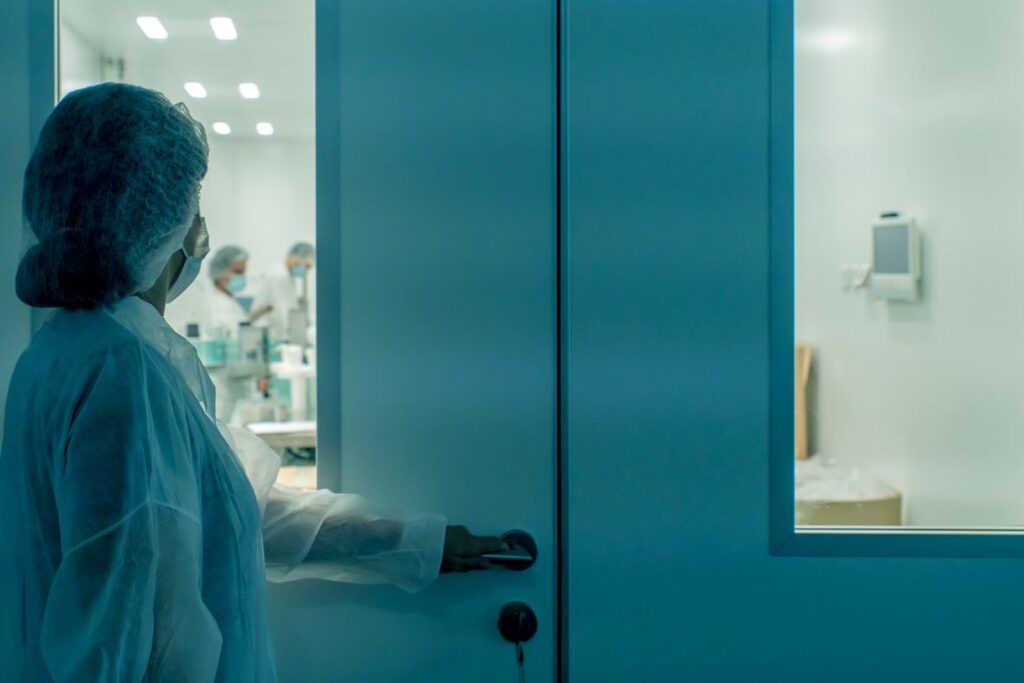
Illustrative photo, not a Kadier project. Pexels stock photo (photo ID 33514502) — by Policarpo Brito, a general illustration of a sterile laboratory, not tied to any pharmaceutical plant or industrial park.
