

 Tiếng Việt
 中文 (中国)
Not every worn floor is worn by heavy vehicles. In many factories, pedestrian walkways, standing work areas, areas where hand trolleys are pushed and pulled, and places workers pass through continuously every day are where the coating deteriorates earliest. This article is about exactly that case: abrasion caused by foot traffic and general production activity, which is different from floors carrying forklift and heavy truck loads, and different from the anti-slip problem solved with grit particles.
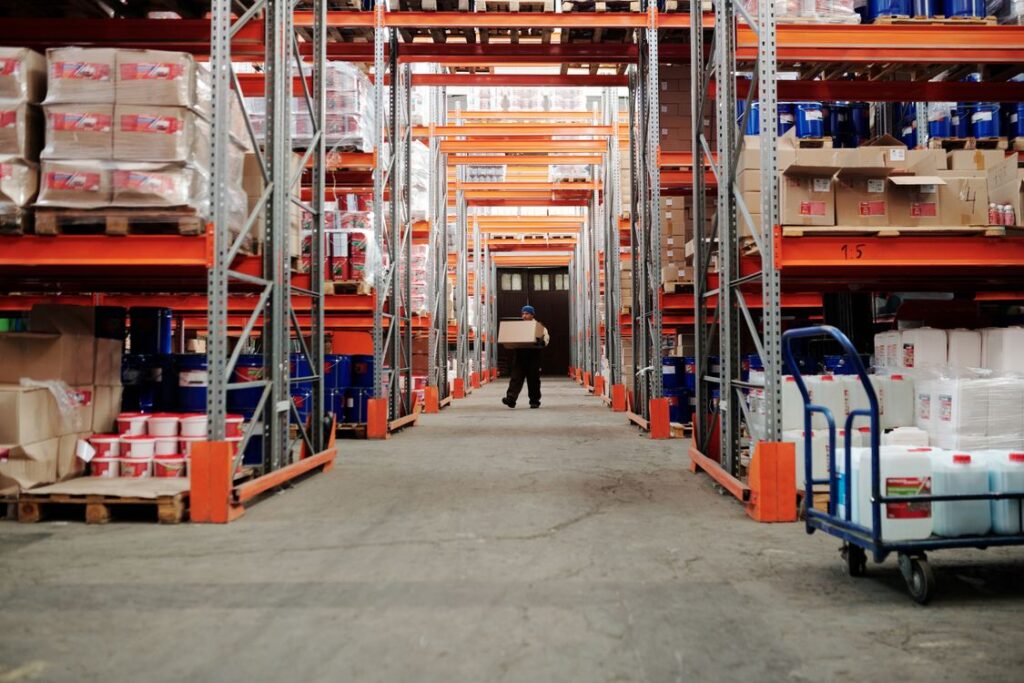
Illustration: workers in a warehouse aisle (Tiger Lily / Pexels). The image only illustrates a walkway space, not a Kadier project.
How Is Wear from Foot Traffic Different from Wear from Heavy Vehicles?
Wear from heavy vehicles concentrates on point loads: wheels, turning points, braking points, and positions where heavy pallets are placed. Wear from foot traffic is different: the force in each pass is smaller, but the number of repetitions is very large and spread evenly along a fixed route. A walkway between two production lines, a corridor leading to a packing area, or a stretch of floor in front of a workbench can take thousands of footsteps and trolley passes every week. The coating there does not break from a single overload; it wears down gradually, loses its gloss, becomes scratched on the surface, and eventually exposes the layer below.
Distinguishing these two forms of wear matters when choosing a coating system, because a system that withstands heavy loads is not necessarily the most suitable choice for a walkway route, and vice versa. During a survey, the map of vehicle loads should be kept separate from the map of pedestrian traffic, rather than merging them into a single requirement for a high-abrasion floor across the whole factory.
The Fastest-Wearing Spots in a Production Area
First are fixed pedestrian routes: the factory entrance, walkways between production lines, routes to the warehouse area, and emergency exits. Pedestrians usually step along one narrow track, so that track wears much faster than the surrounding floor. Second are standing work areas: in front of machines, assembly benches, and quality inspection areas. There, feet pivot, shift, and repeat friction at the same point. Third are hand trolley, light tow cart, and light material cart routes: small wheels, many passes, usually along one route and turning at the same position.
There are also transition points: door thresholds, stair bases, places where floors from two areas meet, and edges of areas regularly cleaned with scrubbing machines. These points face both repeated light impact and friction, so they need to be considered separately when planning maintenance, rather than only assessing the floor surface in general.
Choosing a Coating System for Walkways: Look at the Build-Up, Not Just the Name
As a general characteristic of epoxy material, a seamless coating with no joints helps limit dust build-up and is easy to clean, which is an advantage for walkways and production areas. But durability against repeated abrasion also depends on how the system is built: the primer bonding to the concrete substrate, the intermediate coat providing thickness and flatness, and the topcoat taking direct friction. A system that is thick only in the intermediate coat but weak in the topcoat can still deteriorate early on a walkway route. Conversely, a system with a topcoat suited to repeated friction will keep its surface for longer, even when its total thickness is not the greatest.
When discussing options with an applicator, the client should therefore ask clearly: what coats does the proposed system include, which coat takes direct friction, and will walkway areas be treated differently from areas with little foot traffic? The individual specifications of each Kadier system, including thickness, coverage, and abrasion resistance, should only be checked against the official technical data sheet (TDS) when published; this article does not state any Kadier-specific abrasion index, and the descriptions here are general characteristics of epoxy material, not a substitute for a TDS.
Line Marking and Traffic Routing: Reduce Wear by Reorganising Routes
It is not always necessary to increase the thickness of the entire floor. In many cases, marking traffic lanes and separating pedestrian routes from trolley routes has significantly reduced the density of friction on a single narrow track. When pedestrians and trolleys each follow their own route, wear no longer concentrates in one place, and local cleaning and repair become easier. The colours of the lane markings and of each area should be consistent with the colour-by-function approach presented in the article on epoxy floor colour charts (RAL), so operators recognise boundaries as soon as they look down at the floor.
At trolley turning points and standing work positions, local reinforcement can be considered instead of upgrading the whole floor. This approach concentrates the budget where wear is fastest, and when repairs are needed, only that area needs to be treated instead of stopping the whole production line.
Slip Resistance and Abrasion Resistance Are Two Different Requirements
A floor can resist abrasion well but still be slippery when wet, and a floor with good slip resistance is not necessarily durable against repeated friction. Adding grit aggregate to roughen the surface increases friction for feet, but the grit also changes how the surface wears and how it is cleaned. The two requirements therefore need to be considered together, without using the solution for one to answer the other. The article on anti-slip epoxy floors analyses quartz sand and aluminium oxide grit separately; this article focuses only on abrasion from foot traffic and production activity.
In areas with water, light oil, or fine dust, cleaning conditions need further assessment: a surface that is too rough can trap dust and be hard to wipe clean, while a surface that is too glossy can be slippery. The final choice should be based on an actual on-site survey, including the types of dirt commonly encountered, cleaning frequency, and the cleaning method in use.
Maintaining Walkways: Catch Wear Early, Repair Locally
For floors subject to abrasion from foot traffic, the most effective maintenance is regular inspection of exactly the routes identified from the start: the main pedestrian track, trolley turning points, standing work areas, and door thresholds. Signs to watch for are uneven loss of gloss, surface scratches forming tracks, gradual thinning of the topcoat, and discolouration along the walking track. When these signs first appear, local repair is usually much simpler than waiting until the coating exposes the substrate and the whole area must be treated.
Cleaning also directly affects the rate of wear: sand, hard dust, and metal fragments dragged across the floor increase abrasive friction. Keeping walkways clean, placing dust-control mats at entrances, and cleaning with suitable tools are simple operating measures that can considerably extend the life of the coating.
When Should You Use Which Kadier System?
As general guidance, the roller-applied RollCoat system suits ordinary walkway areas that need fast application and easy local maintenance; the self-levelling LevelFlow system suits production areas that need a flat, seamless floor that is easy to clean over a large area. The final choice still depends on a substrate survey, actual foot traffic, and the official TDS for each system. If the area also has an anti-static requirement or a damp environment, the StatGuard system and the AquaBase system should also be checked before finalising the specification.
Request a consultation: describe the walkway route, production area, and actual frequency of use at your facility to receive advice on a suitable specification at Request a consultation.
