

 Tiếng Việt
 中文 (中国)
A showroom is not only a place to display products, but also part of the product itself. Floor color, gloss level, and decorative pattern determine a visitor’s first impression on entering: luxurious or ordinary, spacious or cramped, modern or dated. This article discusses aesthetic epoxy flooring for showrooms from that angle: choosing color and decorative pattern as a display tool, different from choosing color by operational function in a factory.
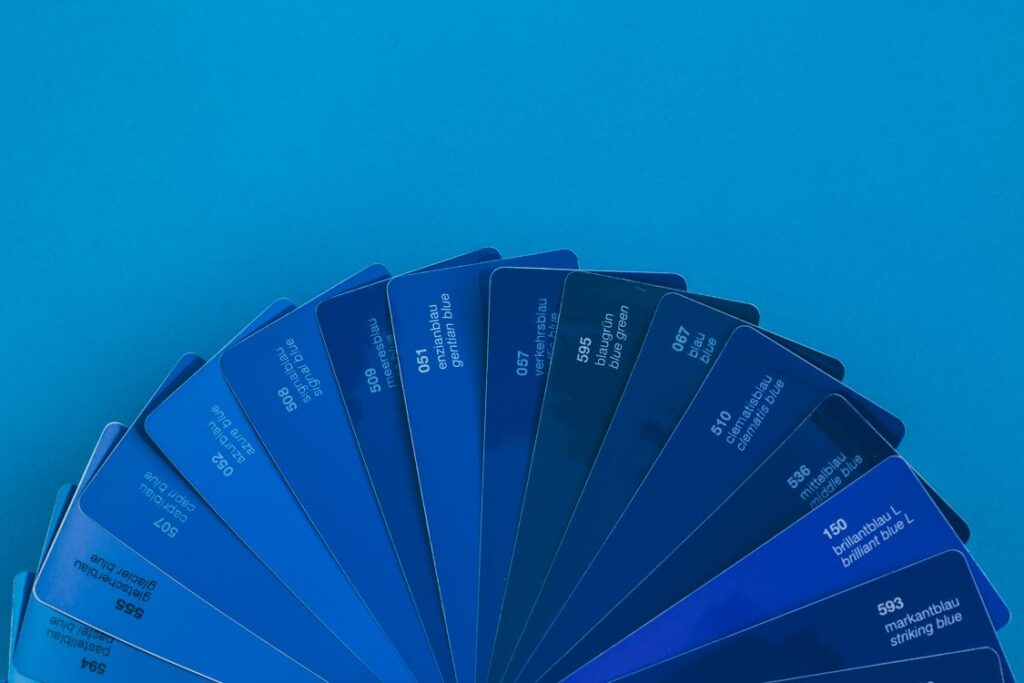
Illustration: blue color sample board (Markus Spiske / Pexels). The image only illustrates color selection, not Kadier’s stock color chart.
How is showroom aesthetics different from factory aesthetics?
In a factory, floor color serves operational organization: zoning, wayfinding, and warnings. In a showroom, floor color serves emotion and brand: highlighting the products on display, guiding visitors’ gaze, and creating an impression of prestige. A floor color that is very sensible in a factory, for example a dark neutral tone to hide dirt, may make a showroom look heavy and drown out the products. Conversely, a floor color that is very beautiful in a showroom may be completely unsuitable for a production area with oil and forklifts passing through.
Therefore, the article on epoxy floor color charts (RAL) and how to choose colors by function remains the reference foundation, but when entering a showroom, the priority order changes: brand and customer experience come first, operational function moves to second place, but does not disappear. A showroom floor must still withstand visitor foot traffic, frequent cleaning, and strong light; those requirements are simply resolved within the aesthetic framework, not the other way round.
Color: choose by the products on display, not by personal taste
The first principle is that the floor must not compete for attention with the products. If the products have many colors, the floor should use neutral tones so the products stand out. If the products have a uniform tone, the floor can use a slightly contrasting tone to create depth, but must still keep its background role. Light colors make a space look wider and brighter, suitable for small showrooms or showrooms with little natural light; dark colors create a luxurious and focused feel, but require good lighting and careful cleaning, because dust and scratches show more clearly on a dark background.
On color reference, the RAL color chart is the industry’s general color standard, using codes to name a tone instead of describing it in words. For example, code RAL 7035 is often mentioned as a light neutral grey tone in industry. Important note: the RAL codes mentioned in this article are only general reference examples, not a commitment that Kadier always has that color code in stock, and they are not Kadier’s stock color chart. Before finalizing a color for the entire showroom, it is necessary to view real color samples under the lighting conditions of the showroom itself and to agree in writing with the contractor, because a color on screen, on paper, and on an actual floor surface always differs to some extent.
Decorative patterns: an accent, not a whole-floor background
Decorative patterns in aesthetic epoxy flooring include effects such as stone veining, cloud veining, metallic sheen, and controlled color blotches. In terms of the general characteristics of the material, these effects are created during the application of the surface coating layer, so each floor surface has a certain uniqueness and is difficult to repeat exactly identically. For that reason, a decorative pattern should be used as an accent: the reception area, the display area for flagship products, or a central floor panel, instead of covering the entire showroom.
When a decorative pattern covers too wide an area, it easily becomes a distracting background and drowns out the products. When used in the right place, it creates a “stage” for the products: visitors linger longer, take more photos, and remember the showroom more clearly. Before applying it over a large area, a trial sample should be requested on a small area in the real showroom, viewed under real light and together with the real products, instead of only viewing sample photos on a phone.
Gloss, light, and the sense of space
The gloss level of a floor directly affects how light spreads in a showroom. A glossy floor reflects light and products, helping the space look brighter and more premium, but it also reflects every scratch and stain, so it requires frequent cleaning. A matte or semi-matte floor hides dirt better and creates a calm, warm feel, but it can make a space look darker if the lighting is already weak. The choice of gloss level therefore cannot be separated from the showroom’s lighting design: lamp positions, light intensity, and light color all change the perception of the same floor surface.
Another practical note is that showroom floors are frequently photographed and filmed. Floor color and decorative pattern in photos can differ from direct viewing, especially under lights with different color temperatures. Checking a floor sample both with the naked eye and in photos taken in the showroom is a simple step but helps avoid disappointment after application is finished.
Application and maintenance of aesthetic floors
An aesthetic floor requires more careful substrate preparation than an ordinary industrial floor, because every substrate defect is easily visible under a glossy coating and decorative pattern. Substrate cracks, unevenness, and old patch marks, if not treated beforehand, will show clearly after the surface layer is applied. Application time and waiting time before use also need to be factored into the showroom’s business plan, because a showroom usually cannot close for long periods like a factory.
On maintenance, an aesthetic showroom floor needs a gentle and regular cleaning routine rather than strong periodic cleaning. Hard scrubbing tools and strong cleaning chemicals can dull the gloss layer and damage the decorative pattern. It should be agreed from the start: daily cleaning by which method, periodic cleaning by which method, and when the surface layer needs to be recoated to restore gloss, instead of waiting until the floor has visibly deteriorated before acting.
System orientation for showrooms
At a general orientation level, the self-leveling system LevelFlow is often considered for showrooms thanks to its flat, seamless floor surface and its ability to show color and decorative pattern evenly over a large area; the roller-applied system RollCoat is more suitable for ancillary areas, small storage rooms, and back passages of a showroom, where aesthetic requirements are lower and fast local maintenance is needed. If a showroom has a damp area or needs application in odor-sensitive conditions, the AquaBase system should also be cross-checked. Every final choice still needs to be cross-checked against the official Technical Data Sheet (TDS) of each system when published; this article does not commit to stock colors, does not state prices, and does not describe any specific Kadier project.
Request a consultation: send photos of your showroom, the products on display, and the current lighting conditions to receive advice on suitable color and pattern options at Request a consultation.

Pingback: Stone-vein and metallic epoxy floors: aesthetics or just decoration? - Kadier — Industrial Epoxy Floor Coating