

 Tiếng Việt
 中文 (中国)
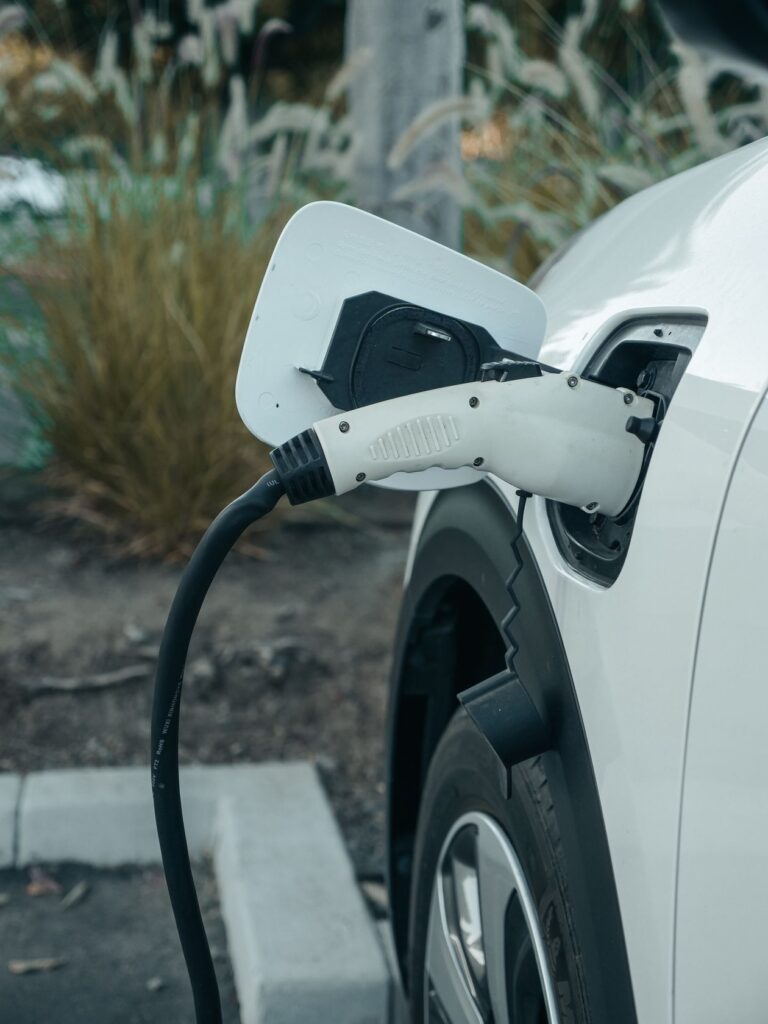
Charging stations and electric vehicle (EV) garages are a new kind of space, but the demands placed on the floor are very familiar: light grease, water, tyre dust, frequent cleaning and safety for users. The difference is this: an EV garage also contains electrical equipment, charging cables and long-stay parking areas, so the floor needs to be considered as part of overall electrical safety and operation, not just as an ordinary garage floor. This article sets out that general framework; it does not state any Kadier-specific electrical safety certification and does not describe any specific charging station.
Illustration: an electric car connected to a charging station (Kindel Media / Pexels). The image only illustrates charging activity; it is not a Kadier charging station.
How is an EV garage different from a conventional car garage?
In terms of load and soiling, an EV garage is similar to a conventional garage: vehicles come and go, wheels bring dust and water onto the floor, and there is occasionally light grease from mechanical systems and dirt from tyres. In terms of operation, an EV garage differs in three ways: vehicles usually park for a long time to charge, charging cables and charging posts take up floor space and walkways, and users frequently handle electrical equipment while standing on the floor. These three points do not change the nature of the epoxy coating, but they do change how the floor is laid out, how lines are marked and how cleaning is organised.
Another difference is the length of time a vehicle stands still in one position. Tyre marks, dirt and moisture accumulating under the wheels have longer to act than in a garage with vehicles coming and going continuously. The charging parking area therefore needs to be inspected and cleaned on its own schedule, rather than only being cleaned together with the whole garage at a single frequency.
Light grease and cleaning: the advantage of a seamless floor
As a general characteristic of epoxy materials, a seamless coating with no joints makes it harder for light grease and water to soak deep into the substrate, and makes cleaning faster than on a floor with many joints. In an EV garage, this advantage matters most around charging posts and user walkways, where the floor needs to be kept dry and clean so that users can work safely. However, this advantage only lasts while the coating remains intact; cracks, peeling edges or poorly executed joints become places where grease and water accumulate.
Cleaning for a charging station should separate the charging post area from the parking area: the charging post area should be cleaned lightly and frequently, avoiding standing water around the base of the posts and the charging cables; the parking area should be cleaned on the general garage schedule, focusing on collecting tyre dust and sand brought in from outside. Cleaning chemicals used in the garage need to be compatible with the epoxy coating and must not leave a slippery residue after wiping.
Electrical safety: the floor is part of the whole, not the only solution
This is the point that needs to be stated most clearly. An epoxy floor, by the nature of the material, is not electrical protective equipment, and this article does not present an epoxy floor as an electrical safety measure that replaces a properly standard-compliant electrical system. The electrical safety of a charging station depends on the whole: the electrical system design, switching and protective devices, earthing, installation of the charging posts in accordance with regulations, and regular operation and maintenance by a qualified provider. The floor contributes only at a supporting level: keeping the area around the charging posts dry, clean and free of standing water, with clearly marked zones so that users do not pull cables across shared walkways and do not park in a way that blocks the working area.
Any claim about the electrical insulation capability, anti-static capability or electrical safety certification of a specific coating system needs to be checked against the official technical data sheet (TDS) and relevant certification when published. This article does not state any Kadier-specific electrical safety certification, does not state any electrical specification specific to any coating system, and does not replace advice from the unit that designs and installs the electrical system for the charging station.
Line marking, traffic flow and charging cable placement
In charging stations and EV garages, floor line marking has additional tasks compared with a conventional garage: marking charging parking positions, user walkways when working with charging posts, and no-parking areas to avoid blocking the working area or escape routes. Charging cables should not be draped across shared walkways; the position of the charging posts, the cable length and the parking direction should be planned together from the outset when laying out the floor, rather than installing the posts first and only then finding a way to deal with excess cable.
Zone colours should be consistent with the approach to choosing colours by function in the article on epoxy floor colour charts (RAL), with the principle that a charging position must be recognisable at a glance when looking down at the floor, even in the low light of a basement garage. Lines in the charging area need to be checked regularly, because this is an area with frequent vehicle and pedestrian traffic, and faded lines will quickly cause confusion about parking positions.
Anti-slip and lighting in basement garages
EV garages are often located in basements or enclosed areas, where there is little natural light and humidity is higher. In these conditions, the floor needs to maintain grip when water is brought in from outside, while a moderately light floor colour will help the space look brighter and make it easier for users to see charging cables, steps and obstacles. The article on anti-slip epoxy floors examines the texturing options separately; in a garage, grip needs to be balanced against cleanability, because an excessively rough surface will hold tyre dust and be hard to clean in an enclosed space.
The locations needing particular attention are entry and exit ramps, garage door thresholds, areas around floor drains and the area beneath charging posts. These are the places where water most easily pools and where users are most likely to slip, so they need to be checked more frequently than ordinary parking areas.
Coating system guidance
At a general guidance level, the roller-applied RollCoat system suits medium-scale garages and charging stations that need fast application and easy local maintenance; the self-levelling LevelFlow system suits large charging areas that need a flat, seamless floor that is easy to clean. If the garage has an anti-static requirement for a related technical area, the StatGuard system should also be checked; if the area has a high substrate moisture level, the AquaBase system should also be checked. Any final choice still requires a survey of the actual substrate, an assessment of the electrical system by a qualified provider, and a check against the official TDS of each system when published.
Request a consultation: describe the size of your garage or charging station, the position of the charging posts and the basement conditions to receive advice on a suitable flooring option at Request a consultation.
