

 Tiếng Việt
 中文 (中国)
Air bubbles in an epoxy coating are tiny holes or bubbles that rise to the surface while the paint is still wet or has just cured. From a distance, the floor can still look glossy and even in colour, but up close the surface is pitted, rough like orange peel, and may even have pinholes reaching down to the coat below. Air bubbles do more than spoil the look: dust, water and chemicals collect easily in the holes, the coating there is thinner, and it wears faster than elsewhere.
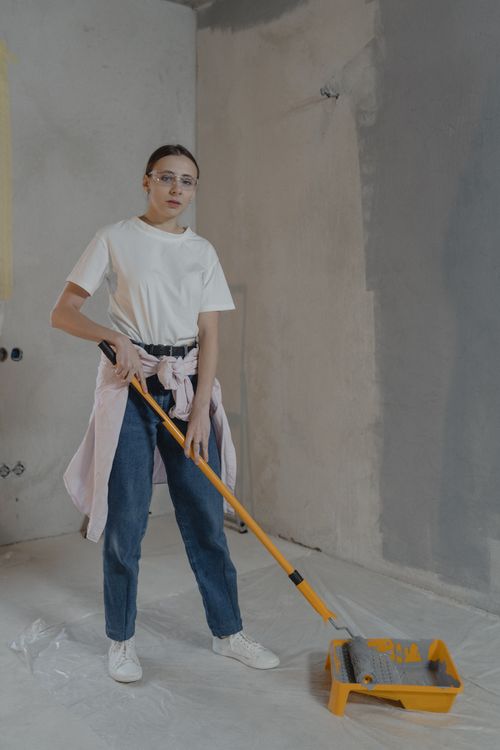
Illustration: roller application — rolling is one of the steps most likely to trap air in the coating. Photo: Tima Miroshnichenko on Pexels, not a Kadier project.
How do air bubbles differ from blistering and pinholes?
These three problems are often lumped together as a “pitted floor”, but their causes and fixes differ, so they need to be told apart before any repair. Air bubbles form during application, when air is whipped into the paint mix or escapes from the substrate and gets trapped in the curing coat. Moisture blistering is different: moisture from inside the concrete pushes up a cured coat into blisters, usually after some time in use rather than right after painting — that problem is covered separately in the article on epoxy floor blistering from subfloor moisture. Pinholes are the mildest form of air bubbles: a bubble bursts at the surface and leaves a very small hole, visible only when viewed at an angle under light.
Getting the diagnosis right avoids a wrong repair: bubbles caused by application are fixed at the surface and in the rolling process; blistering caused by moisture means the moisture source in the substrate must be dealt with first — recoating over a still-damp substrate will only make the blistering come back.
Common causes
Air whipped in while mixing and rolling
Two-component epoxy must be mixed evenly before application. Mixing too fast, using an unsuitable mixing paddle, or mixing for too long can all whip many air bubbles into the mix. When rolling, passing the roller back and forth repeatedly over the same pass, rolling too fast, or using a roller sleeve with too long a pile also traps extra air in the wet coat. With a roller system such as RollCoat — 3-coat roller system, the rolling step largely determines how smooth the surface turns out, because every coat goes on with a roller.
Air escaping from the concrete substrate
Concrete has a capillary network and pores. When the primer has not sealed all these pores, air in the substrate escapes through the still-wet coat and forms bubbles. This shows most clearly on freshly ground, porous substrates, or when the substrate temperature is rising during application — as the substrate warms, the air in its pores expands and escapes more strongly. That is why a penetrating primer matters: it not only improves adhesion but also seals the pores so the coats above have a sealed surface to bond to.
A coat applied too thick in one pass
The thicker the coat, the harder it is for trapped air to escape before the paint cures. Self-levelling paint has the same problem if it is poured too thick at one spot because the substrate is uneven: thick areas hold air longer than thin ones. With LevelFlow — self-levelling system, keeping an even thickness across the whole floor is therefore also a way to prevent trapped air, not just a flatness requirement.
Unfavourable application conditions
A strong draught makes the paint surface skin over quickly, sealing off the escape route for bubbles below. High temperatures shorten the time the paint stays liquid, so bubbles are trapped before they can burst. Conversely, applying when the substrate is colder than the dew point can let moisture condense on the surface, causing bubbles as well as harming adhesion — the dew-point issue is explained separately in the article on dew point in epoxy application. Mix ratio and pot life are related too: a mix near the end of its pot life thickens, making it harder for air to escape — see the article on epoxy mixing ratio and pot life.
Preventing air bubbles during application
The most effective prevention tackles all three sources of air at once: air in the paint, air in the substrate, and air trapped by thick coats. Mix as the manufacturer directs, at a moderate speed, avoiding a strong vortex; after mixing, let the mix rest briefly so large bubbles can burst if the instructions allow. Roll with even pressure in one direction, avoiding repeated passes over the same strip once the paint has started to set.
On porous or freshly ground substrates, the primer must be applied sufficiently to seal the pores; if the substrate absorbs the primer and leaves dry patches, those patches are where bubbles will escape into the next coat. After rolling or pouring the coat, run a spiked roller (defoaming roller) lightly over the still-wet surface to puncture bubbles — this must be done while the paint is still liquid, since doing it late, once the paint has skinned, will leave roller marks. Finally, choose a time to apply when the substrate temperature is stable or falling slightly, avoiding direct strong sunlight that heats the substrate as work proceeds.
What to do when a floor already has air bubbles
Mild — sparse bubbles, surface only, coating still well bonded: the whole affected area can be sanded to open the holes, cleaned of dust, and recoated with a thin coat following the system manufacturer’s process. The recoat must be able to bond to the sanded old coat, so the sanding and cleaning steps must not be skipped.
Severe — dense bubbles, deep holes, a clearly rough surface: sanding the surface is not enough, because deep holes remain. The usual approach is to grind off the failed coating until the bubbles are gone, treat the substrate again if the cause was an unsealed porous substrate, and then reapply from the primer up. Whether to repair locally or redo the whole area should be judged by the bubbled area and its location: bubbles on a main traffic route or a forklift area show more and fail sooner than bubbles in a hidden corner. The process for patching and recoating local areas is covered separately in the article on localized epoxy floor repair.
Frequently asked questions
Do air bubbles disappear on their own after a period of use?
No. Bubbles cured into a coating are a permanent defect of that coat. Wear and cleaning may make the surface feel less rough, but the holes remain and will collect dirt again. To remove bubbles, the surface must be sanded or ground off and recoated.
Can another coat of paint be applied over a bubbled floor?
Only after thorough sanding and cleaning so the new coat can bond, and only when the bubbles are mild and shallow. Coating directly over a glossy surface with dust still in the holes will make the new coat prone to peeling, and the old bubbles underneath will show through as the new coat wears.
Are air bubbles a sign of poor-quality paint?
Not necessarily. Air bubbles are usually a sign of the application process — mixing, rolling, primer, substrate conditions and weather — rather than of the material itself. The same paint applied by different crews can give completely different surfaces. When assessing the problem, review the application log: mixing time, roller type, primer, temperature and humidity at the time of application, rather than blaming the paint straight away.
A note on specifications
Official technical data (TDS) for each Kadier product is published on the Products page; this article sets out a general framework and does not replace the TDS of a specific product. Standards such as TCVN 9014:2011 and TCVN 12574-2018 set the general framework for epoxy paints and coatings; in actual application, mix ratio, pot life, recoat time between coats and primer requirements must follow the TDS of the specific product to be used. Project owners should ask the supplier to provide the TDS and confirm in writing that the application process has accounted for the risk of air bubbles under the project’s actual substrate conditions.
If your factory, warehouse or production floor has air bubbles or a pitted surface after application, send photos of the current condition and information about when the work was done for advice on sanding, recoating or redoing the job — see Get a quote and contact Kadier for an on-site survey.
See also
- RollCoat — 3-coat roller system — the roller system where the rolling step determines surface smoothness.
- LevelFlow — self-levelling system — even thickness control helps limit air trapped in thick coats.
- AquaBase — water-based, low VOC — the water-based system for spaces in operation; application requirements still follow the product TDS.
- Epoxy floor blistering from subfloor moisture: causes and fixes — telling moisture blistering apart from application bubbles.
- Epoxy primer: role and selection — why a primer that seals substrate pores matters for air bubbles.
