

 Tiếng Việt
 中文 (中国)
How Bau Bang differs from the rest of Binh Duong
If VSIP and Song Than are the mature industrial cluster in the south of old Binh Duong, around Di An, Thuan An and Thu Dau Mot, then Bau Bang is the expansion to the north, along National Highway 13 toward the Central Highlands. That difference decides the flooring question as well. In Bau Bang, the dominant question is rarely how to renovate a thirty-year-old plant in a fully occupied park. It is how to build a new floor for a new factory, for a ready-built factory in the expansion zone, and for warehouses serving the northern road-freight corridor. Large plots, room to grow and a steady flow of new investment mean floors here are usually decided at the design stage, not patched after the production line is already running.
This article covers Bau Bang Industrial Park only. The broader Binh Duong cluster is covered in the article on the Binh Duong industrial park cluster (VSIP, Song Than), and the comparison between Southeast-region clusters is in the Southeast region market overview. What follows is specific to Bau Bang: its industries, its location and the floor types common in this park.
A note on names: “Binh Duong” in this article is the familiar geographic name investors still use when searching; administratively, the old Binh Duong province has belonged to expanded Ho Chi Minh City since the merger of 1 July 2025. The old name is not used here as a current administrative unit.
Location and scale: the northern gateway on Highway 13
Bau Bang Industrial Park, developed by Becamex IDC, lies in Lai Hung and Lai Uyen communes, Bau Bang district, in old Binh Duong province. The park sits directly on National Highway 13 and connects to the My Phuoc – Tan Van highway, the artery linking the northern industrial area of old Binh Duong with Ho Chi Minh City, Cat Lai Port and, in future, Long Thanh International Airport. For a factory located here, the dominant transport mode is road: trucks, container vehicles and forklifts moving in and out of warehouses — not rail, as in the Song Than ICD advantage.
On scale, secondary sources record the Bau Bang urban–industrial area phase 1 at 2,166 hectares, of which about 699.24 hectares is industrial land, the remainder being infrastructure and urban–service areas; the expansion phase adds about 1,000 hectares under the name Bau Bang Expanded Industrial Park. Headline totals differ between secondary sources depending on whether they count the whole urban–industrial area or industrial land alone, so what matters for flooring is the consequence rather than a single total: a large land bank, many vacant plots and new ready-built factories, which means new floors account for a much larger share of demand than renovation of old floors.
The park was established under Decision 566/TTg-CN of 10 May 2007, construction of the urban–industrial area began in the first quarter of 2014, and it officially came into operation in March 2015. Bau Bang is therefore far younger than VSIP I or Song Than 1, and that youth shows directly in floor condition: new concrete slabs, few layers of old coating to strip, but also a duty to get the coating system right the first time, because fixing a badly specified new floor costs far more than fixing an old floor whose defects are already known.
Industries in Bau Bang and what each does to a floor
Bau Bang is a multi-industry park without the strict “clean” filter applied at VSIP. According to secondary sources on the park, attracted industries include: electrical machinery, industrial and household electrical equipment; electronics, IT and telecommunications; food, agricultural and forestry processing; machinery, automotive and spare-parts manufacturing; precision engineering including plating; ceramics, glass and crystal; industrial gases; steel of various kinds; and textiles and garments. Each group places a different demand on the floor, which is why no single coating system fits the whole park.
Electrical and electronics plants need flat, seamless, low-dust floors so concrete dust does not settle on components and equipment. In assembly areas for sensitive components, the additional requirement is electrostatic control, since a single discharge can damage a component before the finished product ever leaves the plant. Machinery, steel and automotive-parts plants need the opposite emphasis: heavy-load resistance, impact resistance and abrasion resistance, because moulds, steel blanks, heavy forklifts and industrial oils wear a floor faster than anything else. Food and agricultural processors need seamless, easy-to-clean floors that withstand frequent washing, with no joints that trap water or microbes. Plating and chemical areas need chemical resistance around plating tanks, chemical stores and walkways at risk of spills. Textile production, especially the dyeing sub-zone planned within the park, combines wet and chemical exposure at once: floors must handle constant water, dye solutions and cleaning agents, and stay slip-resistant for workers on foot.
Warehousing is a further Bau Bang speciality. With its northern gateway position and large land bank, many companies place raw-material stores, finished-goods warehouses and distribution centres inside or beside the park. Warehouse floors here carry high-frequency forklift traffic, heavy wheel loads, fork impacts and a need for durable line marking that separates vehicle and pedestrian flows. A good warehouse floor in Bau Bang is not only durable; it lets forklifts run fast and safely without stopping the shift for repairs.
Common floor types in Bau Bang, by functional zone
Grouping floors by functional zone, rather than by company name, lets an investor match the article directly to their own layout.
Heavy-load production floors. The most common floor type in Bau Bang, tied to machinery, steel, machine building and automotive parts. The concrete slab carries equipment loads, machine vibration and forklift traffic; the coating needs strong adhesion, abrasion resistance and impact resistance, plus oil resistance. Even a new slab must be checked before coating for moisture, surface strength and flatness, since freshly poured concrete is not automatically dry or flat enough to coat.
Warehouse and logistics floors. Warehouse floors face repeated forklift passes every day, need abrasion resistance, slip resistance on walkways and loading areas, and durable line marking. For new warehouses in the expansion zone, marking should be planned with the floor design rather than painted over a finished coating afterwards, because lines painted on top of a completed coating tend to peel fastest exactly where wheels roll over them.
Electronics and ESD-controlled floors. Electronics, component and telecom plants need flat, low-dust floors and, where required, controlled static dissipation. This is an area where an ordinary floor cannot simply be hoped into compliance: an anti-static system must be designed together with its earthing and tested by surface-resistance measurement at handover, not judged by eye.
Food and wet floors. Food plants, agricultural processors and the textile dyeing zone share constant water and cleaning chemicals. Floors need to be seamless, impermeable, easy to clean, laid to falls for drainage, and slip-resistant. In dyeing areas, chemical resistance to dyes and cleaning solutions must be added, because chemical staining and attack — not mechanical wear — is the most common failure there.
Plating and chemical floors. The most chemically demanding zone in the park. Floors around plating tanks, preparation areas and chemical stores must resist spills of acids, alkalis and metal salts for the actual contact time in the plant, and make spill points easy to spot and clean. System selection here must start from the plant’s own chemical list; it cannot be copied from the system used for offices.
Offices, corridors and ancillary areas. Light loads, but these are the areas visitors and inspection teams see first. Floors need to stay clean and low-dust, be easy to maintain, and use clear colour zoning. Within the wider Bau Bang urban–service area, ancillary floors also include car parks and shared walkways, where slip resistance and line marking matter as much as in production areas.
Which Kadier system fits each zone?
Kadier’s four systems map onto the four flooring problems most often seen in Bau Bang. The mapping below is a guide by function; the final choice must still rest on a survey of the actual slab in each factory.
RollCoat — the 3-layer roller system suits general production floors and medium-load warehouses: roller-applied, seamless, dust-proof and easy to maintain. It is the baseline choice for most of the floor area in Bau Bang, where the dominant need is a durable, clean and economical floor over large areas. LevelFlow — self-levelling is for areas needing high flatness and a fully seamless surface: electronics plants, precision assembly and food areas that must be washed down quickly. The self-levelling layer fills small defects in the concrete and gives a flat surface with few joints and few places for dirt to lodge.
StatGuard — anti-static is the dedicated system for electronics and component areas with electrostatic-control requirements. It only works as a system, together with earthing and periodic testing, and should not be treated as an ordinary coating with an extra feature. AquaBase — water-based, low VOC suits areas sensitive to odour and VOC, or plants partly in operation that need to limit disturbance to neighbouring areas. For ready-built factories being let in the expansion zone, AquaBase is also a practical choice when the floor must be brought into use without waiting for solvent odour to clear.
Quick mapping: heavy-load production, machinery and steel — RollCoat, after checking load and abrasion requirements before choosing thickness. Warehouses and logistics with high-frequency forklifts — RollCoat with line marking and slip resistance. Electronics and precision assembly — LevelFlow, plus StatGuard where static control is required. Food, wet areas and textile dyeing — seamless LevelFlow, plus chemical resistance matched to the actual chemical list. Plating and chemical areas — select by the plant’s specific chemical list, never by a generic system. Offices and ancillary areas — RollCoat or AquaBase depending on odour and programme requirements.
Surveying the slab first: what gets missed in a new park
Because Bau Bang has many new slabs, the common mistake is not coating over a failed old floor but assuming a new floor is automatically ready. In practice, new concrete may still be too wet, the surface may carry a weak cement laitance layer, flatness may not yet suit high-speed forklifts, or shrinkage joints may be untreated. A pre-coating survey should measure slab moisture, check surface strength, record cracks and joints, establish equipment loads and forklift frequency, list chemicals in contact with the floor and, where relevant, the end customer’s electrostatic requirements.
Phased work is another point. Even in a new plant, the whole floor is rarely empty at once: equipment arrives in stages, warehouses receive stock in parts, and offices open before production areas. The coating programme should follow functional zones and the equipment-installation schedule, so each zone is finished when it is needed, rather than coating everything at once and then protecting a finished floor through months of remaining installation work. For ready-built factories let in stages, this matters even more, since tenants usually take space in phases and need floors ready phase by phase.
Finally, handover in Bau Bang should follow a checklist rather than visual impression: thickness measured at multiple points, adhesion, flatness on forklift routes, surface resistance in anti-static zones, wash-down performance in food and wet zones, and clarity and adhesion of line marking in warehouses. A good-looking floor without a clear handover record is very difficult to deal with when peeling or wear appears a few months into operation, especially in a park with many FDI plants running strict quality-inspection routines.
Bau Bang is not a second VSIP and not a second Song Than. It is a northern park with a large land bank, new factories, road-based logistics and a broad industry range from electronics to steel, from food to plating and textile dyeing. Choosing a floor for Bau Bang therefore starts from the functional zone of the investor’s own plant — heavy load, warehouse, static control, wet use or chemical exposure — then matches a system to that zone, and always surveys the actual slab before deciding.
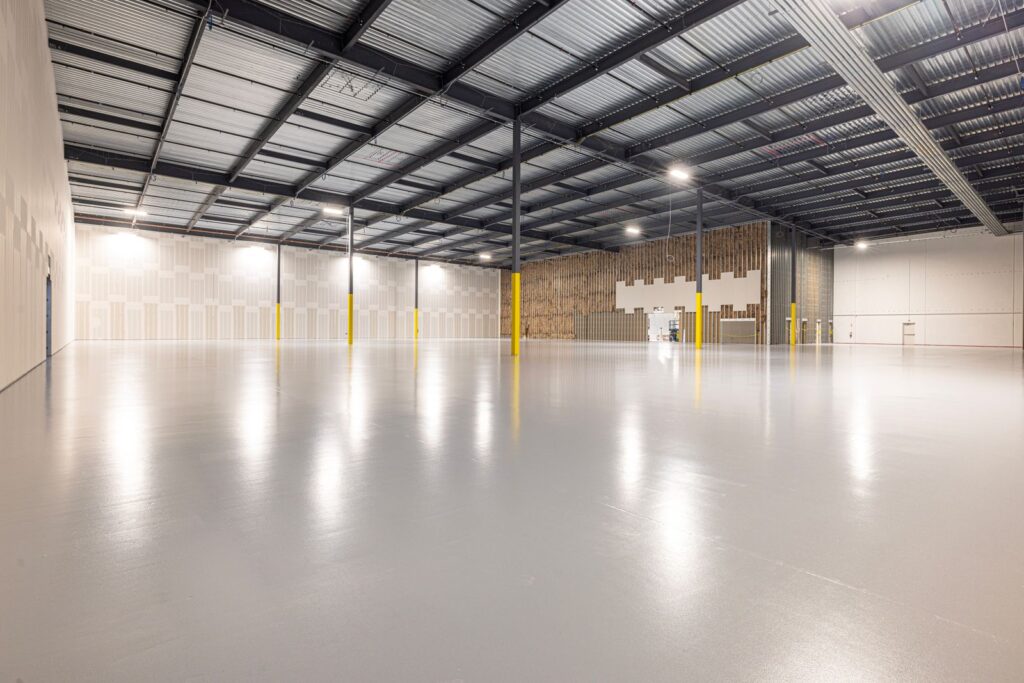
Illustration image: stock source (Pexels 36217325), not an actual Kadier project.
