

 Tiếng Việt
 中文 (中国)
Which park this is, and why the address needs stating clearly
IDICO Huu Thanh Industrial Park, developed by IDICO Corporation – JSC, was established under Decision 3469/QD-UBND dated 26 August 2016, covers 524.14 ha, and has an operating term to 2069. The park is in Duc Hoa commune, Tay Ninh province (formerly Huu Thanh commune, Duc Hoa district, Long An province).
This article is about IDICO Huu Thanh Industrial Park in Duc Hoa commune, Tay Ninh province (formerly Huu Thanh commune) — not The Ky Industrial Park (119 ha, Hai Son investor), which is also on the former Huu Thanh commune’s land, and not Hai Son Industrial Park.
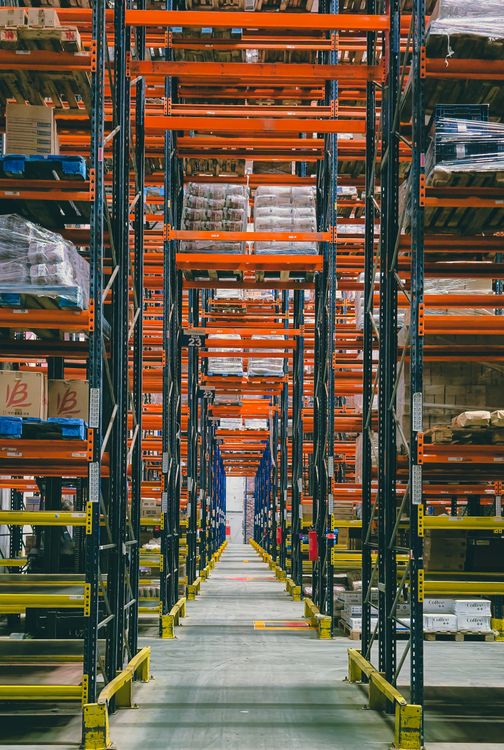
Illustrative photo: a warehouse aisle with racking and a concrete floor (stock photo, not Huu Thanh Industrial Park and not a Kadier project).
The Long An Economic Zone Management Board issued the first investment certificate on 16 August 2019; the InvestVietnam portal records the start of operations as 6 August 2019. Construction of the park started on 6 June 2020. According to IDICO, the park is connected to the Ho Chi Minh City – Trung Luong expressway, Ring Road 3 and the seaport system; the Ben Luc – Long Thanh expressway fully opened on 1 October 2026, adding a connection towards the south-east region.
Why floors are a live decision here right now
In March 2026, IDICO recorded two new projects in the textile and footwear value chain breaking ground in the park, including Stepwell Technology, which broke ground on 14 March 2026 on a foam-components factory for the footwear industry at lot B-2-7-1, covering over 1 ha. The second project in the same month was not named in the source read, so this article does not name it.
At the same time, IDICO offers ready-built factories and warehouses for lease in the park (according to IDICO’s ready-built factory page, a planned 28 ha, factory area 12.73 ha, units from 1,000 m² to 10,000 m²). A tenant taking a ready-built unit faces an immediate decision: keep the handed-over floor, coat it with epoxy, or rework it before installing machines and racking.
The tenant mix is already taking shape. On 10 July 2026, Suntory PepsiCo Vietnam Beverage Co., Ltd. inaugurated a plant in Huu Thanh Industrial Park (Duc Hoa commune), covering 20 ha, with an expected total investment of about USD 300 million, a designed capacity of about 1.244 billion litres per year, and its 6th plant in Vietnam. This is context about the park’s tenant mix, not a Kadier project. Bao Tay Ninh reported that an auto-parts and accessories factory of Shiliduo Vietnam Industrial Co., Ltd. (3 ha, total investment USD 14.5 million according to the article) has been inaugurated in the park.
In other words, three floor moments are happening in the same park at once: new factories under construction, ready-built units just handed over, and operating plants that need floor refurbishment. Each needs different substrate preparation, even though all of them are described with the same word, epoxy.
Choose the floor by zone, not one floor for the whole park
According to IDICO’s investment-attraction list, the park admits: electrical and electronic equipment and components; machinery and precision engineering; production, repair and assembly of motorcycles, automobiles, tractors and transport vehicles; wood products and furniture; ceramics and glass; plastics; rubber; paper and packaging (no wood-pulp production); textiles and garments (no dyeing, no washing, no stone-washing); leather (no tanning); food and animal feed; pharmaceuticals; chemicals and cosmetics; logistics, warehousing and rental factories.
The exclusions in parentheses are part of the list, not an added note. A dyeing plant or a tannery is not admitted to this park, and its floor problem is not this park’s problem. Depending on the actual substrate and load survey, zone-by-zone thinking runs as follows:
- Dry production areas with heavy traffic: a floor that resists abrasion and repeated wheel loads, is easy to keep free of production dust, and has clear lane markings so forklifts and pedestrians do not share the same path.
- Warehouse and logistics areas: a floor that carries forklift wheel loads, racking loads and impact from loading, stays flat, and does not shed dust into stored goods.
- Wet and food-adjacent areas: a seamless, washable floor with few joints where water and dirt can sit; coving, drains and gullies must be treated together with the floor surface, not separately.
- Chemical-adjacent areas: only where the admitted scope allows that industry, and only once the chemical, its concentration and its contact time have been established by survey; no single floor automatically resists every chemical.
The contrast is instructive when read alongside epoxy flooring for Phu An Thanh Industrial Park: Phu An Thanh is in the same province, Tay Ninh (former Long An), but it has pollution zones for dyeing, plating and tanning — exactly the part Huu Thanh excludes. The two parks teach each other by opposition: the same floor question, but a different admitted-industry list gives a different answer.
New factory, ready-built factory, existing floor: three different starting points
A new factory starts from a freshly laid concrete slab. The first job is to check whether the slab is old enough, dry enough and flat enough, and to treat cracks, joints and residual moisture before any coating is chosen. Coating in a hurry over a slab that is not ready is the fastest way to a floor that peels within months, however good the coating system is.
A ready-built factory starts from a handed-over floor. The question is not new versus old, but whether the handed-over floor meets the racking loads, forklift loads and cleanliness requirements of the incoming industry. If it is flat and strong enough, an epoxy coat may need only surface preparation; if it is cracked, damp or under-strength for the new loads, the substrate must be repaired first, and the handover programme must allow time for that repair.
An existing operating floor starts from a worn surface that may carry oil, chemicals or several rounds of patching. Here the survey must answer what the old layer is, how much adhesion remains, and whether it needs full removal or only local treatment. A new coat should not be applied directly over an old layer whose adhesion is unknown, because the new layer will fail together with the old one underneath.
What to check before choosing: a survey checklist
Before a floor system is fixed, the owner or tenant should ask the survey to answer six questions, and every system recommendation should be tied to those answers, depending on the actual substrate and load survey:
- Current substrate condition: new or old concrete, cracked, hollow, delaminated, or already coated with an earlier layer?
- Substrate moisture: residual moisture, rising damp, or areas that regularly hold water?
- Load and traffic: which forklifts, what wheel loads, where the racking sits, and whether pedestrian and vehicle routes are separated?
- Wet, chemical and heat exposure: which areas stay wet, which chemicals may spill, and for how long?
- Downtime window: how long can the area be closed for preparation, application and curing before it returns to use?
- Park constraints: is the industry within IDICO’s investment-attraction list for Huu Thanh Industrial Park, and does the area fall under an exclusion (dyeing, washing, stone-washing, tanning, wood-pulp production)?
A quotation only means something when it is tied to these six answers. A quotation without a substrate survey is easy to compare wrongly: the same area in a new factory, a ready-built unit and an old plant involves completely different preparation work.
Neighbouring Duc Hoa parks: do not confuse one park with another
Readers looking for a floor in Huu Thanh often also look at neighbouring Duc Hoa parks, but each park poses a different floor problem. The general article on epoxy flooring for Duc Hoa Industrial Park places Huu Thanh in the wider local picture, while two park-specific neighbours go deeper into their own parks: epoxy flooring for Tan Duc Industrial Park (Duc Hoa), with the angle of an integrated park holding both old and new factory floors, and epoxy flooring for Xuyen A Industrial Park (Duc Hoa), with floors by phase and industry. Huu Thanh differs from both: its problem is new factories breaking ground in 2026 plus ready-built units for lease, in an IDICO park that is still filling, not a long-established integrated park or a phased park.
Survey and quotation
If your factory or warehouse is in Huu Thanh Industrial Park, start with a substrate survey: send the area to be floored, its size, the industry, the current substrate (new concrete, a ready-built unit’s handed-over floor, or an existing operating floor) and the window in which the area can be closed. Kadier will base its system recommendation for each zone on the actual substrate and load survey, rather than recommending one floor for the whole plant. See the epoxy floor coating quote page or contact Kadier through the contact page to arrange a survey. This article gives no floor price, no warranty period, and does not present Kadier as the park developer or a land broker — Kadier supplies and applies epoxy flooring for factories and warehouses.
