

 Tiếng Việt
 中文 (中国)
Choosing the wrong coating system usually costs more than choosing an expensive one: a good-looking system with the wrong function will need early repair, recoating or replacement, while a system with a higher initial material price but the right function and the right substrate will have a lower total cost over its period of use. This summary article helps you narrow to 1–2 suitable system groups from function and budget, before contacting us for a quotation. This article states no specific prices, no warranty periods, no discounts or promotions, and no detailed specifications for each system — all specific specifications follow the TDS and a survey of the actual substrate.
Step 1 — Define function first, ask for a price second
Before asking for a price, answer the following 6 questions. These are also the 6 items to send when contacting us for a quotation, so the quotation is close to reality from the start:
- Function and zone: workshop, cold store, hospital, basement car park, food plant, or cleanroom and electronics?
- Loads: pedestrians, forklifts or trucks; frequent turning or static parking only?
- Chemicals, temperature and substrate moisture: which chemicals contact the floor, what the service temperature is, whether the substrate is damp?
- Specific requirements: slip resistance, electrostatic discharge (ESD) control, or specific hygiene requirements?
- How long may operations stop for application?
- What is the area and current substrate condition, with photographs of the actual substrate?
Step 2 — Qualitative function matrix
The table below is only an initial guide by function. Every cell carries the same note: the system TDS and the substrate survey result decide in the end. The table does not rank any system as “best”, because the best system only exists in a specific project with a specific set of conditions.
| Function | System group to compare first | Note |
|---|---|---|
| Zones needing electrostatic discharge control | Anti-static group such as StatGuard | Only for zones with an ESD requirement; resistance range per the TDS |
| Damp substrates or odour-sensitive application conditions | Water-based, moisture-tolerant group such as AquaBase | Permitted moisture limit per the TDS of each system |
| High-aesthetic flat surfaces needing absolute flatness | Self-levelling group such as LevelFlow | High substrate-preparation and applicator-skill requirements |
| Large areas with a tightly balanced budget | Roller group such as RollCoat | Compare by lifecycle cost, not material price alone |
See the overview of systems at the epoxy coating systems page before comparing each system against your function.
Step 3 — Read the budget by lifecycle cost: 5 components
The initial material price is not the total cost. When comparing budgets between options, compare all 5 components below, on the same project and the same substrate conditions:
- Materials: the coating system and its component coats per the agreed system design.
- Application and substrate preparation: especially moisture treatment, crack repair and substrate grinding — this item can push costs up if a poor substrate is not surveyed first.
- Downtime: the time a store, workshop or zone must stop operating during and after application.
- Cleaning and maintenance: daily cleaning costs and periodic maintenance per the actual operating process.
- Repair and recoating: the cost of localised repair or recoating when the floor deteriorates.
In this article, “low, medium or high budget” is only a relative level comparing options within the same project, not a price per square metre and not a price list.
Step 4 — 4 expensive mistakes
- Choosing by material price while ignoring substrate treatment: an untreated damp or cracked substrate will ruin the coating however good the material is.
- Choosing a good-looking system with the wrong function: for example a smooth, glossy floor for a wet zone that needs slip resistance.
- Ignoring the cleaning-chemical list: daily disinfectant and cleaning chemicals can also damage the floor surface if not checked in advance.
- Accepting by eye without keeping a measurement file: with no moisture, thickness and adhesion baselines, later tracking and repairs will lack a basis.
Checklist before contacting us for a quotation
Prepare the following so the quotation is close to reality: the 6 function questions in step 1, photographs of the current substrate, the list of cleaning and process chemicals, and the permitted downtime. The fuller the customer preparation, the faster and more accurate the TDS comparison and quotation.
Contact for a quotation: send the 6 items in the checklist above via the quotation page or the contact page (hotline/Zalo 0899355489, WeChat wxid_95o54joujyrr12) for a comparison of the coating system suited to the function and budget of your project.
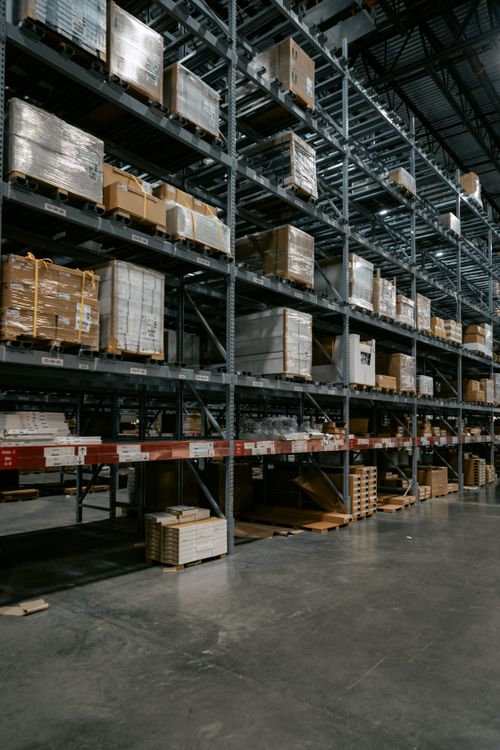
Illustration: a warehouse with high racking and a wide concrete floor, illustrating the scale of a project needing function defined before a system is chosen. Pexels stock photo (photo ID 10697106), illustrating a warehouse space, not a photograph of a Kadier project.
