

 Tiếng Việt
 中文 (中国)
How VSIP differs from the rest of the cluster: a Singapore-style “clean” benchmark
VSIP is known as the Vietnam–Singapore model industrial park, developed by Becamex IDC together with a Singapore consortium led by Sembcorp. That positioning is more than a branding story: it brings with it an industry filter. The priority industries are electronics and components, precision engineering, pharmaceuticals and medical devices, premium consumer goods, automobiles and supporting industries, food technology and logistics. By contrast, heavily polluting industries such as toxic chemicals or large-scale metallurgy are strictly restricted at VSIP I, according to consolidated industry sources.
For anyone choosing a floor, that industry filter matters more than any claim about gloss. An electronics plant and a dyeing textile mill cannot share the same flooring answer, even within the same geographical area. At VSIP, the core flooring problem is a flat, seamless, low-dust surface that is easy to clean and — where required — controls static electricity. That is why this article looks at each VSIP generation in turn, instead of repeating the overview of the whole cluster.
Note on names: “Binh Duong” in this article is a familiar geographical area name; administratively today, the former Binh Duong area belongs to Ho Chi Minh City following the merger effective 01/07/2025. This article does not use the old name as a current administrative unit.
Three VSIP generations, three flooring problems
VSIP I: renovation is the main job
VSIP I has been in operation since 1996, covering around 500 ha with an occupancy rate of close to 100%, according to consolidated sources. After nearly three decades of operation, many workshops here are older plants or ready-built factories leased out again. The flooring problem therefore leans towards renovation: grinding the old concrete floor, treating cracked joints and oil stains, overcoating an old coating that still adheres well enough, and working in sections so the plant does not have to halt production entirely.
Before deciding whether to overcoat or strip the old layer and start again, the floor must be surveyed in practice: the adhesion of the old coating, floor moisture, the extent of cracking and oil contamination. There is no single answer for every old workshop — some only need overcoating after grinding and localised treatment, while others must be stripped completely because the old coating has peeled over a wide area.
VSIP II: demanding FDI-style acceptance
VSIP II sits within the area’s large integrated complex. On area, secondary sources give different figures depending on what is measured — the core industrial park, or the park including its expansion and the wider complex — so this article states no absolute figure. What is more certain is its character: large FDI plants with demanding acceptance requirements.
FDI-style acceptance usually checks the floor against its own checklist: thickness measured at many points, load testing, handover records and the cleanliness standard of each zone. A floor that looks good but lacks clear acceptance documentation can still fail. So when choosing a coating system, the investor should settle in advance: which zones need an absolutely flat finish, which need static control, which carry forklifts, and by what criteria each zone will be accepted.
VSIP III: new floors on new concrete
VSIP III, in the former Bac Tan Uyen – Bau Bang area, is the newer land bank in the system. The problem here is the reverse of VSIP I: new floors on new concrete. Three jobs must not be skipped: waiting until the concrete is old enough, measuring floor moisture, and choosing a suitable primer before coating. Coating new concrete that is still damp is a common cause of later blistering, even when the initial coating looks perfect.
A third difference, less often mentioned, is the landlord-investor’s problem: ready-built workshops and built-to-suit workshops leased out need a “neutral” floor — flat enough, clean enough, easy to maintain and easy to renovate when the next tenant changes industry. A landlord’s floor differs from an owner-occupier’s floor: one needs flexibility for the next tenant, the other needs optimisation for one specific production line.
Floors for electronics and precision engineering: anti-static, flat, low-dust
Electronics and precision engineering plants need a flat, low-dust floor that stays stable as precision equipment moves. In zones with anti-static requirements, the direction is the StatGuard anti-static coating system, but the anti-static area must be drawn clearly on the floor plan from the start, with earthing and testing carried out to that plant’s own procedures. Each plant has its own standard, so this article sets no single threshold or common standard for all electronics plants.
For general production areas that need a flat, seamless finish, the LevelFlow self-levelling coating system is the suitable direction. For more detail on when full-zone anti-static protection is needed and when only localised zones need it, see Epoxy flooring for electronics plants: anti-static and cleanroom requirements and Anti-static epoxy flooring for cleanrooms and electronics plants.
Floors for pharma, medical devices and food: seamless, easy to clean
Pharma, medical device and food technology areas need a seamless floor with no joints where dirt can collect, able to withstand frequent cleaning and resist deep staining. Coved wall bases, sealed joints and wet zones separated from dry zones are details that decide long-term cleanability, no less important than the main coating.
To be clear: an epoxy floor is only one infrastructure component; whether a plant meets its standards depends on the plant’s whole management and operating system, not on the coating alone. For the flooring framework for this industry group, see Epoxy flooring for pharmaceutical plants meeting GMP and Epoxy for cleanrooms, pharma and food plants. For wet areas, the AquaBase water-based, low-VOC coating system is worth considering when the survey confirms the floor conditions suit it.
Warehouse and in-park logistics floors: forklift loads, line marking, slip resistance
Warehouses and logistics inside VSIP carry very different loads from production floors: fully loaded forklifts turning continuously, heavy pallets dragged across the floor, and traffic lines that must stay legible after long use. The usual direction is the RollCoat roller-applied system for forklift traffic, combined with line marking and slip-resistant treatment at turning areas and walkways. Outdoor or semi-outdoor areas need an extra consideration — a chalk-resistant topcoat under UV light, since epoxy generally does not withstand prolonged direct sunlight.
How the floor is prepared before coating — grinding, crack repair, moisture measurement — decides much of the coating’s service life; see Concrete floor preparation before epoxy coating: grinding, crack repair, moisture testing.
Choosing a coating system for each zone in a VSIP plant
Instead of asking “which epoxy floor is best for VSIP”, the right question is “which zone, which industry, a new floor or an old floor”:
- Electronics and precision engineering zones with static requirements: survey the plant’s ESD requirements, place StatGuard only in the required area, and do not spread it across the whole plant when it is not needed.
- General production zones needing a flat, seamless finish: LevelFlow self-levelling.
- Pharma and food zones: seamless, easy to clean, resistant to cleaning agents; separate wet and dry zones.
- In-park warehouses and logistics: RollCoat for forklift traffic, line marking, slip resistance.
- Old VSIP I workshops: survey the old coating first, prioritise phased renovation; strip and redo only when the old coating no longer adheres well enough.
- New VSIP III workshops: wait until the concrete is old enough, measure moisture, choose a suitable primer, then coat.
The final specification of each coating system follows the paint manufacturer’s technical documents and the results of the on-site survey; this article only sets out a general selection framework and does not replace a floor survey or the manufacturer’s data sheets.
Frequently asked questions
How does floor selection differ between VSIP I, II and III?
It differs in floor age and purpose. VSIP I leans towards renovating old floors in phases; VSIP II leans towards demanding FDI acceptance with thickness measurement and load-test records; VSIP III leans towards new floors with moisture control and concrete age. It also differs by role: an owner-occupier’s floor differs from a landlord’s ready-built rental workshop floor.
Does an anti-static floor need to cover the whole plant?
No. Only zones with anti-static requirements need an ESD system, with its area drawn clearly on the floor plan and tested to that plant’s own standard. Covering everything wastes money and complicates maintenance.
Can an old workshop be overcoated, or must the old layer be stripped?
It depends on the survey of the old layer: adhesion, moisture, cracking and oil contamination. An old layer that still adheres well can be ground and overcoated; one that has peeled over a wide area must be stripped and redone. The decision should not be made by eye alone.
What information should I send to get advice?
Send whether your plant is in VSIP I, II or III, which industry (electronics, pharma, food, logistics or another), the area, whether the floor is old or new, and any cleanliness or load requirements. From that, Kadier can advise a suitable coating system and arrange an on-site survey.
Contact for advice and quotations
Is your plant in VSIP I, II or III, and in which industry? Send the area, the type of workshop or warehouse, and any cleanliness or load requirements to receive advice on a suitable coating system. Quotations are prepared after an on-site survey, with no single rate applied to every plant — see the process on the Epoxy floor coating quote page or contact us via the Contact page (hotline/Zalo 0899355489, WeChat wxid_95o54joujyrr12).
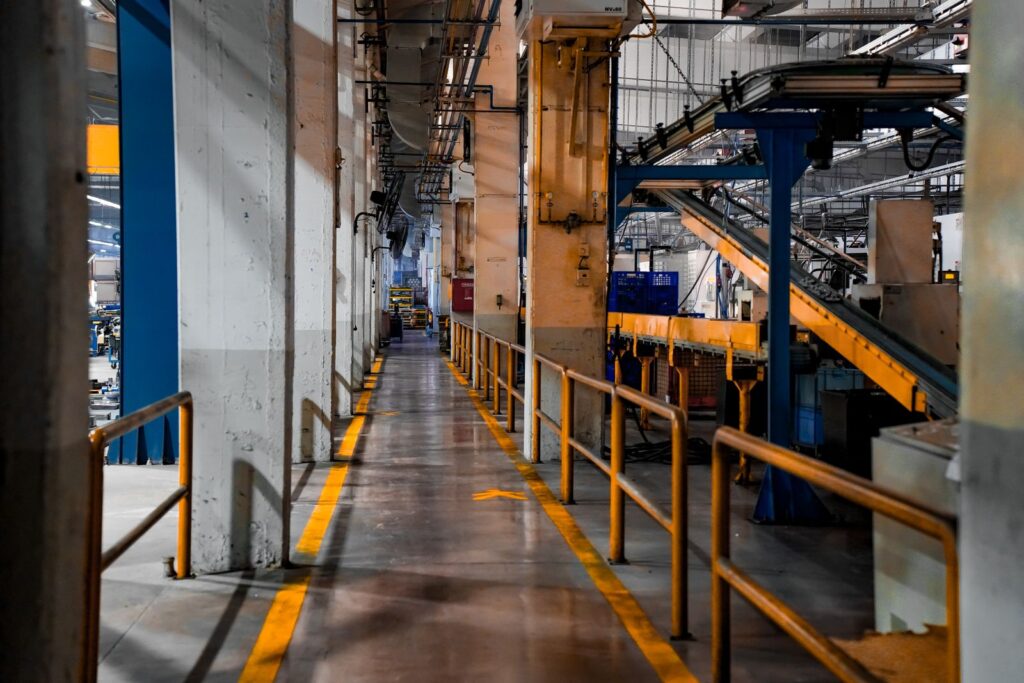
Illustration: a modern industrial plant, Pexels stock photo by Yetkin Ağaç. Illustration only, not a Kadier project.
