

 Tiếng Việt
 中文 (中国)
Bien Hoa: the oldest FDI centre in Dong Nai — why renovation is the main axis
Bien Hoa is the long-established FDI industrial centre of Dong Nai, with plants that have been operating for around 30 years. Unlike Long Thanh or Nhon Trach, where new floors account for a large share, the problem in Bien Hoa leans towards renovating workshops in operation: grinding old floors, treating cracks and oils, phased overcoating, and using low-odour systems so production is not affected. This article looks at each zone in turn — Amata, Bien Hoa 2 and the special case of Bien Hoa 1 — instead of repeating the overview of the whole Dong Nai cluster.
Note on names: Bien Hoa, Amata and Long Binh in this article are familiar geographical area names within the present-day Dong Nai area (the new Dong Nai comprises the former Dong Nai and former Binh Phuoc following the merger effective 01/07/2025).
Amata and Bien Hoa 2: two industry filters, two ways of choosing a coating system
Amata: clean, electronics, pharma — its own filter
Amata has been in operation since 1994, covering more than 500 ha according to consolidated sources, developed by a Thai investor with international-standard infrastructure, its own power plant and high-standard wastewater treatment. Its industries lean towards high technology and added value: electronics components, precision engineering, auto and motorcycle parts, pharmaceuticals and cosmetics, supporting industries and logistics. According to rental listings for workshops in the park, Amata restricts dyeing textiles, electroplating and chemical industries — note that this is secondary information, used here only as orientation, not asserted as a currently applicable official regulation.
With that filter, floors at Amata lean towards flat, seamless, low-dust and easy-to-clean finishes. In electronics and precision engineering zones with static requirements, the direction is the StatGuard anti-static coating system, with its area drawn clearly and tested to that plant’s own standard — see the detailed framework in Epoxy flooring for electronics plants: anti-static and cleanroom requirements. General production zones needing a flat, seamless finish suit the LevelFlow self-levelling coating system. Pharma and cosmetics zones need seamless, easy-to-clean floors resistant to cleaning agents — see Epoxy flooring for pharmaceutical plants meeting GMP.
Bien Hoa 2: mixed, with chemicals and materials
Bien Hoa 2 is a mixed industrial park, highly occupied according to consolidated sources, with engineering, chemicals and materials. Floors here must therefore also allow for chemical resistance at a suitable level and machine loads — quite unlike Amata, which leans towards clean and electronics. Zones with light, occasional chemical contact differ from zones with frequent contact and zones at risk of leaks; each level has a different direction, and which chemicals a given system resists, at what concentration and for how long, must be checked against the manufacturer’s chemical resistance table and the on-site survey results — see Chemical resistance of epoxy floors: lookup by acid concentration and Epoxy flooring for chemical plants: acid and alkali resistance.
The Amata–Bien Hoa 2 comparison within one city is the core difference of this article: both are in Bien Hoa, but one filters for clean industries and the other is mixed with chemicals, so they cannot share one flooring answer.
Bien Hoa 1 changes function: the “do not build a new floor” angle
Bien Hoa 1 is on a path of functional conversion towards urban and service uses, according to consolidated sources. This article does not advise new plant floors at Bien Hoa 1: the real need here, if any, is renovation or handover of premises during the conversion. Every statement about the conversion timeline stays at the level of “on a conversion path” as of the source, with no specific timeline stated. Workshop owners in a converting zone should confirm the planning and handover schedule before investing in a new floor — to avoid building a floor for premises about to change function.
This is the only angle in the in-depth series written as a “do not build” warning, and it matters no less than the “how to build” guides: a new floor only pays for itself when the workshop’s remaining useful life is long enough to recover the cost.
Renovating an operating FDI workshop floor: grinding, phased coating, low-odour systems
A 30-year-old FDI workshop in Bien Hoa usually has the same set of problems: an old concrete floor, cracked joints, oil contamination, and an old coating peeling locally. Renovation starts with a survey — old-layer adhesion, floor moisture, cracking and oil contamination — detailed in Concrete floor preparation before epoxy coating: grinding, crack repair, moisture testing. Phased work, one zone handed over at a time, lets the plant keep producing; for areas in operation and sensitive to odour, low-odour water-based systems are worth considering — see the AquaBase water-based, low-VOC coating system.
Warehouses and logistics at Bien Hoa carry forklift loads and need line marking and slip resistance — the usual direction is the RollCoat roller-applied system for forklift traffic. For the framework distinguishing factory floors from warehouse floors, see How does epoxy flooring differ between factories and logistics warehouses?
FDI-style acceptance: thickness measurement, load testing, records
FDI plants usually accept floors against their own checklist: thickness measured at many points, load testing in load-bearing zones, adhesion checks and handover records by zone. Preparing acceptance documentation from the start — settling each zone’s criteria before work, measuring and recording during work — costs far less than arguing after the floor has been handed over. A good-looking floor without thickness and load-test records can still fail.
The final specification of each coating system follows the paint manufacturer’s technical documents and the results of the on-site survey; this article only sets out a general selection framework and does not replace a floor survey or the manufacturer’s data sheets.
Frequently asked questions
How does floor selection differ between Amata and Bien Hoa 2?
Amata leans towards clean, electronics and pharma, so its floors lean towards flat, seamless, low-dust finishes and anti-static protection where needed. Bien Hoa 2 is a mixed park with chemicals and materials, so its floors must also allow for chemical resistance and machine loads. Both are in Bien Hoa, but two different industry filters lead to two different ways of choosing a coating system.
Should a new floor be built at Bien Hoa 1?
Do not rush into a new floor while the zone is on a conversion path towards urban and service uses. Confirm the planning and handover schedule first; the real need here, if any, is usually renovation or handover of premises.
Can a workshop in operation be coated with epoxy?
Yes, with phased work and low-odour systems: one zone at a time, handed over zone by zone, without halting all production. The conditions are a prior floor survey and a work schedule matched to the plant’s production schedule.
What information should I send to get advice?
Send whether your plant is in Amata or Bien Hoa 2, whether the floor is old or new, which industry, and the current floor condition. From that, Kadier can advise renovation or a new floor and arrange an on-site survey.
Contact for advice and quotations
Is your plant in Amata or Bien Hoa 2, with an old or new floor, in which industry? Send the area and the floor condition to receive advice on renovation or a new floor. Quotations are prepared after an on-site survey — see the process on the Epoxy floor coating quote page or contact us via the Contact page (hotline/Zalo 0899355489, WeChat wxid_95o54joujyrr12).
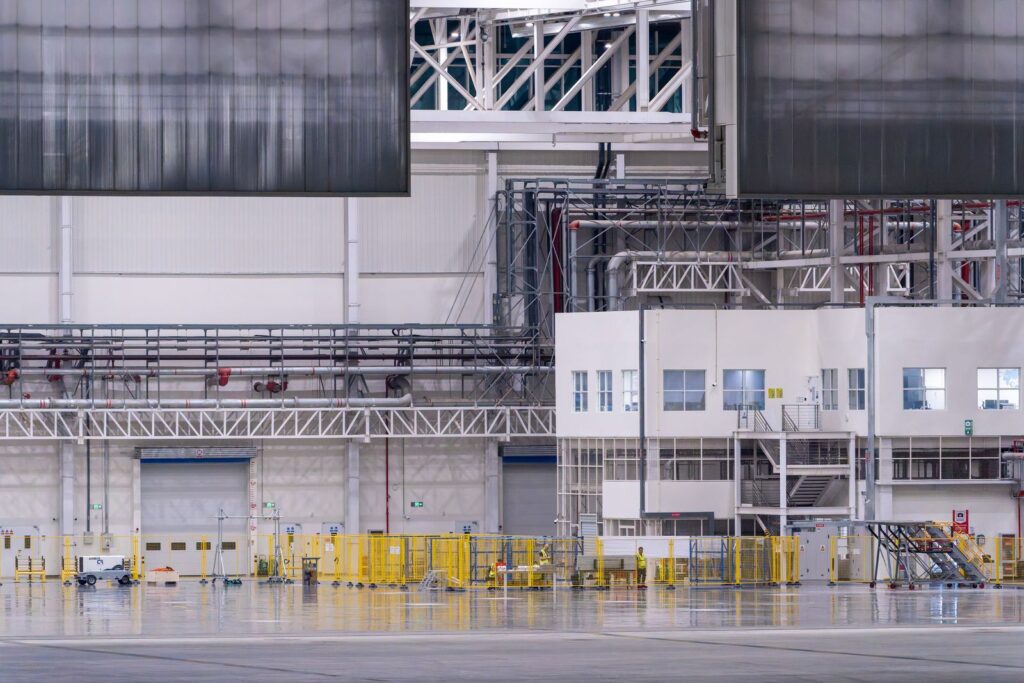
Illustration: a modern industrial plant, Pexels stock photo by Peter Xie. Illustration only, not a Kadier project.
