

 Tiếng Việt
 中文 (中国)
Long Hau Industrial Park in Long Hau commune, Can Giuoc, is not a single-industry park. Within one park boundary, a food processing plant sits near a logistics warehouse, a packaging plant sits near an electronics and precision engineering workshop, and a pharmaceutical and cosmetics plant sits near an apparel factory. Each industry puts a different demand on the floor, which is why one blanket epoxy answer for the whole park will be wrong in at least one zone. This article maps Long Hau floors by functional zone, so an investor can see where to invest properly and where a lighter system is enough.
A note on names: “Long An” in this article is the familiar geographic name; administratively the area is now in Tay Ninh province following the merger of 01/07/2025. The article uses “Long An” so readers can recognise Long Hau in Can Giuoc, not as a claim about the current administrative unit.
Long Hau at a glance: one park at the southern gateway of Ho Chi Minh City
Long Hau is developed by Long Hau Corporation and has operated since 2006. It comprises three existing components: Long Hau IP at 137.02 ha, Long Hau IP Expansion at 108.48 ha, and Long Hau 3 IP Phase 1 at 123.98 ha. This article lists only these three components, because different sources still report the wider zone total on different bases, and a combined figure that also sweeps in residential land or future phases would mislead anyone estimating floor area.
Location is what shapes the floors here. Long Hau is about 3 km from the SPCT container port and the Saigon–Hiep Phuoc port system, about 12 km from Phu My Hung, about 19 km from the centre of Ho Chi Minh City and about 25 km from Tan Son Nhat airport. Goods therefore move in and out of the park closely tied to port transport and distribution into Ho Chi Minh City, while workers and specialists can travel from the south of the city. Warehouse and factory floors in Long Hau consequently carry a higher import and export rhythm than a purely inland park, and coating schedules have to reckon with plants that cannot shut down entirely to recoat a whole floor.
The Long An cluster overview already placed Long Hau inside the two-pole Duc Hoa–Can Giuoc picture; this article goes deep into a single park. For the wider cluster comparison, see Epoxy Flooring for the Long An Industrial Park Cluster (Duc Hoa, Can Giuoc).
Industries and floor types by functional zone
Food and fast-moving consumer goods: seamless floors that stand up to repeated washing
Food processing and fast-moving consumer goods are among the park’s attraction sectors, from processing and packing to distribution. Floors here need to be seamless, with few joints, easy to clean and resistant to repeated washing, with coved skirting and sealed joints in cleaner areas so dirt does not collect at wall bases and joint edges. Wet areas also need slip resistance when wet and good drainage, but the texture must be balanced against cleanability: too rough a finish traps residue and makes cleaning heavier. For the food-plant framework, see Epoxy flooring for food plants: hygiene safety and HACCP. To be clear: the floor is only one infrastructure component; a plant’s compliance status belongs to the plant’s own management and operating system as a whole.
Packaging and supporting industries: abrasion resistance, easy cleaning, clear lane marking
Packaging, printing and supporting workshops typically run medium forklifts, trolleys and pallets continuously, alongside fixed machinery. Floors need abrasion resistance on traffic lanes, light oil resistance in mechanical areas and easy cleaning in packing areas, plus lane marking that separates vehicle routes from pedestrian walkways. The RollCoat roller system suits general areas with moderate requirements, while areas needing a flatter, more seamless finish should consider the LevelFlow self-levelling system. The most common failure in this group is not the coating itself but the fixed traffic lane: handover testing should be done on the actual main traffic lane, not only on a general surface check.
Electronics and precision engineering: flat, low-dust floors with a separate anti-static zone
Electronics and precision engineering workshops need flat, seamless, low-dust floors, because dust and uneven ridges both interfere with assembly work and equipment movement. Where anti-static performance is required, the direction is the StatGuard system — but only in the zone that actually requires it and to the investor’s own standard. Coating an entire factory anti-static when only one zone needs it is both costly and harder to maintain to standard. Remaining areas use a roller or self-levelling system according to the flatness required, and the boundary between the two systems must be detailed with a clear joint from the design stage.
Pharmaceuticals and cosmetics: seamless, wash-resistant floors installed with low odour
Pharmaceuticals and cosmetics are Long Hau’s clean highlight. Floors need to be seamless, with few joints, easy to clean and resistant to frequent washing, with coved skirting and sealed joints. For the pharmaceutical framework, see Epoxy Flooring for Pharmaceutical Plants Achieving GMP Standards. In areas that stay in operation and are sensitive to odour, the water-based AquaBase system is worth considering, because it allows work in phases with less effect on neighbouring production areas. As with food plants, the floor is one component only; plant status belongs to the plant’s own system.
Apparel: durable, bright, easy-to-clean floors with clear production zoning
Apparel workshops have high labour density, densely placed sewing tables and continuous fibre, thread and fabric dust. Floors need to stand up to heavy foot traffic, stay bright for inspection, clean easily and zone clearly between cutting, sewing, quality checking and packing. Most of the area can use a roller system, reserving self-levelling for high-flatness areas such as end-of-line quality checking and packing. A common mistake is choosing one dark floor colour for the whole workshop to hide dirt, then finding the quality-checking area too dark to spot fabric defects — floor colour should follow the function of each zone, not a habit of hiding dirt.
Logistics and cold chain: load-bearing, slip-resistant floors with joints that tolerate movement
Given its port-linked advantage, logistics and cold chain are a major part of Long Hau, not merely a supporting function. Warehouse floors carry forklifts and trucks, high in-and-out frequency and dust from yards, so they need concentrated abrasion resistance on fixed traffic lanes, slip resistance on walkways and turning points, and durable lane marking. For the heavy-traffic framework, see Epoxy flooring for forklift and heavy truck floors. In cold stores and temperature-transition areas, joints and coatings must allow for movement caused by temperature change and condensation; coating over a moving joint without treating the joint will crack again in exactly the same place.
Warehouse aisles: Long Hau’s biggest floor problem
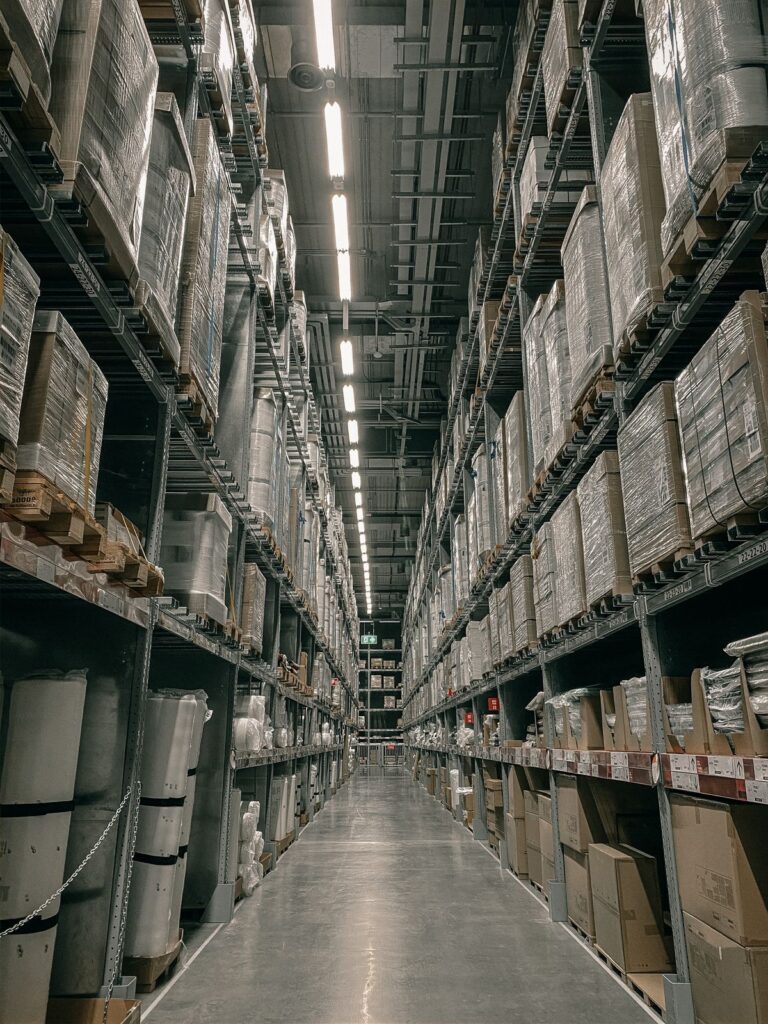
If only one zone in Long Hau deserves the most careful floor investment, it is the warehouse aisle. An aisle is where forklifts run the same route day after day, rack legs concentrate load at single points, and pedestrians cross vehicle routes at many points. Three requirements must travel together: abrasion resistance on the traffic lane, slip resistance on walkways and turning points, and lane marking that stays legible rather than peeling within months. A beautiful coating with faded marking loses its traffic-separation purpose, and a load-bearing coating that is slippery when wet is dangerous precisely at a turning point. At survey stage, record the main traffic route, rack-leg positions, turning points and pedestrian–vehicle crossings, because those four facts determine the system and the slip-resistance level — not the warehouse area in general.
Three factory formats, three different floor starting points
Long Hau offers land for self-build, ready-built factories for lease and multi-storey factories, and each format gives the floor a different starting point. A self-built factory on a new slab allows the floor to be designed from the start, but the concrete still needs a moisture and flatness survey before coating, because a new slab is not necessarily dry and flat as drawn. A ready-built factory has an existing floor: the main job is assessing the old floor — cracks, old coatings, oil penetration, moisture — before deciding whether to grind deep, repair or recoat, rather than coating over a delaminating old layer. A multi-storey factory adds a per-floor problem: flatness, joints and the route for moving materials to upper floors all differ from the ground floor, so each floor needs its own survey instead of one system applied to the whole building. In short, do not ask “what does epoxy for a Long Hau factory cost” before answering “what condition is that factory’s floor in”.
Quick map: functional zone, system direction and watch-out
The table below is only an initial direction; the final system must still be settled after a floor survey and confirmation of the investor’s requirements.
| Functional zone | System direction | Watch-out |
|---|---|---|
| Food, fast-moving consumer goods | LevelFlow; AquaBase for areas in operation | Seamless, easy to clean, wet-area slip resistance balanced for washing |
| Packaging, supporting, light mechanical | RollCoat; LevelFlow where flatness matters | Traffic-lane abrasion, light oil resistance, lane marking |
| Electronics, precision engineering | LevelFlow; StatGuard only where required | Flat, low dust, clear anti-static zone boundary |
| Pharmaceuticals, cosmetics | LevelFlow; AquaBase for odour-sensitive areas | Seamless, coved skirting, sealed joints, phased work |
| Apparel | RollCoat for most areas; LevelFlow for quality checking | Bright, easy to clean, zoning by production line |
| Logistics warehouses, cold chain | Abrasion-resistant RollCoat, durable lane marking | Traffic lanes, turning points, joints tolerating temperature and moisture movement |
Working while the plant operates: phasing, low odour, clean separation
Most plants in Long Hau cannot stop all production to recoat a floor, so work has to be phased by zone. The practical rule is: coat the least disruptive zone first, keep one walkway and one clean buffer zone between the work area and production, and open a new zone only once the previous zone is confirmed ready for use by the coating team and the investor. In odour-sensitive areas, a water-based system is worth considering; in high-moisture areas, a moisture barrier and a suitable primer are mandatory before coating, because moisture from the slab is a leading cause of blistering. Before coating, the slab must be ground, cracks repaired, oil treated and moisture tested; epoxy does not repair a slab that is settling or cracking for structural reasons, and coating over such a slab only hides the crack for a short time.
Frequently asked questions
For a Long Hau workshop, roller system or self-levelling?
It depends on the zone. General, packaging and most apparel areas can use a roller system; zones needing high flatness and seamlessness, such as electronics, pharmaceuticals, quality checking and clean areas, should consider self-levelling. Anti-static coating belongs only in the zone that requires it. Do not choose one system for a whole factory merely because it simplifies the quotation.
How does a port-linked Long Hau warehouse differ from an inland warehouse?
Vehicle movements are more frequent, fixed traffic lanes wear faster and yard dust is heavier, so the floor needs stronger traffic-lane abrasion resistance, slip resistance at turning points and durable lane marking. Cold chain adds the joint problem of temperature and moisture movement. Warehouse handover should test loads on the actual main traffic lane.
Can a ready-built factory be coated with epoxy immediately?
Not yet. The existing floor must be assessed first: whether the old coating still adheres or is peeling, whether oil has penetrated, and what the cracks and moisture readings are. Many cases need grinding and substrate treatment before coating; coating over a peeling old layer will peel with it.
What information is needed for advice?
Which component of Long Hau the workshop is in, the industry, whether the factory is self-built, ready-built or multi-storey, whether the floor is new or existing, the area of each zone and the vehicles running on the floor. That is enough to direct the system choice and arrange a survey before a specific quotation.
Is your workshop or warehouse in Long Hau Industrial Park — which industry, and is the floor new or existing? Send the details to receive system advice and a survey schedule via the quote page or the contact page (hotline/Zalo 0899355489, WeChat wxid_95o54joujyrr12).
Featured image: imeenhae on Pexels — view the original on Pexels. Stock illustration of a general warehouse aisle, not a Kadier project.
