

 Tiếng Việt
 中文 (中国)
Name note — read before confusing the parks: This article is only about VSIP 2 Industrial Park in the Tan Uyen / Binh Duong New City area (former Binh Duong, now in Ho Chi Minh City). It is NOT the original VSIP Binh Duong park — commonly called VSIP 1 — in Thuan An, in operation since 1996 on about 500 hectares, covered in Epoxy Floor Coating for VSIP Industrial Park, Binh Duong: Common Industries and Floor Types. It is also NOT Vinh Thanh Industrial Park Phase 1 (VSIP Can Tho) in Can Tho City — a park still under construction — and it is not VSIP 3 in Bac Tan Uyen. Same VSIP brand, but each park is a different place, at a different stage of development, with a different floor problem.
VSIP 2 was established in 2006, following the success of VSIP 1, by the same investor, the Vietnam-Singapore Industrial Park Joint Venture Company Limited. The project is an integrated industrial, township and services development with a total scale of 2,045 hectares, in two phases: phase 1 of 345 hectares (2006) and phase 2, also called VSIP 2A, of 1,700 hectares (2008), of which about 1,000 hectares are industrial land and 700 hectares are township, according to VSIP project material. The 2,045-hectare figure is therefore the scale of the whole integrated project, not the area of industrial land for lease alone — a point worth stating plainly, because secondary sources quote different figures depending on the scope they measure. On location, park material places VSIP 2 inside the Binh Duong New Township, about 15 km north of VSIP 1 and about 32 km north of Ho Chi Minh City.
Why the floor job at VSIP 2 differs from a new park
The deciding fact about VSIP 2 is its age and level of occupation. Management Board statistics quoted in a secondary park summary reported that by September 2020, phase 1 of the park had no land left available for lease — a 100% occupancy rate at that date. This article does not claim a current occupancy percentage for the whole park: later secondary totals differ and their measurement scopes are not consistent. But the direction is clear. At VSIP 2, most floor demand is not first coats for new plants on new concrete. It is floors that already exist: warehouse floors under daily forklift traffic, plant floors due for recoating after years of operation, and ready-built units that need refreshing before handover to the next tenant.
A second feature belongs to VSIP 2 alone among the parks compared here: the park houses a logistics park offering ready-built and built-to-suit warehouses and distribution centres. Alongside owner-occupier plants, VSIP 2 therefore has a very different floor customer — the landlord. The two cannot share one answer. An owner-occupier optimises a floor for one specific production line, while a landlord needs a floor that is flat enough, clean enough, easy to maintain and easy to recoat when the tenant changes industry. This article goes into exactly those three jobs, rather than repeating the general picture of the whole Binh Duong cluster.
Logistics and warehouse floors: forklifts, dock edges and lane markings
Warehouses and distribution centres inside VSIP 2 carry loads quite unlike production floors. Fully loaded forklifts turn repeatedly at the same point, heavy pallets drag across the surface, dock doors see the highest frequency of vehicle movements, and lane markings must stay legible after long use. For general warehouse areas and aisles, the direction is RollCoat roller-applied coating for forklift traffic, combined with lane marking and anti-slip treatment at turning points and pedestrian routes. But concentrated-load zones — turning points, dock edges, heavy-truck routes — need a separate survey of load and frequency before a system is chosen, because a coating adequate for a general aisle is not necessarily adequate for a fully loaded turning point.
For rental warehouses, one more requirement applies: the floor must survive a change of racking layout and vehicle routes when a new tenant moves in. Old markings need clean removal and re-marking, cracks from concentrated loads need repair before recoating, and the finished floor must be flat enough for forklifts to run steadily across the whole new route, not only the old one. How the substrate is prepared before coating — grinding, crack repair, moisture testing — decides much of the coating’s life; see Concrete Floor Preparation Before Epoxy Coating: Grinding, Crack Repair, Moisture Testing, and the heavy-load frame in Epoxy Flooring for Forklift and Heavy-Truck Floors.
Neutral floors at tenant changeover: the landlord’s asset
For ready-built and built-to-suit units let and re-let, the best floor is often not the most specialised floor but the most neutral one. A coating over-specialised for the previous tenant’s industry — a floor resistant to one particular chemical, or anti-static coating across the whole plant — can become a removal cost for the next tenant, while a flat, seamless, easy-to-clean and easy-to-recoat floor keeps its value across several tenancies. For general production and warehouse areas in rental units, LevelFlow self-levelling coating is the direction for that flat, seamless result.
Changeover work also has its own time constraint: the gap between two tenancies is usually short, and a landlord does not want a long recoating programme to delay the new tenant. Before signing a new tenancy, a landlord should therefore settle three things: whether the old coating still adheres well enough to recoat over or must be stripped; the phased scope so areas can be handed over one by one; and a programme that does not clash with the new tenant’s fit-out. Where neighbouring areas keep operating and are sensitive to odour, AquaBase water-based, low-VOC coating is worth considering once the survey confirms the substrate suits it.
Floors for the sectors listed at VSIP 2: plastics, wood and precision engineering
Park listings name several enterprises and sectors at VSIP 2 that the VSIP 1 article does not use as its main axis, including plastics (Key Plastics), wood (Shang Wood), and precision and industrial enterprises such as CNC Industry. This article names them exactly as they appear in park listings — not as Kadier clients or projects — and uses them only to point to three different floor problems rather than one general answer.
For a plastics plant, the step before any coating is a chemical-resistance check against the plant’s actual chemical list — including cleaning agents — by type, concentration and contact time, rather than reliance on a general chemical-resistance claim. For a wood plant, wood dust and loose material set the requirement: a floor that holds little dust, sweeps clean at the end of a shift, and withstands dragged timber pallets. For a precision engineering plant, the central requirement is flatness and stability while precision equipment moves, with dusty areas separated from warehouse and dispatch areas. Each plant still has its own standard, so this article imposes no single threshold or common standard on every plant in the park.
Phased recoating in a live plant
Many plants at VSIP 2 have operated for years, so recoating without stopping all production is a real requirement, not a hypothetical case. Recoating starts by grinding back to sound concrete, treating cracks and old oil contamination, then working zone by zone and handing each zone back in turn. An area that still adheres well can be treated differently from an area that has already delaminated, but the decision to recoat over or strip back must rest on an actual adhesion test, not on how the surface looks. An old coating that looks sound but has lost adhesion over a wide area will delaminate together with the new coat, and the later repair always costs more than the original survey.
Before deciding, the plant should settle the programme against its production shifts: which zone goes first, which zone stays in production, which temporary route forklifts use during the work, and which areas need a low-odour water-based system because they sit beside a running line. Those questions belong to a site survey at the plant, and cannot be answered from the park’s area or name alone.
What to send before a survey
To receive advice suited to a plant, warehouse or rental unit at VSIP 2, send Kadier the following: confirmation that the plant is at VSIP 2 (not VSIP 1 or VSIP Can Tho), its industry, the area of each zone, whether the concrete is old or new, whether an old coating remains or has delaminated, the forklift types and routes on the floor, the chemical and cleaning-agent list if any, and any phased-programme time constraint. From that, Kadier advises a suitable coating system and a site-survey schedule. Final system parameters follow the coating manufacturer’s technical data and the survey results; this article gives only a general selection frame and does not replace a substrate survey or a manufacturer’s data sheet.
Contact and quotation
What industry is your plant, warehouse or rental unit at VSIP 2 in? Send its area, unit type and load or chemical requirements to receive advice on a suitable coating system. Quotations are prepared after a site survey; no single rate is applied to every plant — see the process on the Epoxy Floor Coating Quote page or contact Kadier via the Contact page (hotline/Zalo 0899355489, WeChat wxid_95o54joujyrr12).
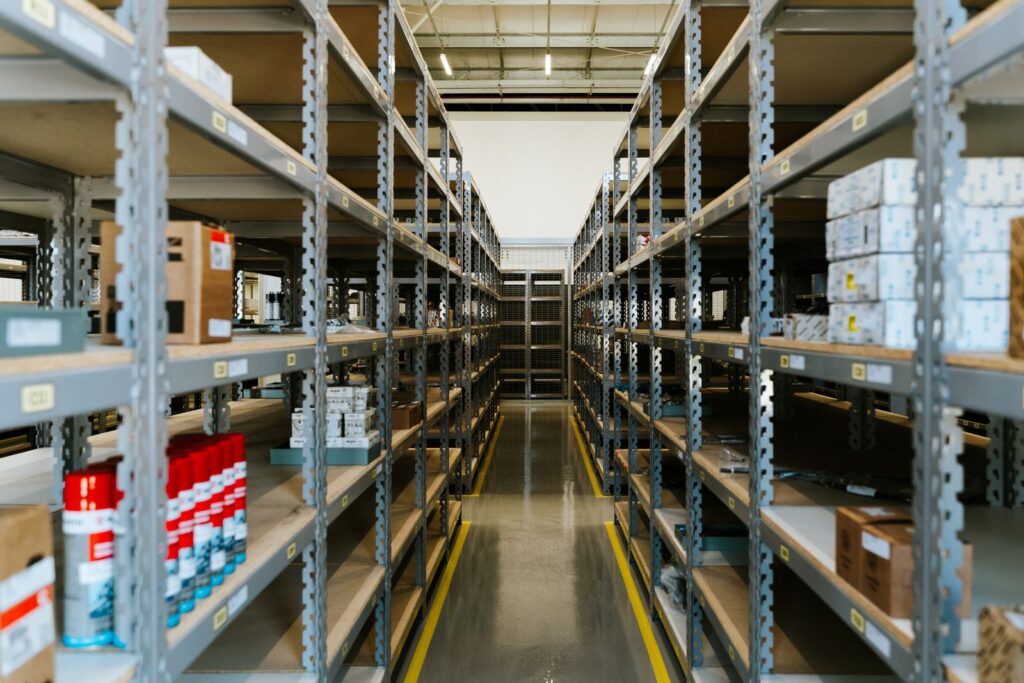
Illustration: a warehouse aisle between shelving with yellow lane markings and a polished floor, Pexels stock photo (ID 12234109). Illustration only: not a Kadier project and not an actual floor inside VSIP 2 Industrial Park.
