

 Tiếng Việt
 中文 (中国)
A chemical plant is a place where floors and walls must withstand several impacts at once: spilled acid, alkaline cleaners, solvents, temperature changes, and vehicle loads. Acid-resistant epoxy coating is not a single product that works for every chemical plant, but a group of coating systems whose acid resistance depends on the resin type, acid concentration, temperature, and contact time. Getting any one of those four factors wrong is enough to make the coating fail early.
This article presents the general framework of epoxy materials in acidic environments. The statements below are general material properties, not confirmed specifications of a specific Kadier system. The specific parameters of each coating system must be taken from the official technical data sheet (TDS) and the chemical-resistance table of that system when available. This article does not state any product-specific test figures.
Why does the same “acid-resistant” label give different results?
Acid is not a single substance. Sulfuric acid, hydrochloric acid, nitric acid, and organic acids attack a coating film by different mechanisms, and the same acid at a dilute concentration may be harmless but at a concentrated level may destroy the film quickly. Temperature also amplifies the effect: at the same concentration, hot acid corrodes faster than cold acid, and acid vapor condensing on walls or ceilings can attack even locations that are not in direct contact with liquid.
Contact time is the third factor. A spill that is cleaned up immediately is quite different from continuous immersion in a collection channel or pit. A system that withstands short-term spillage may not necessarily withstand long-term immersion, and conversely a system designed for immersion may be an excessive cost choice for an area with only a small spillage risk. The first requirement when choosing a system is therefore not “the strongest acid resistance,” but an accurate description of the actual contact scenario for each area.
Zoning the plant by acid-exposure level
The practical approach is to divide the floor plan into three zones. Zone one is the storage and dispensing area: high spillage risk and high concentration, needing the strongest chemical-resistant system, with seamless wall coving and collection-channel details so that acid cannot seep into the substrate through joints. Zone two is transport routes and general production areas: moderate spillage risk, mainly splashes and cleaning with cleaning chemicals, where a mid-level chemical-resistant system may be used. Zone three is offices, dry warehouses, and pedestrian routes: almost no acid contact, needing only an ordinary industrial flooring system.
Zoning this way both saves cost and avoids a common mistake: using a single system for the whole plant and then discovering that the most hazardous zone is the one that system cannot handle. When zoning, the boundary of each zone must be clearly marked on the drawings so that the application team does not apply the wrong system at a transition location.
Where do ordinary epoxy and specialist chemical-resistant epoxy differ?
In general terms, epoxy systems for ordinary industrial floors have good chemical resistance to oils and greases, dilute alkalis, and some dilute acids under short-term spillage conditions. Specialist chemical-resistant systems usually use modified epoxy or novolac resins, with a higher crosslink density, allowing them to withstand higher concentrations and higher temperatures. This difference is about the resin formulation, not only about thickness: applying an ordinary system more thickly does not turn it into a specialist chemical-resistant system.
When reading a chemical-resistance table, the test conditions must be read in full: chemical name, concentration, temperature, and contact time, together with the assessment result — no change, slight discoloration, or film failure. A table that only states “good resistance” without stating conditions is not enough for a decision for a chemical plant. If your chemical is not in the table, testing on a sample at the correct working concentration and temperature is needed before large-area application.
Application details that decide outcomes in acidic environments
In a chemical plant, the details that are often overlooked are the ones that fail first: wall bases, channel edges, pipe penetrations through the floor, and expansion joints. Acid pooling at a wall base or in a channel will attack continuously, while a flat floor surface has already been cleaned. The general treatment is to cove wall bases with epoxy mortar so that no liquid-pooling corners remain, to coat seamlessly across collection channels, and to treat joints with a suitable chemical-resistant joint sealant.
The concrete substrate also needs more thorough preparation than usual before coating, because acid may already have soaked into an old substrate through cracks. For a renovation floor in an operating chemical plant, it must be checked whether the old substrate has been deeply corroded by acid or contaminated; if the substrate is already weak, coating a new layer on top will only conceal it temporarily, and the coating will peel as the substrate continues to weaken. The article Concrete Floor Preparation Before Epoxy Coating: Grinding, Crack Repair, Moisture Testing presents the general substrate-preparation steps that apply before any coating system.
Cleaning and operation: half of service life lies in this stage
Even a specialist chemical-resistant system has a tolerance limit over time. The operating procedure should state clearly: how quickly a spill must be collected and neutralized, what cleaning chemicals are used and at what concentration, and which areas prohibit cleaning chemicals containing ingredients that attack the coating film. Operating staff need to know that a “chemical-resistant floor” does not mean acid can be left pooling overnight.
Scheduled inspections should focus on liquid-pooling locations, wall bases, and collection channels: discoloration, surface softening, blistering, or hairline cracking are early signs that the system is approaching its limit. Early detection allows local repair; if left late, acid will soak through the failed coating into the concrete substrate, and remediation will require removing the corroded substrate layer as well.
Occupational safety goes with the work, not apart from it
Application and maintenance in a chemical plant must comply with the plant safety regulations: ventilation, personal protective equipment suited to the chemicals present in the area, and spill-response procedures. A good floor coating does not replace a chemical safety procedure, and conversely a safety procedure cannot rescue a coating system chosen wrongly from the start. Both must be finalized together in the design.
To choose a system for a chemical plant, a full chemical list must be provided, together with concentration, working temperature, the contact scenario for each area, and the current substrate condition. The Kadier coating systems include the roller-applied RollCoat system, the self-leveling LevelFlow system, the water-based AquaBase system, and the anti-static StatGuard system; the specific acid resistance of each system must be checked against the chemical-resistance table and official TDS of that system, and must not be inferred from the general name.
Request a consultation to zone acid exposure and compare the chemical-resistance table at the correct concentration, temperature, and contact time for your plant.
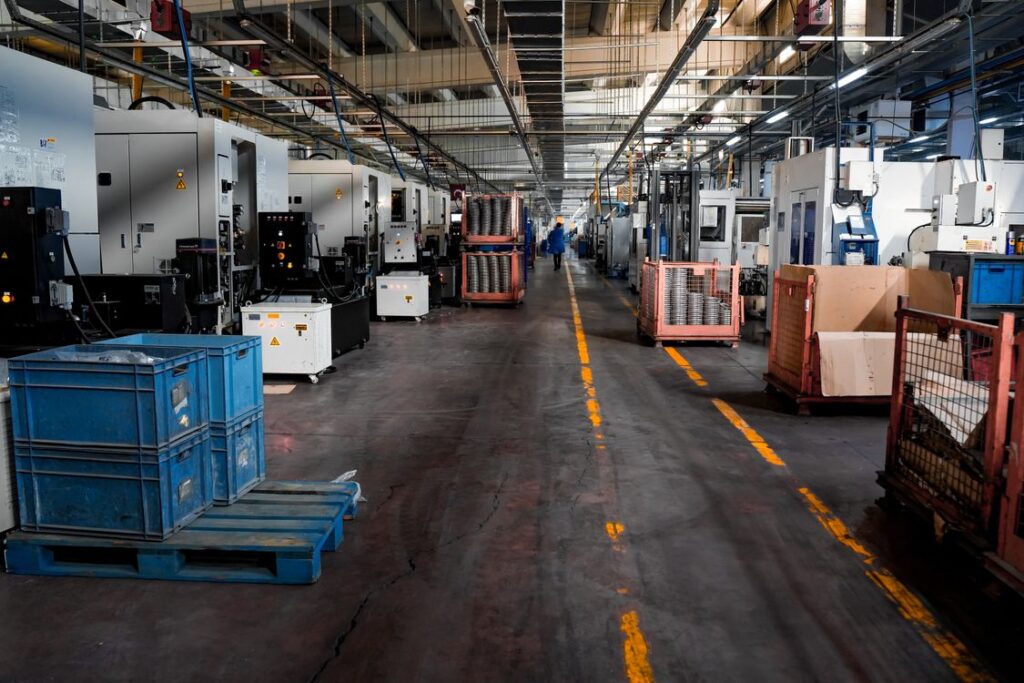
Illustrative image: an industrial plant floor with machinery and containers (Source: Yetkin Ağaç / Pexels).

Pingback: Epoxy Flooring Heat Resistance: How High a Temperature Can It Handle? - Kadier — Industrial Epoxy Floor Coating