

 Tiếng Việt
 中文 (中国)
When people talk about flooring for hospitals and cleanrooms, one requirement usually comes to mind first: the floor must be clean, easy to wipe down, and must not become a place where dirt accumulates. Antibacterial epoxy coating is often mentioned in that context. This article presents antibacterial performance at the level of general principles, the cleaning and disinfection requirements of hospitals and cleanrooms, and how an antibacterial coating — if it has one — only supports, and never replaces, a facility’s cleaning and infection-control procedures.
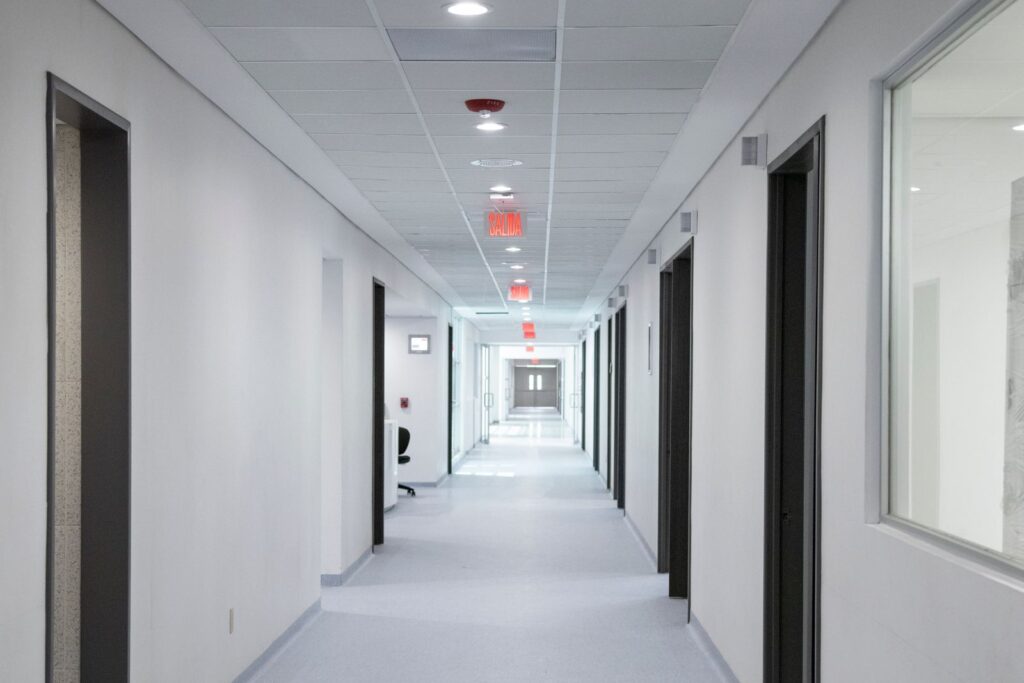
Illustration: a hospital corridor with a bright, seamless floor (stock photo from Pexels, by Enrique Silva) — this is an illustration of a generic space, not a real hospital project by Kadier.
Important note, please read before choosing a coating system: This article does not claim that any Kadier coating system has verified antibacterial properties, and it states no medical certification or antibacterial certification of Kadier’s own. Kadier’s official TDS has not been published, so any product-specific data — if any — must be checked directly against Kadier’s official documentation once that documentation is published. Antibacterial flooring does NOT replace the facility’s cleaning, disinfection and infection-control procedures.
1. The specific need: hospital corridors and cleanroom transition areas
This article focuses on one specific, easy-to-picture need: hospital corridors and transition (buffer) areas before entering a cleanroom. These are places with frequent foot traffic and trolleys passing through, where the floor must withstand repeated cleaning and disinfection while staying clean between cleaning rounds.
In these two areas, what a floor must deliver is not just “good-looking” or “durable”, but:
- A seamless surface with few gaps and joints — because gaps and joints are where dirt and moisture easily accumulate and are hard to clean.
- Easy cleaning with the facility’s ordinary wiping routines, without hard-to-reach corners.
- Resistance to high-frequency cleaning without quickly peeling, staining or roughening, because a degraded surface only becomes harder to keep clean.
- No excessive slipperiness when wet, especially in corridors used by people on foot and trolleys.
Looking at a single feature alone — for example “antibacterial” — while ignoring the requirements above easily leads to the wrong choice: a surface that is hard to clean will be hard to keep clean in real operation, whatever other feature it may have.
2. Antibacterial performance at the level of general principles: understanding it correctly before choosing
2.1. What is usually meant by “antibacterial”?
At the level of general principles, a coating described as antibacterial usually aims at one of two approaches, or a combination of both:
- Limiting the conditions for microbes to attach and grow on the surface — for example a smooth, seamless surface with few pores, gaps or joints, so that wiping removes dirt and soiling films more easily. This is an indirect contribution: a surface that is easy to clean is easier to keep clean.
- An antibacterial additive within the coating — at the level of general principles, some coatings on the market add an additive intended to inhibit bacterial growth on the surface. How well this works in practice depends on the type of additive, its concentration, the test method and the conditions of use — and it must be demonstrated by test reports for that very product, never inferred from general principles.
The point to stress: a general principle is not the same as a verified feature of a specific product. A coating system may only be described as “antibacterial” when the manufacturer clearly states its composition, test method and corresponding test results. For Kadier, this information has not been officially published (see section 6), so this article does not attribute antibacterial properties to any Kadier coating system.
2.2. Antibacterial does not mean sterile
Even a floor with an antibacterial coating — even where that feature has been tested — does not turn an area into a sterile environment. Bacteria can come from the air, people, instruments and supplies; the floor is only one of many surfaces in the infection-control system. Any claim along the lines of “with an antibacterial floor, disinfection is no longer needed” is therefore a dangerous misunderstanding.
The standing rule of this article, repeated so that no other reading is possible: antibacterial flooring does NOT replace the facility’s cleaning, disinfection and infection-control procedures. A coating — if it has verified antibacterial properties — only plays a supporting role, underneath the facility’s own cleaning and infection-control procedures.
3. The cleaning and disinfection requirements of hospitals and cleanrooms
3.1. Hospitals: cleaning is a procedure, not a single floor-mopping job
In a hospital, floor cleaning sits within the facility’s overall infection-control procedure, which usually includes:
- Classifying areas by risk level (public areas, care areas, high-risk areas) with a corresponding cleaning frequency.
- Wiping and disinfection procedures using the disinfectants specified by the facility, at the right concentration, contact time and with the right tools.
- Managing cleaning tools separately by area, to avoid carrying dirt from one area to another.
- Monitoring and recording cleaning work, and dealing immediately with stains, spills or damaged surfaces.
For epoxy flooring, this creates a practical requirement: the coating must withstand the disinfectants the facility is already using, at the frequency the facility already applies. A coating that degrades quickly under strong cleaning chemicals will develop a rough, pitted surface — and that surface is in turn harder to clean. Before choosing a coating system, the facility should therefore check its disinfectant list against the chemical resistance stated in the product’s TDS (once the TDS is published).
3.2. Cleanrooms: the floor is only one link in the control system
A cleanroom operates on the principle of overall control: air filtration, pressure, clothing, entry procedures, surface cleaning and monitoring of dust particles and microbes. Within that system, the floor contributes in the following ways:
- A surface that generates little dust, attracts little dust, and is easy to wipe with the cleanroom’s own cleaning method.
- Seamless, with few gaps, limiting places where dust and microbes accumulate.
- Able to withstand the cleanroom’s specific cleaning procedures without peeling or shedding particles from the coating itself.
- In electronics cleanrooms, an additional antistatic requirement may apply — this is a separate requirement, not a substitute for cleaning requirements (see also the article on cleanrooms, pharma and food, and the article on GMP pharmaceutical plants in the related links at the end of this article).
Readers should keep the distinction clear: the overview article on cleanrooms, pharma and food presents the general picture of these industries, while this article goes deeper into a single feature — the antibacterial coating — and its supporting position within the cleaning procedure. Similarly, the article offering a comprehensive solution for hospitals presents the overall requirements for hospital flooring (easy to clean, seamless, resistant to disinfectants, and so on), while this article does not repeat that whole solution but focuses on understanding “antibacterial” correctly.
4. How an antibacterial coating supports the cleaning procedure — and where its limits lie
When an antibacterial coating has been properly tested, its supporting role can be pictured as follows:
- Between two cleaning rounds: a surface less favourable for microbes to attach and grow may help the surface stay cleaner in the interval between wiping rounds — but not indefinitely, and it never replaces the next cleaning round.
- During cleaning: a smooth, seamless surface helps wiping remove dirt more effectively, reducing the risk of dirt left behind in gaps and corners.
- When the surface is soiled: the coating does not clean up spills, bodily fluids or chemical splashes by itself — these still need immediate handling under the facility’s procedure.
Limits to keep in mind:
- An antibacterial coating does not disinfect the air, instruments, people’s hands or other surfaces.
- Any antibacterial effect (if present) may decline when the surface is worn, deeply scratched, peeling or covered with a thick layer of dirt — so timely maintenance and repair remain mandatory.
- Do not use an antibacterial feature to reduce cleaning frequency or disinfectant concentration, unless the facility has a risk assessment and a new procedure approved by its own infection-control department.
- Do not infer antibacterial effectiveness from gloss, colour or the “clean feel” of a surface.
5. Criteria for choosing a coating system for healthcare and cleanroom areas
Below are the criteria to use when assessing a coating system for hospitals or cleanrooms. These criteria are a general assessment framework, not data for any Kadier coating:
5.1. Surface and cleaning criteria
- A seamless surface with few joints; coved skirting (where applied) so that no dirt-trapping corners are created.
- Easy cleaning with the procedure and disinfectants the facility already uses; no hard-to-find special tools or chemicals required.
- Chemical resistance to disinfectants at the facility’s actual concentrations and frequencies — check the TDS, do not guess from the product name.
- Enough roughness to resist slipping when wet, while still being easy to wipe (a surface that is too rough will hold dirt).
5.2. Antibacterial criteria — accepted only with evidence for the product itself
- The manufacturer clearly states: whether the product contains an antibacterial additive, which additive (if disclosed), and which test method was used.
- There is a test report for that very product, stating the bacterial strains tested, the test conditions and the results — do not use another product’s report to infer results.
- Do not accept an antibacterial claim based only on general principles, generic advertising, or experience of use at another project.
- If the manufacturer has not published the above information, the correct approach is to state clearly “not published” and choose a coating system on the basis of surface, cleaning and chemical-resistance criteria that can be verified — without attributing antibacterial properties on your own.
5.3. Installation and operation criteria
- The coating system suits the existing substrate (moisture, flatness, substrate strength) and the actual installation conditions; a weak or damp substrate that is not properly treated will make the coating fail quickly, whatever its surface features.
- Drying time and return-to-service time fit the area’s shutdown plan — hospitals and cleanrooms often cannot shut down for long.
- There is a plan for maintenance, periodic inspection and local repair when the surface is scratched or peeling; damaged surfaces must be repaired promptly because they are the hardest to keep clean.
- Where antistatic performance is needed (electronics cleanrooms, some healthcare areas with sensitive equipment), assess the antistatic requirement separately — do not confuse it with the antibacterial requirement.
5.4. How to compare with Kadier coating systems
Kadier currently offers coating systems named RollCoat, LevelFlow, StatGuard and AquaBase. This article does not attribute antibacterial properties to any of these four systems, because Kadier’s official TDS has not been published. When choosing, readers should:
- Read each system’s introductory page to understand the general type of coating system (roll-on, self-levelling, antistatic, water-based) at the level of general description.
- Compare the area’s actual requirements (cleaning, disinfectants, antistatic performance if any) with Kadier’s official documentation once it is published.
- Contact us for guidance on this comparison, rather than concluding on your own that a coating system is “antibacterial” from its name or from this article.
6. Note on specifications
Official technical data (TDS) for each Kadier product is published on the Products page; this article sets out a general framework and does not replace the TDS of a specific product. This article therefore gives no Kadier-specific technical data — no recommended thickness of its own, no coverage rate of its own, no chemical resistance of its own, and no antibacterial test result of its own for any Kadier coating system. Any figures that appear in official documentation later must be checked directly against that TDS, together with the test conditions stated in the document.
Readers should also not use industry-general data (for example general standards or reference tables) to infer the data of a specific Kadier product. A general standard sets out the requirement framework, while a product’s TDS states how far that product meets the framework — the two types of document do not replace each other.
In particular, this article states and implies no medical certification or antibacterial certification of Kadier’s own, because no such certifications have been published. If Kadier later publishes a certification or test report, the content must be updated with the certification name, the issuing body and the specific scope of application — not updated with a generic claim.
7. Conclusion: choose flooring by procedure, not by a single adjective
An antibacterial epoxy coating, properly understood, is a supporting feature within the cleaning and infection-control system — not a substitute for that system. The right way to choose is: start from the facility’s actual cleaning and disinfection procedures, require a seamless surface that is easy to clean and resistant to the disinfectants in use, and only then consider antibacterial performance — accepting antibacterial performance only when there is a test report for that very product.
For Kadier, the final comparison step is still waiting on the official TDS to be published. Until then, every coating choice for hospitals and cleanrooms should rest on the surface and cleaning criteria set out above, together with direct consultation — and always keeping the principle intact: antibacterial flooring does NOT replace the facility’s cleaning, disinfection and infection-control procedures.
Photo source: Illustration of a hospital corridor — Pexels, by Enrique Silva (https://www.pexels.com/photo/a-corridor-of-a-hospital-5203594/). Illustration of a generic space, not a Kadier project.
Related articles:
- Epoxy flooring for hospitals: antibacterial and easy to clean — a comprehensive solution for hospitals.
- Epoxy for Cleanrooms, Pharma and Food Plants — an overview of cleanrooms, pharma and food.
- Epoxy flooring for GMP-compliant pharmaceutical plants — flooring requirements for pharmaceutical plants.
Kadier coating systems (introductory pages):
- RollCoat — 3-coat roll-on system
- LevelFlow — Self-levelling
- StatGuard — Antistatic
- AquaBase — Water-based, low VOC
