

 Tiếng Việt
 中文 (中国)
This article is about one park only: Song May Industrial Park, established in 1998 under Decision 269/QD-TTg dated 07/04/1998 of the Prime Minister, developed by Song May Industrial Park Development Joint Stock Company. It is not Giang Dien Industrial Park, Bau Xeo Industrial Park or Ho Nai Industrial Park in the same Trang Bom area, and it is not the Song May Lake tourist area. These names are often lumped together because they share the Song May – Trang Bom geography, but they are different places, and each poses a different flooring question.
Which park this is: a two-phase park from 1998 whose infrastructure was never finished evenly
Song May Industrial Park was established in 1998 and has been in operation since 1999. According to listings, the park is planned on about 473.95 ha, split into Phase 1 of about 250 ha and Phase 2 of about 223.95 ha. These figures are listing-only — not verified from an official management-board source — and this article keeps each phase denominator separate: the total planning figure is never presented as operating area, and never as land available for lease. The park lies in the Trang Bom – Vinh Cuu area of Dong Nai province. From 01/07/2025, the park’s former communes fall in the Binh Minh commune, Ho Nai ward and Tan An commune area of Dong Nai province: under Resolution 1662/NQ-UBTVQH15, former Bac Son commune and former Binh Minh commune merged into the new Binh Minh commune; former Ho Nai 3 commune and former Tan Hoa ward merged into Ho Nai ward; former Tan An commune and former Vinh Tan commune merged into the new Tan An commune; the district level was abolished. Former commune names appear in this article only when quoting the 2022 clearance reporting, and are always marked as former.
According to Bao Dong Nai (May 2022), the park then had 75 licensed enterprises, of which 67 were operating, 3 had suspended operations and 5 had not yet started operating. That count is from 2022; this article does not silently update it to the present. According to listings, the park’s attraction fields include food and agricultural processing, electrical and electronics, textiles and footwear, mechanical engineering, packaging, and sports goods, household goods and children’s toys. Also according to listings, the operating part’s infrastructure includes main roads 22–35 m wide, internal roads 15–22 m wide with a 30-tonne load capacity, power at 110/22 kV of about 61 MVA, clean water of 10,000 m3/day for Phase 1 and a central wastewater treatment plant of 4,000 m3/day — and the same listings note that some sections have not yet been fully completed. The wider Dong Nai picture is in the Dong Nai industrial park cluster overview, where Song May appears only in a passing clause about the traditional National Highway 1A pole; the overview contains no floor map for this park alone.
The deciding difference: both phases were still incomplete on infrastructure because of clearance
According to Bao Dong Nai (May 2022), both phases of Song May Industrial Park were then still incomplete on technical infrastructure investment because of compensation and site-clearance problems. In Phase 1, nearly 42 ha in former Ho Nai 3 commune and former Bac Son commune were in land inventory work. In Phase 2, 160 ha in former Bac Son commune and the remaining area in former Tan An commune (former Vinh Cuu district) were in compensation and site clearance. Because the developer had not received the land, Phase 2 infrastructure had then not yet been built. The same report gives the reason for the delay: many households whose land was to be recovered did not agree to accept compensation, support and handover, and some already-cleared land handed to the infrastructure company was encroached after handover because management was not tight, making recovery harder.
Two later reports show the vướng area remaining large, but they are two different reporting dates and this article does not merge them. According to the Dong Nai Industrial Zones Authority (DIZA) as reported by Bao Dong Nai (August 2023), the vướng area for Song May was nearly 258 ha, among ten parks in the province still vướng on compensation, support and resettlement. According to the same authority as reported in the press (March 2024), the Phase 1 + Phase 2 area of Song May not yet compensated and cleared was 184.8 ha. The 258 ha (2023) and 184.8 ha (2024) figures belong to different reporting dates and reporting methods; this article does not average them, does not infer a trend from them, and does not present either as a current measured figure. This article also gives no percentage figure for the whole park or for either phase, because the sources use different denominators and cannot honestly be combined into a single sentence.
For a flooring buyer, the practical consequence is: infrastructure cannot be assumed uniform across the park. A lot in the cleared part, with a plant already running, poses a completely different flooring question from a lot in a phase where land has not been handed over and infrastructure has not yet been built. Internal roads, drainage and the wastewater connection at the lot boundary must be confirmed lot by lot, phase by phase — never from a park average, and never by inferring the unbuilt part from the operating part. That is why this article is split in two clear parts: floors for operating plants in the cleared part, and a pre-signing checklist for anyone about to take land here.
A floor map for operating plants in the cleared part
In the cleared part, where plants have run for many years, the dominant flooring question is recoating and maintenance, not flooring a new concrete slab. The five industry groups below are not a tenant list; they are a floor-choice frame based on how each plant actually uses its floor.
Food and agricultural processing. Floors need to be seamless, easy to wash and resistant to frequent washdown. Wet zones need slip resistance even when wet, and washdown-chemical resistance must be checked against the coating manufacturer’s chemical-resistance table for the actual agents in use, at the actual concentration and contact time — no coating is claimed to resist every chemical. For general production areas, a RollCoat roller system suits light to medium loads; areas needing absolute flatness and a seamless finish should consider a LevelFlow self-levelling system; frequently wet areas may consider a low-VOC water-based AquaBase system, once a survey confirms the substrate allows it.
Electrical and electronics, equipment and component assembly. Floors need to be low-dust, seamless and easy to clean, because floor dust is a source of assembly defects. Electrostatic-dissipative requirements apply only to the areas where the buyer’s own standard requires them — the direction is a StatGuard electrostatic-dissipative system in exactly those areas — not an ESD floor across the whole plant merely because the park hosts electronics firms. Before coating, substrate moisture must be measured and old-coating adhesion checked, because coating early over a damp substrate is a common cause of later blistering.
Textiles and footwear. Fibre, leather dust and material offcuts are the daily problem: floors need to sweep and vacuum clean, and must not trap dust in cracks. Dyeing and wet areas must be separated from dry areas in both floor choice and slip treatment, because one answer for both will be slippery where wet and over-specified where dry. Forklift wheel paths and turning points wear first, so strengthening belongs at exactly those points rather than a thicker coat across the whole floor.
Mechanical engineering and packaging. This group carries heavy loads, impact and oil. Floors must allow for machine loads, forklift loads, dropped tools and oil penetration — and deep oil penetration is a different preparation problem from surface oil: it must be dealt with according to the survey findings, not coated over in the hope that a new coat will seal it. In-plant warehouse and loading areas need clear lane marking and slip resistance at walkways and turning points.
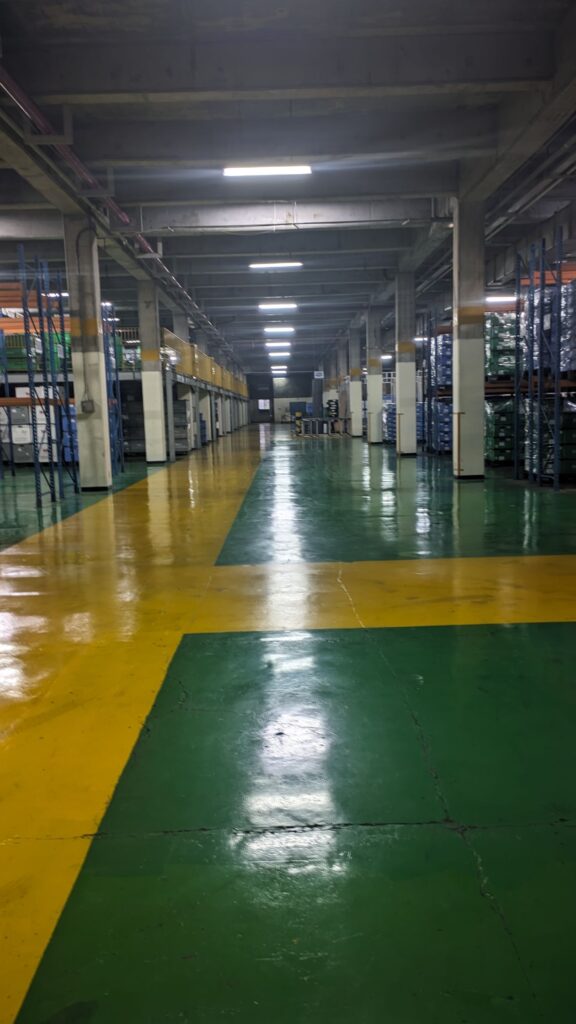
In-plant warehouse and loading. Unlike the airport-gateway logistics warehouses in the Loc An – Binh Son article, a Song May warehouse serves production inside a running plant: forklifts move continuously, racking and aisles are fixed, and production cannot stop for a whole-floor rebuild. The direction is a forklift-resistant roller system with lane marking and slip resistance, applied phase by phase around production shifts. The illustration for this article — a warehouse with a green-and-yellow coated floor, lane markings and racking on both sides — is a stock photo, not a floor inside Song May Industrial Park and not a Kadier project.
Recoating an old floor in a running plant: survey first, then work in phases
An old floor in a running plant must not be treated like new concrete. Before a system is chosen, the survey must answer five questions: how well does the old coating still adhere; how deep has oil penetrated; where are the cracks and movement joints, and are they still moving or stable; what is the substrate moisture level; and what is each area’s use history (which areas ever leaked chemicals, which ever carried loads beyond design). Grinding and crack repair must follow exactly what the survey found: coating over a failed old coat only moves the failure to next week; it is not a solution.
Work inside a running plant must proceed phase by phase, with machinery protected and dust separated, and with drying and waiting times agreed in advance with production shifts before forklifts return. A low-odour system is worth considering near production lines where odour matters, but only after load and chemical requirements have been checked — low odour does not compensate for a system that cannot carry the area’s loads or chemicals. Acceptance should be agreed in writing beforehand: thickness, flatness, adhesion and slip resistance, measured by which method, with what pass thresholds. A similar problem in a different setting — a long-operating park split in two by a national highway — is in the Bau Xeo article; the new-plant, ready-built and warehousing problem in one park is in the Giang Dien article. Song May differs from both: the problem is not a split site or a choice of plant type, but infrastructure that was never finished evenly.
Pre-signing checklist: check each phase, never take the park average
The checklist below is not a FAQ section; it is the list of checks anyone about to lease land or take over a plant in Song May should run before signing, because these are the points where a flooring decision goes wrong fastest in a two-phase park with unfinished infrastructure.
1. The clearance status of exactly this lot, in writing. Is this lot in Phase 1 or Phase 2? Has it been fully cleared, or is it still in inventory or compensation? Which document confirms that, and what is its date? A park-level answer is not an answer for a specific lot.
2. The infrastructure completeness of exactly this phase. Does an internal road reach the lot boundary, and are drainage and the wastewater connection at the boundary ready or still pending? If a link is missing, who builds it, who pays, and what completion date is written into the contract? For Phase 2 in particular: according to the 2022 reporting, Phase 2 infrastructure had then not been built because the developer had not received the land — anyone signing for Phase 2 must confirm, with a new written document, whether that position has changed, and must not infer it from Phase 1 progress.
3. The right to survey the floor before signing. Can the tenant measure substrate moisture, check old-coating adhesion, check levels and inspect cracks and joints before signing? If a ready-built plant’s floor already shows blistering, peeling or oil penetration, who pays for substrate preparation — the infrastructure developer, the previous plant owner, or the new tenant?
4. A phased work plan agreed with production shifts. Which phase is done first, how is machinery protected, how is dust separated, and how long after coating before forklifts return? Drying and waiting times must be stated precisely, not left as “once the coating is dry”.
5. Acceptance in writing. Thickness, flatness, adhesion and slip resistance measured by which method, with what pass thresholds, and who pays for remedial work if acceptance fails? A flooring contract with no measurable acceptance leaves the whole risk with the tenant.
Two neighbouring questions to compare, not to merge figures from: the Nhon Trach article (chemical resistance and heavy loads in a heavy-industry cluster) and the Long Thanh article (new-build floors and airport logistics) show the same Dong Nai province posing a different flooring question in each cluster; Song May poses a third: floors in the cleared part, plus a phase-by-phase infrastructure check before signing. A different phase structure altogether — a stable operating Phase 1 and an eco Phase 2 in preparation — is in the Dau Giay article, and no Dau Giay figure is used for Song May.
To survey a running plant’s floor in the cleared part, or to check a specific lot before signing, see Kadier’s epoxy systems and request a survey and works quote, or contact Kadier to book a survey. Illustration: Pexels stock photo (photo ID 19890000), by Heri Saputra. Illustration only, not a Kadier project and not a floor inside Song May Industrial Park.
