

 Tiếng Việt
 中文 (中国)
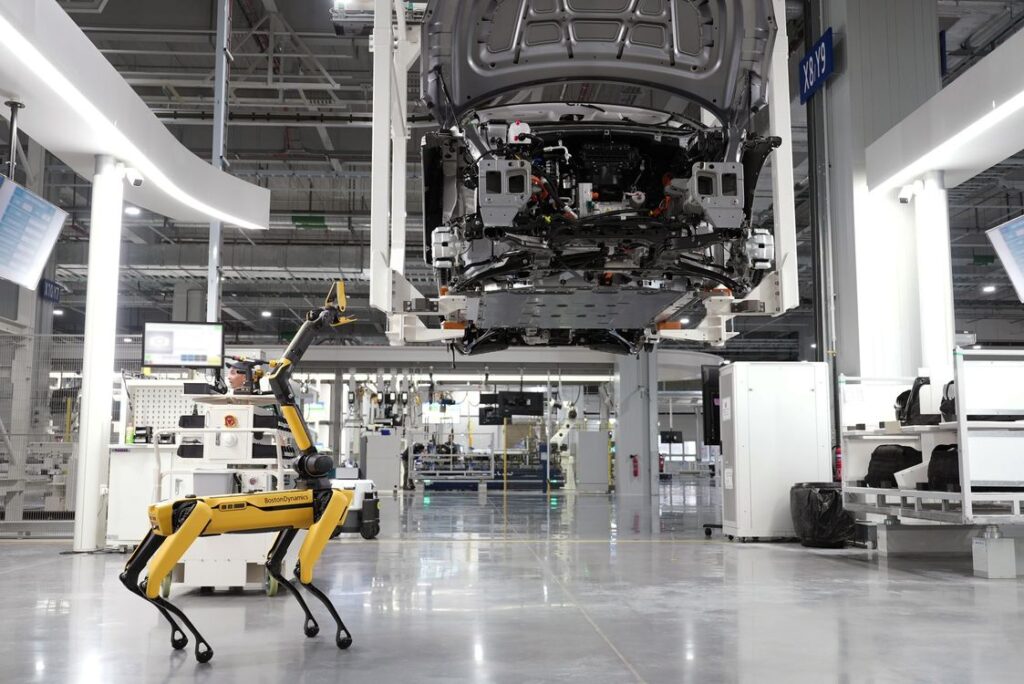
The particular demands of automotive, motorcycle and parts factory floors
Automotive, motorcycle and parts factories organise production around the assembly line: vehicle bodies and frames move along conveyors or automated guided vehicles, workers work along both sides of the line, and forklifts and tow trucks carry components back and forth continuously. Floors therefore face a combined load: forklift and tow-truck traffic, tyre marks left on the surface, oil and grease and fluids leaking from engines, gearboxes and hydraulic systems, and metal dust from parts machining.
Tyre marks are a problem specific to this industry. Hot tyres and the plasticisers in rubber can leave marks on some floor surfaces, especially where vehicles stop for a long time or turn around frequently. Oil and grease left standing also cause slipperiness and stain the surface. Floors therefore need to be flat, seamless, easy to clean of oil and grease, and clearly zoned for the line, vehicle routes and pedestrian walkways.
Requirements for epoxy floors in automotive, motorcycle and parts factories
At the level of the material in general, a seamless epoxy floor coating makes cleaning oil and grease and sweeping metal dust easier than bare concrete, and a flat surface helps the line and tow trucks run more steadily. However, actual resistance to tyre marks, forklift load capacity and oil and grease resistance depend on each coating system and coating thickness; this article gives no Kadier-specific figures, because no official TDS has been published yet. When choosing a system, check the official TDS and the factory’s actual vehicle traffic.
Another requirement is slip resistance in areas frequently contaminated with oil. A fully glossy floor can be slippery when oil or grease is present, so areas around oil supply stations, line maintenance areas and internal vehicle washing areas should be considered for a suitable anti-slip solution, rather than using one type of surface for the whole factory.
Choosing a system by zone
- Along the assembly line and worker areas: a roller-applied system such as RollCoat is often considered for large areas, where the main requirements are a clean surface, easy cleaning and clear zoning by production stage. Check the official TDS before finalising the choice.
- Forklift and tow-truck routes and component loading areas: consider a self-levelling system such as LevelFlow with a thicker coating, giving a flatter surface that holds up better under wheels and loads. The specific thickness and permitted load must follow the official TDS.
- Areas frequently contaminated with oil and grease: check the oil and grease resistance in the official TDS before choosing; do not assume every coating system withstands every type of industrial oil.
- Renovation areas with low-odour requirements: a water-based, low-VOC system such as AquaBase is a direction to consider when working with limited ventilation or when a neighbouring line keeps running.
The anti-static system StatGuard is only needed where a factory has an electronic component assembly area with its own electrostatic control requirements; for an ordinary mechanical assembly line, it is not a default requirement.
Application and handover: points that commonly fail in automotive and parts factories
Before coating, the substrate must be ground, degreased, crack-repaired and moisture-tested. Oil and grease soaked into an old substrate must be treated thoroughly, because this is a common cause of later peeling. Work usually has to be split into phases so the whole line is not stopped; each phase needs a plan for barriers, vehicle routing and drying time before vehicles run again.
Line marking and zoning play an especially important role in this type of factory: tow-truck routes, pedestrian walkways along the line, vehicle stopping positions and hazardous areas around equipment need to be clearly separated. At handover, adhesion and surface condition should be checked at vehicle routes, vehicle turning areas and areas previously contaminated with oil.
Cleaning and maintenance
Daily cleaning covers sweeping metal dust, wiping oil and grease marks early, checking tyre marks where vehicles stop for a long time, and clearing swarf from parts machining areas. When the floor peels locally or cracks, repair it early to prevent damage spreading under vehicle loads. Light tyre marks on the surface usually affect appearance only; what needs watching is whether the coating is peeling, cracking or exposing the substrate.
See also the general guide to epoxy floor maintenance and cleaning done right, the article on line marking and zone painting for factory floors, and how to choose an epoxy floor system by industry and use.
Note on specifications
The characteristics described in this article are general characteristics of epoxy floor coating materials. Official technical data (TDS) for each Kadier product is published on the Products page; this article sets out a general framework and does not replace the TDS of a specific product. Any figures for thickness, load capacity, oil and grease resistance or tyre-mark resistance of a specific product must be checked against the official TDS when available.
Photo: Hyundai Motor Group, source Pexels (Pexels photo 19319639).
