

 Tiếng Việt
 中文 (中国)
This article is about one industrial park only: Long Khanh Industrial Park, in the Suoi Tre and Binh Loc areas of the Long Khanh area, Dong Nai province. It is not about Suoi Tre Industrial Park — a different park of about 150 hectares, developed by Sonadezi An Binh and established in 2012 — even though the two parks share the Suoi Tre name. It is not about the place name Long Khanh as a town or a region, and it is not about any other Dong Nai park such as Giang Dien, Dau Giay or Tam Phuoc; each of those has its own article, and none of their figures are used for Long Khanh. Place names here are familiar geographic names used to identify the location, not claims about current administrative units. The argument of this article is short: Long Khanh has been operating for nearly twenty years, so the live flooring question here is first of all refurbishment of old floors inside running plants; and what decides the floor map is not the size of the park but its restricted industry list — a list that excludes several industries, and thereby rules out several flooring answers from the start.
1. The park in verified numbers
Long Khanh Industrial Park was established in June 2008 under Decision No. 1783/QD-UBND of the Dong Nai Provincial People’s Committee, with Long Khanh Industrial Park Joint Stock Company as the infrastructure developer — a subsidiary of Dong Nai Rubber Corporation under Vietnam Rubber Group. The total area of the park is about 264 hectares according to listings; one listing also gives 246 hectares as the project scale, so this article uses only the rounded figure of about 264 hectares and does not present an area to two decimal places as though every source agreed. On connections, listings put the park about 2 kilometres from National Highway 1A and about 6 kilometres from the Ho Chi Minh City–Long Thanh–Dau Giay Expressway, about 50 kilometres from Bien Hoa and about 70 kilometres from Ho Chi Minh City; these are listing distances, to be reconfirmed at survey, not measurements made by this article. Internal roads are listed at 20 to 41.5 metres wide with a 30-ton load capacity. The land-use term recorded in listings runs to 2058; that too is listing information, not a promise for any specific plot, and any tenant must check the file for its own plot. The park has a central wastewater treatment plant in operation; this article deliberately gives no capacity figure for it, because sources disagree — 6,400 cubic metres per day at the time construction started, and 3,000 and 3,200 cubic metres per day in later sources — and a single settled figure drawn from conflicting sources would be false information. The wider cluster context is in the Dong Nai cluster overview, but that overview does not mention Long Khanh at all; everything below is at the level of this one park.
2. What the industry list forbids, the floor map forbids too
The park’s investment-attraction list, on which the listings agree, covers: agricultural and food processing (excluding wheat flour processing); garments, footwear and toys; wood products and interior decoration; packaging (excluding recycled paper as a raw material); electronics and microelectronics; frame stamping, motorcycle assembly and parts (excluding plating); sports equipment assembly only (no processing or full manufacturing); pharmaceutical production; stationery; and handicrafts, glass, decorative building materials and concrete components. The three exclusions in that list matter more than the list itself, because they cut out the heaviest flooring problems that other parks still have to solve. There is no plating industry here, so there is no plating-hall flooring problem of acids and plating solutions ponding on the floor — and this article prescribes no plating-resistant system for Long Khanh. There is no wheat flour processing and no recycled-paper packaging, so there is no fine flour-dust problem and no paper-pulp effluent problem in the list. Sports equipment is assembly only, so its floors are light assembly and parts-storage floors, not heavy machining floors. Read this way, the list warns a flooring specifier against importing the heavy-industry answer of another park into Long Khanh, and against applying a wet dyeing answer to a park where garments sit alongside footwear and toys rather than alongside dyeing. The chemical-plant flooring framework is used here only within the narrow pharmaceutical scope of the section below, substance by substance, never as a park-wide answer.
3. A floor map by industry group
(a) Agricultural and food processing: wet zones, washdown and slip resistance
For food and agricultural processing, the survey must split dry zones from wet zones from the start. Dry intake and preparation areas need wear-resistant, easy-to-clean floors so raw material does not cake into the surface; washing, wet processing and equipment-cleaning areas need slip resistance exactly where it is wet, washdown resistance and drainage that leaves no standing water on the floor. One answer for the whole plant will be wrong in at least one of those two zones. For general production areas, the RollCoat roller system suits light to medium loads, while areas that need a flat, seamless finish should consider the LevelFlow self-leveling system; the final choice still follows the substrate survey and the investor’s requirements.
(b) Garments, footwear, toys and wood: dust, fixed traffic lanes and finishing zones
For garments, footwear, toys and wood, floors face fibre dust, wood dust and wear along fixed lanes at the same time. Cutting, machining and sanding areas generate dust continuously: floors there must be easy to clean so dust does not build into a layer, and must resist wear on the fixed routes of trolleys and forklifts. Finishing, packing and finished-goods stores, by contrast, need a clean, flat floor so products are not scratched or soiled before dispatch. The right approach is to separate those two zones in the floor map at survey stage, and to coordinate the floor with the dust-extraction system, because a clean floor without extraction still gets dirty. The factories-versus-warehouses framework explains why a finished-goods store floor cannot borrow its answer from a machining area floor.
(c) Electronics and microelectronics: flat, seamless, and anti-static only on a written requirement
For electronics and microelectronics, the requirement partly reverses: dust must be tightly controlled, and the floor itself must be flat and seamless so it does not generate dust from its own coating. Areas needing a perfectly flat, seamless finish should consider a self-leveling system. Where an anti-static requirement exists, the direction is the StatGuard system, but only in exactly the area that carries the requirement and to the investor’s standard. This article asserts no general cleanroom or semiconductor standard for the park, and attaches no anti-static requirement to any specific company: an anti-static requirement exists only where the investor confirms it in writing for that area. See also the cleanroom flooring solutions and the factory flooring solutions in general.
(d) Frame stamping and motorcycle assembly: oil, point loads and oil-contaminated old floors
For frame stamping, motorcycle assembly and parts, floors carry point loads from presses and moulds together with oil that escapes during operation. The mechanical-workshop flooring article identifies the two decisions that matter here: a real load map, in which heavy machine bays, traffic lanes and light production areas do not share one answer; and the oil condition of the substrate before coating. An oil-contaminated floor must be ground and degreased before coating, because oil left under a new coat is a cause of early delamination. This article names no specific mechanical company operating in the park, and gives no thickness or service life for a heavy-workshop option before a survey result exists.
(e) Pharmaceuticals, packaging and stationery: clean, seamless, and chemicals substance by substance
For pharmaceuticals, packaging and stationery, the floor must be chosen by the actual chemical in contact, at its actual concentration and contact time — no coating resists every chemical. A spot where a chemical only splashes lightly now and then cannot be grouped with a spot where it can spill and pond; the two spots need two different treatments, and the spill-risk spot needs a specialist resistant system checked against the manufacturer’s resistance table for that exact chemical before any decision. Pharmaceutical packing and clean packaging areas need seamless, easy-to-clean floors that stand up to washdown; and because recycled-paper packaging is outside the park’s list, this article does not carry a paper-pulp effluent problem into the packaging group here.
(f) Warehousing and yards on the National Highway 1A corridor: repeated loads, turning points and outdoor areas
The last layer is warehousing and yards, tied to the park’s National Highway 1A frontage and expressway junction. Warehouse floors carry high-frequency forklift traffic and constant truck movements, with wear concentrated on fixed routes, turning points and pedestrian crossings. The direction is a forklift-rated roller system with lane marking and slip resistance at turning points and walkways, and acceptance testing must run load and turning trials on those exact routes, not only a general surface check. The forklift and heavy-truck flooring framework explains why a warehouse floor cannot borrow its answer from a light production floor. Semi-outdoor yard areas need an outdoor-rated coating that resists ultraviolet exposure; an indoor epoxy system cannot simply be carried outside unchanged. See also the logistics warehouse flooring solutions.
4. A long-running park: recoating is a survey decision, not a default coat
This is the largest flooring job in the park, because Long Khanh has been operating since 2008 and most demand sits inside running plants. The recoating article asks the right question: an old coat that still bonds well and is only worn on the surface can be overcoated after surface preparation; an old coat that is peeling, blistering or heavily oil-contaminated usually has to be ground off. Three things must never be skipped when recoating an old floor: measuring substrate moisture, treating cracks and damp areas, and choosing a primer that suits the substrate condition — see also the concrete preparation article. Moisture from the substrate is a common cause of blistering after a recoat. In operating areas that are sensitive to odour, the AquaBase water-based, low-VOC system is a direction worth considering once the survey confirms the substrate suits it. Working zone by zone — deciding in advance which zone goes first, which goods move, and what acceptance test applies per zone — lets a plant keep producing while its floors are upgraded in stages, instead of closing the whole plant to coat it in one pass. This article does not promise that every old floor can be saved with one coat, and it gives no thickness or service life for any recoat option before a survey result exists.
On operating history, two dated snapshots from the sources should be read as a growth story, not merged into one present-day figure. A company interview in 2017 reported that by the end of 2014 the park had leased only 7 hectares, 5 percent of its leasable area; by the time of the interview it had attracted 30 investors, of which 7 were operating, 7 were building and 16 were in licensing procedures. A later listing records 44 investors, 41 operating and 3 building, with about 13,500 jobs, and describes the park as full. The later figure is an undated listing, so this article does not turn it into a present-day occupancy rate, gives no current count of operating companies, and offers no plots. The direct consequence is that the live flooring demand in this park is refurbishment and extension inside running plants — not floors for empty plots. Neighbouring Dong Nai parks pose different questions: Giang Dien with three building types, Dau Giay with a full phase 1 and an eco phase 2, and Tam Phuoc with refurbishment by industry group in a near-full park.
5. Expansion: proposals on record, not land on offer
On expansion, the sources also disagree, and this article records exactly that. The 2017 interview reported that the province had accepted a phase 2 expansion proposal adjoining the existing park, with an area of 365 hectares. Reporting from 2020 and 2021 instead described a 500-hectare expansion proposal, toward Xuan Thien, with an in-principle acceptance for including that area in the land-use plan. Two different figures, at two different dates, and no source among them states the current status of the proposal; so this article settles on no single phase 2 figure, asserts no completion date, offers no land or factory there, and attaches no certification to any future expansion area. This section is only a preparation framework for an investor who will one day build there, if and when the expansion takes shape: for a new concrete floor, three things must never be skipped — waiting for the concrete to reach sufficient age, measuring substrate moisture, and choosing a suitable primer before coating; and flooring is the last trade in a factory handover programme, so its schedule must be coordinated with the overall handover to avoid being forced to coat a floor that is not yet ready. Every immediate flooring need belongs to the operating plants in the sections above, not to the expansion.
6. Survey checklist before any system is settled
Before any flooring system is settled for a specific location inside Long Khanh Industrial Park, the following checklist must be answered with evidence, not with assumptions. One, the concrete floor has reached sufficient age and its moisture has been measured, with a written result; for an old floor, the old floor type, the extent of oil contamination and damage, and the scope of repair before coating have all been established. Two, a real load map exists: machine bays, forklift lanes, light production areas and warehouse areas do not share one answer. Three, chemical, oil and moisture exposure have been assessed zone by zone, rather than one answer for the whole plant. Four, dry and dusty zones (garments, wood, packaging), wet and slip-risk zones (food processing, equipment washing) and semi-outdoor ultraviolet-exposed zones have been separated from each other. Five, any anti-static requirement has been confirmed by the investor, and if so, to which standard and for exactly which area. Six, overhead and dust-generating work has finished before the top coat goes on, the flooring schedule sits last in the handover programme, and, for a running plant, the work zones and the goods-moving plan have been agreed. This article gives no price, no warranty promise and no technical specification, certificate or thickness figure; those come only after a real survey and a per-site quotation. Contact directly through the quote page or the contact page (hotline and Zalo 0899355489, WeChat wxid_95o54joujyrr12).
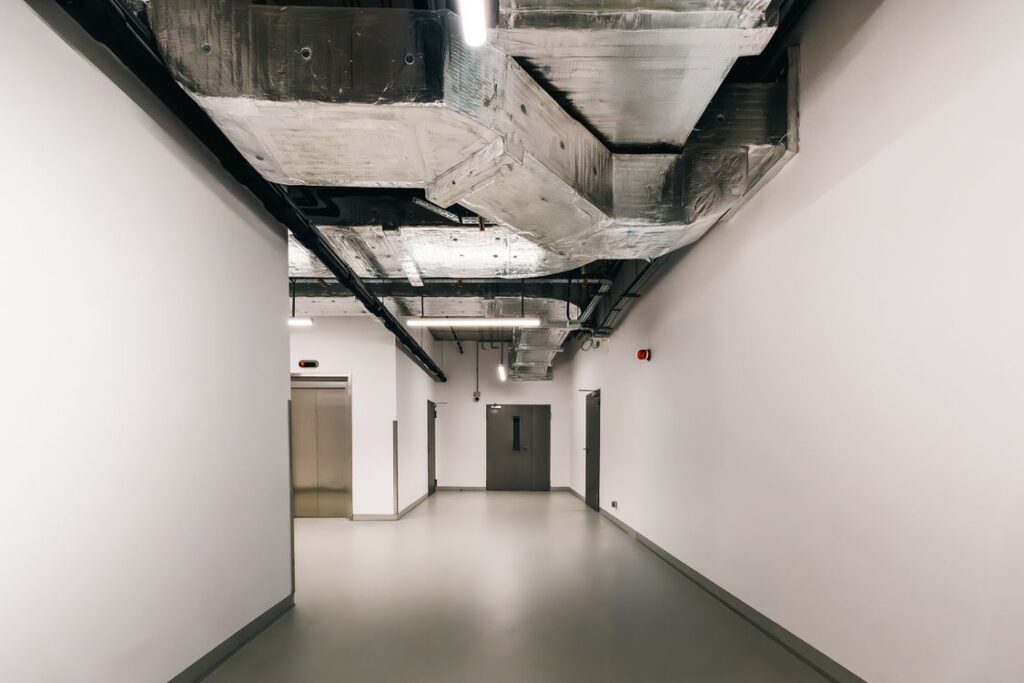
Cover image: Jakub Zerdzicki on Pexels — view the original on Pexels. Stock illustration of an industrial hallway with a smooth floor, not a Kadier project.
